Monterey Car Week: the barometer of collecting, from the fog of Pebble Beach to its 75th Concours
How the August week on the Monterey Peninsula really works: the fog at six in the morning, Dawn Patrol, who stands on the lawn and what changed in the judging and the money across three editions on the lawn, from 2024 to the 75th Pebble Beach Concours d'Elegance in 2026.
Some events are covered. Others rearrange the calendar until one accepts a simple fact: the automotive year begins in August, on a stretch of Californian coast barely twenty kilometres long.
Monterey is the second kind. I was there in 2024, in 2025 and again in August 2026, for the 75th Pebble Beach Concours d’Elegance. This account has two ambitions: to explain, for those who have never been, how the week really works, and to record, for those who collect, what changed in the criteria and in the numbers across those three editions.
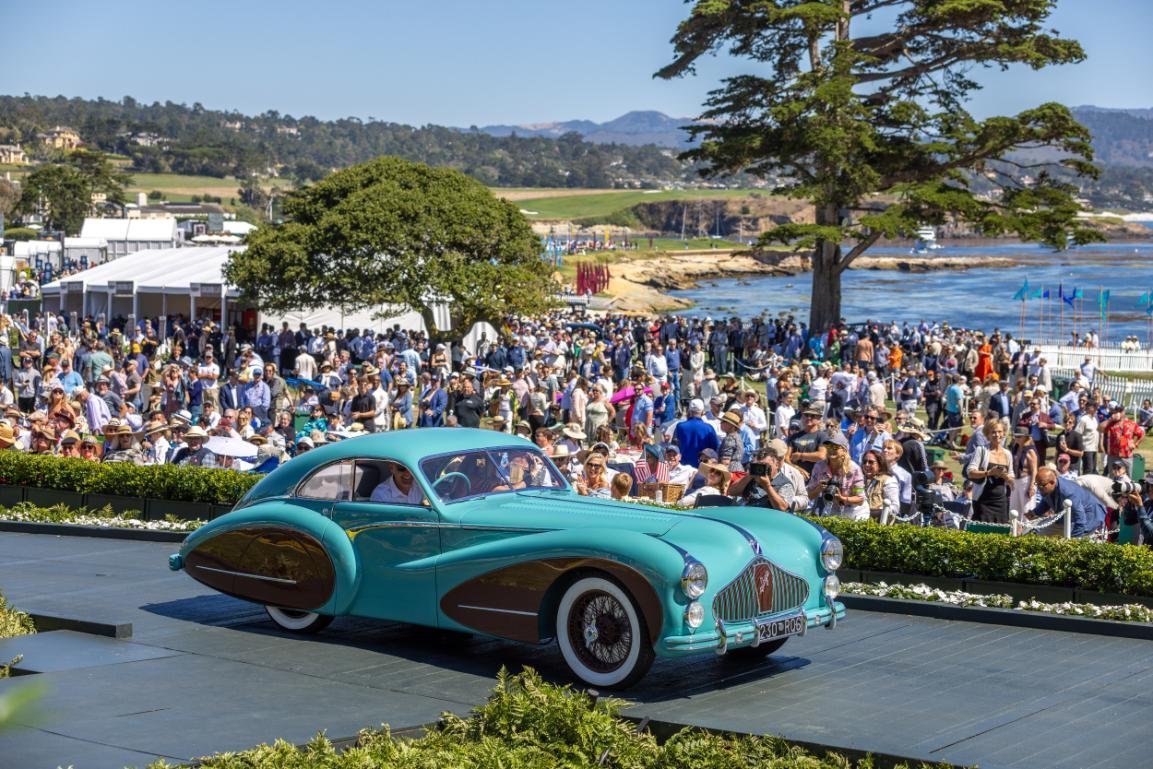
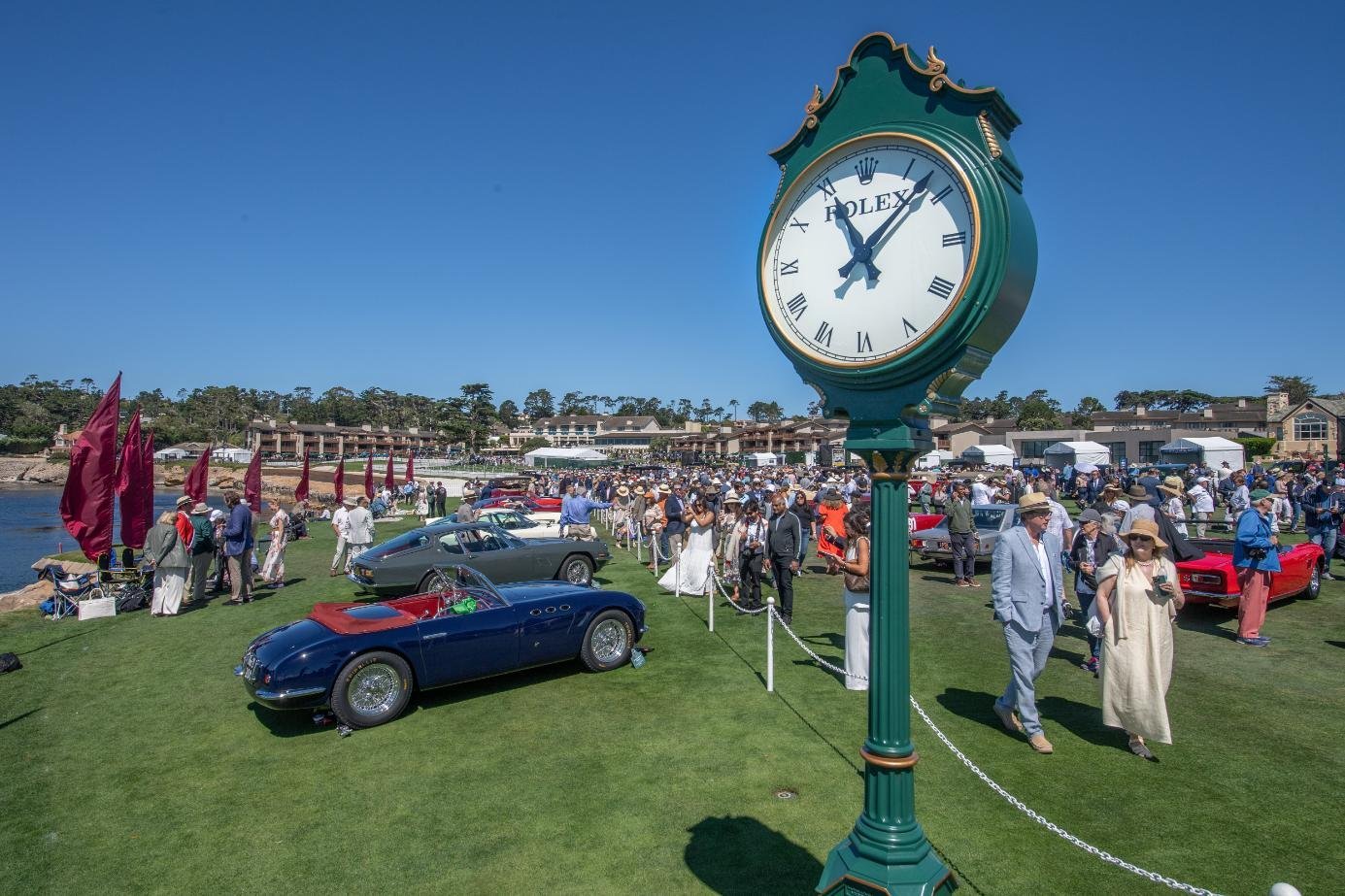
Pebble Beach, 2024: the lawn before the crowd. Photo: Rolex
Where it happens
The Monterey Peninsula lies about 190 kilometres south of San Francisco. It is small, expensive and poorly served by roads, which explains almost everything about the logistics of the week.
Four addresses hold what matters. Pebble Beach Golf Links, where the Concours takes over the 18th fairway above the Pacific. Quail Lodge & Golf Club, in Carmel Valley, home of The Quail. WeatherTech Raceway Laguna Seca, near Salinas, where the historic cars race. And downtown Monterey, where the auctions are held. Around them lie 17-Mile Drive, the Del Monte Forest, Carmel-by-the-Sea and, further south, Big Sur. None of it is scenery for its own sake: the landscape is part of the argument.
The atmosphere no one warns you about
The first surprise is the cold. August on the central Californian coast is not summer. It is dense fog until mid-morning, wind off the Pacific, and a temperature that asks for a coat at six and allows short sleeves at noon. Those who arrive dressed for a holiday spend half the day shivering.
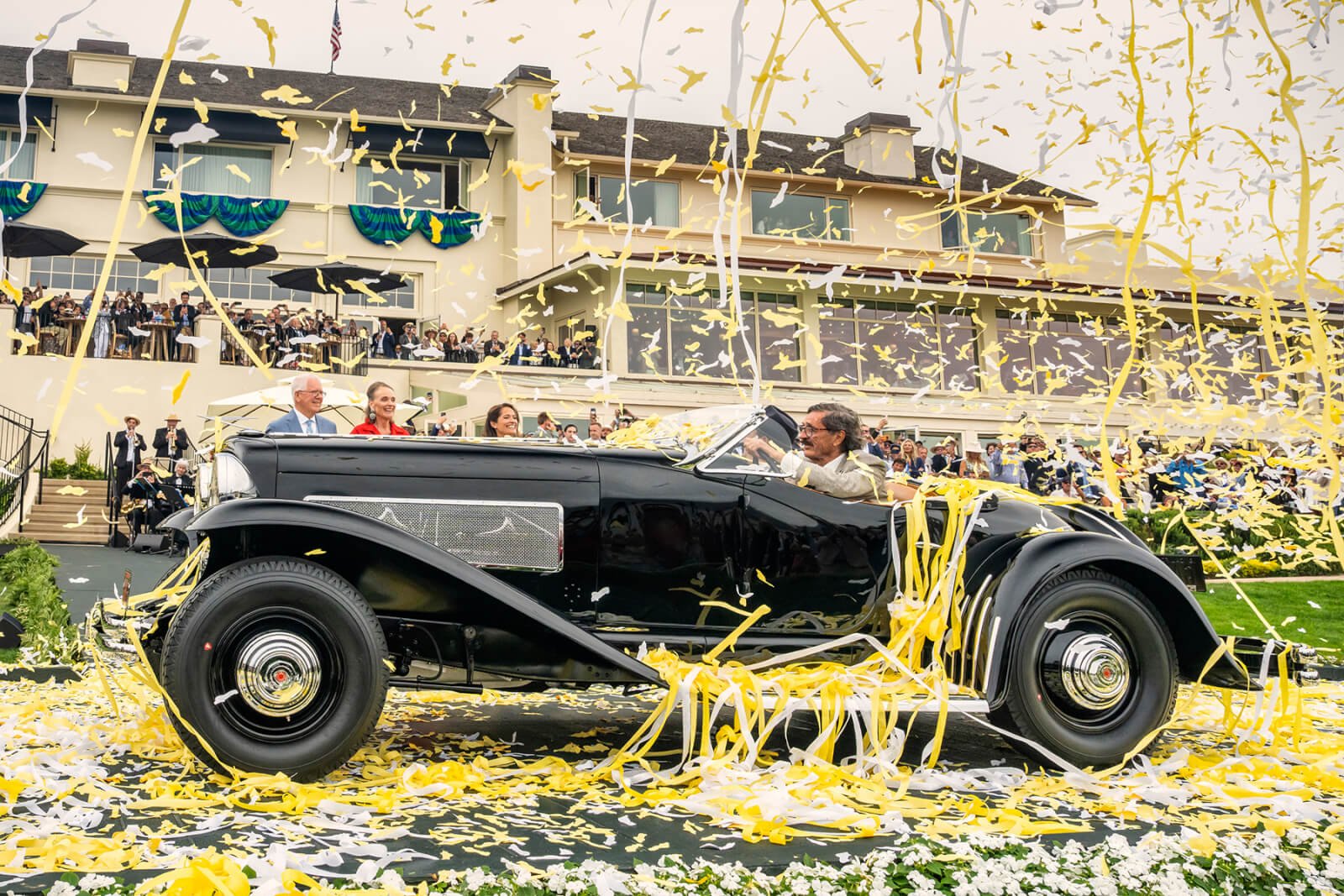
The second is the pace. The lawn at Pebble Beach is a slow place. People stop, crouch, look beneath a wing, talk to an owner and move on. There is Vivaldi in the background, glasses in hand early, picnics laid out at the edge of the fairway and a tacit rule never to touch anything. When Best of Show is announced, the confetti cannons fire and the car climbs the ramp with its owner at the wheel, almost always moved. It is the only loud moment of the day.
The third is the informality. Heads of marques, design directors and racing drivers walk the lawn without an entourage, in sunglasses and hats, stopping to look at cars like anyone else. Nobody asks for a photograph. That collective restraint may be the most characteristic thing about the week. The dress code sits somewhere between country club and specialist press: a blazer and comfortable shoes will do, a hat helps after eleven, and heels are a logistical mistake on uneven grass.
There is a kind of power that never needs to raise its voice. At Pebble Beach, it wears a wool coat and holds a coffee at six in the morning.
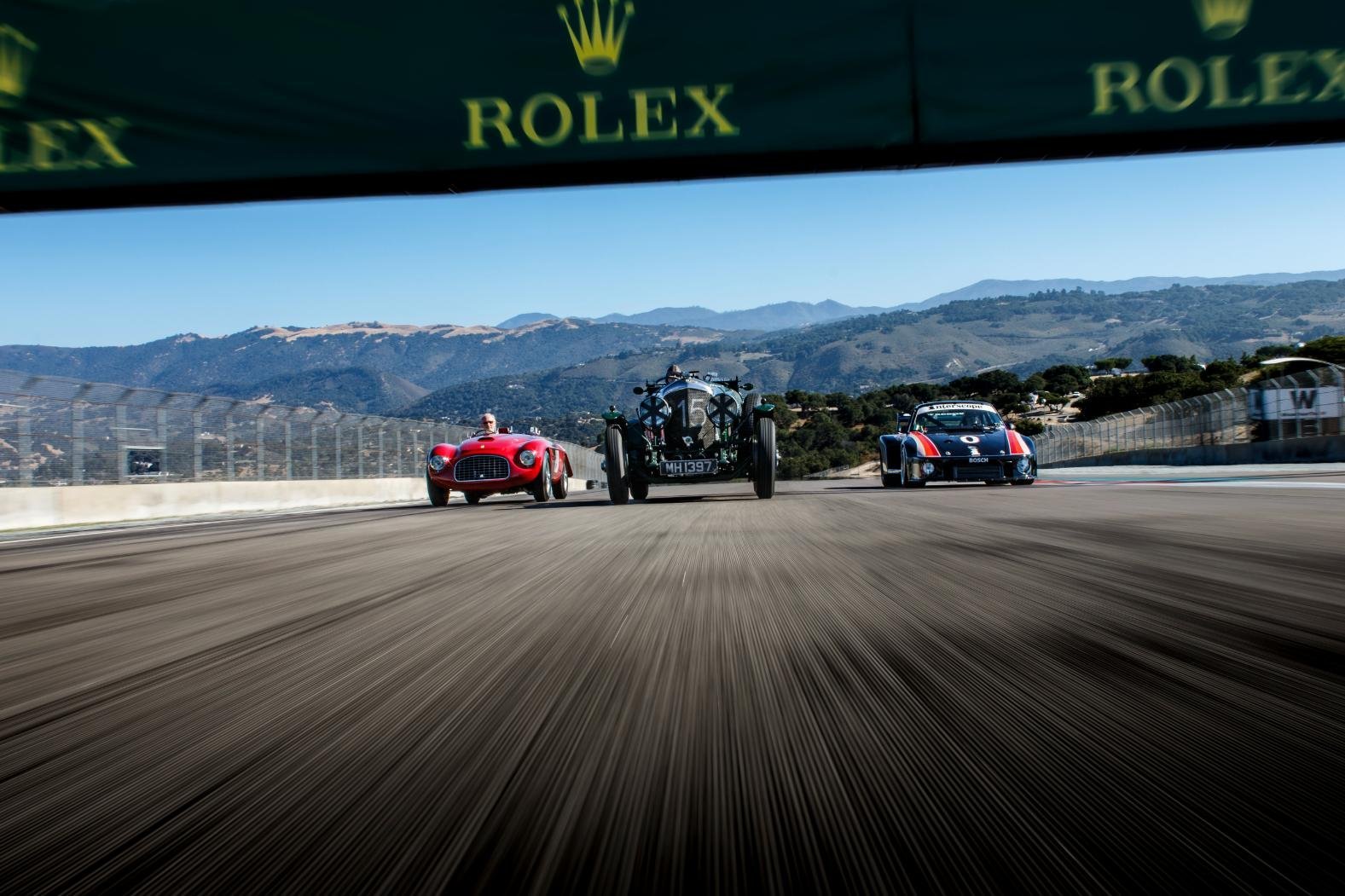
Laguna Seca, forty minutes away, is the exact opposite: the smell of unburnt fuel, unfiltered noise, grandstands, open paddocks and historic racing cars used as they were built to be used. In the evenings, Carmel absorbs everything else: full restaurants, waiting lists, tables where half the conversations are about provenance.
Laguna Seca, the week’s loud counterpoint. Photo: Rolex
How it began
The Concours was born on 5 November 1950 as an elegant companion to a road race through the Del Monte Forest. It was the supporting act. The race ended in 1956, when the course became too dangerous. The Concours stayed. Seventy-five years later, the race that was the reason has disappeared, and the social detail that accompanied it has become the centre of the collector-car calendar, with ten days of programming across the entire peninsula.
How a car reaches the lawn
This is what most surprises newcomers: a place at Pebble Beach cannot be bought. Applications close in early January. Cars must be impeccably restored or preserved and, ideally, should not have appeared at another major concours, or at Pebble Beach itself, in the previous decade. The final list is published in April. On Sunday, each class is assessed by technical judges, and above them sits a panel of honorary judges drawn from design studios, the great marques and motor racing. In 2025 that panel included Tom Kristensen, nine-time winner of the 24 Hours of Le Mans.
Class winners cross the ramp in the late afternoon. A single car takes Best of Show, the highest title a collector car can receive.
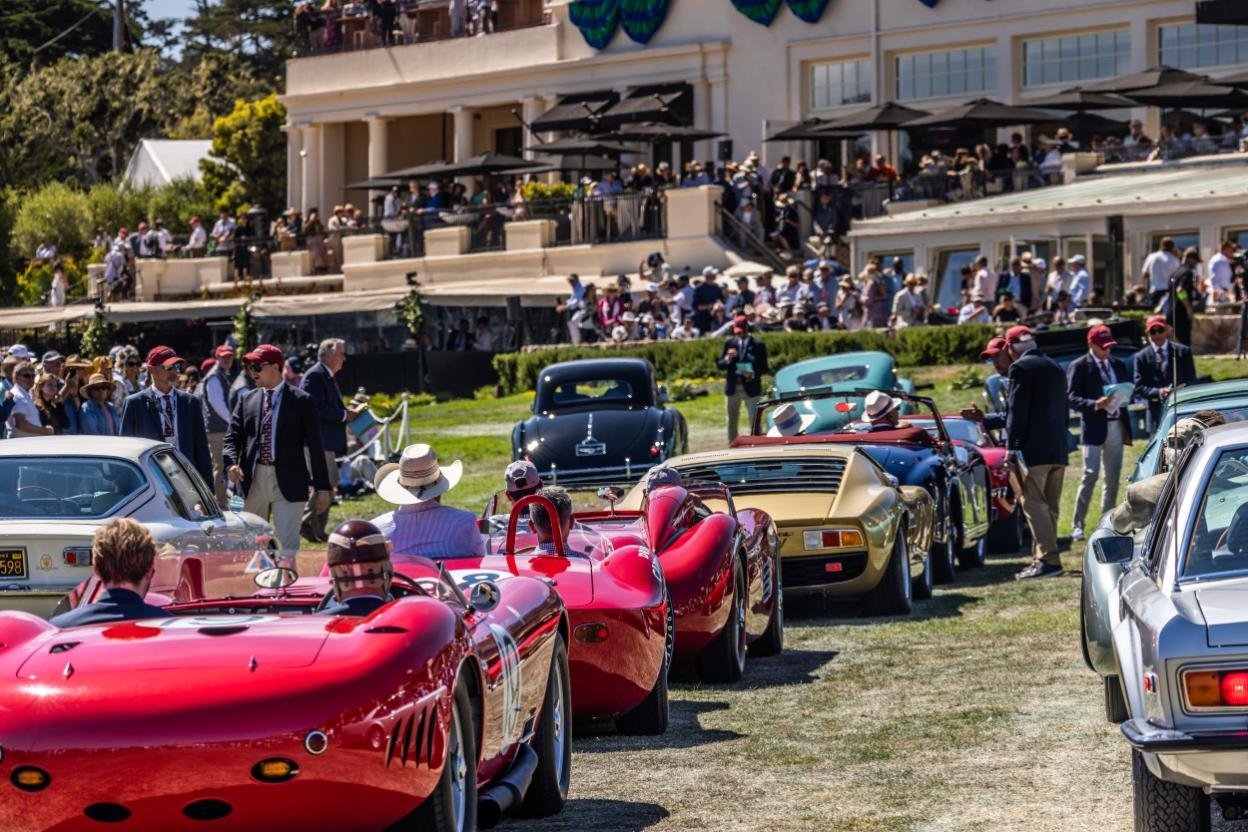
From the January application to Sunday’s ramp. Photo: Rolex
Sunday begins in the dark
What nobody tells a first-timer is that the best moment happens before the event opens. It is called Dawn Patrol. Before sunrise, the cars climb in procession onto the fairway, headlamps lit, engines cold, between rows of people in coats. Coffee and doughnuts are served. Each machine can be heard on its own, with no crowd around it, and the owners are still approachable, many of them driving their own cars. Then come the dust cloths, the positioning, the judging and the crowd.
Beside the competition lies the Concept Lawn, where the marques show concepts and prototypes. It is a deliberate counterpoint: on one side, a century of settled history; on the other, a wager on the next ten years.
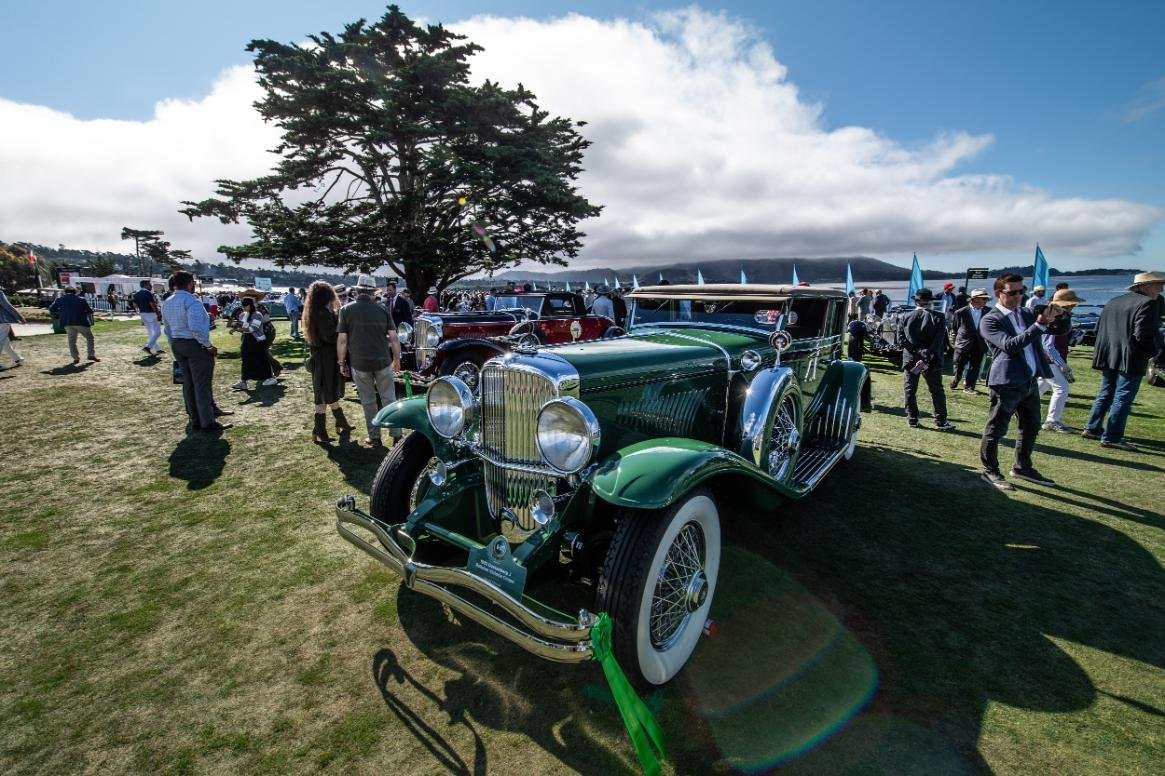
The 18th fairway, where a century of the automobile gathers once a year. Photo: Rolex
The week, event by event
Pebble Beach Tour d’Elegance. On Thursday, some two hundred Concours entrants set out on a coastal route of about 110 kilometres. It proves the cars run, and it counts as a tiebreaker on Sunday. It is also the most generous day for those who simply want to watch: a folding chair by the road and some patience are enough, as local families have known for decades.
The Quail, A Motorsports Gathering. On Friday, in Carmel Valley, with attendance limited to around 3,500. It has taken over the role motor shows have lost: this is where marques stage world premieres. Immaculate lawns, food and wine all day, its own concours and its own Best of Show. The mood is a long lunch among people who know one another.
Rolex Monterey Motorsports Reunion. Four days of historic racing at Laguna Seca, with hundreds of competition cars grouped by era.
Racing cars used as they were made to be used. Photo: Rolex
The auctions. RM Sotheby’s, Gooding Christie’s (the official auction house of the Concours), Broad Arrow, Bonhams and Mecum run in parallel from Wednesday to Saturday. Monterey is the one week of the year when several eight-figure cars cross the block, which makes it the industry’s principal price indicator.
Everything else. Motorlux at the Monterey Jet Center, the Automobilia Collectors Expo, RetroAuto, Concours Village, the Porsche Werks Reunion, the Little Car Show in Pacific Grove and the Concours d’Lemons, which rewards the opposite of everything Pebble Beach celebrates.
Who stands on the lawn
It is worth being direct, because the image that circulates is partial. Around Pebble Beach, houses are counted between eight and fifty million dollars. In a single recent year, the week’s auctions offered more than 160 cars estimated above a million dollars. At The Quail, the audience watches the unveiling of a seven-hundred-thousand-dollar car and then asks the marque’s representative how to buy one. That is why premieres moved there: it is not a showroom, it is a sales floor.
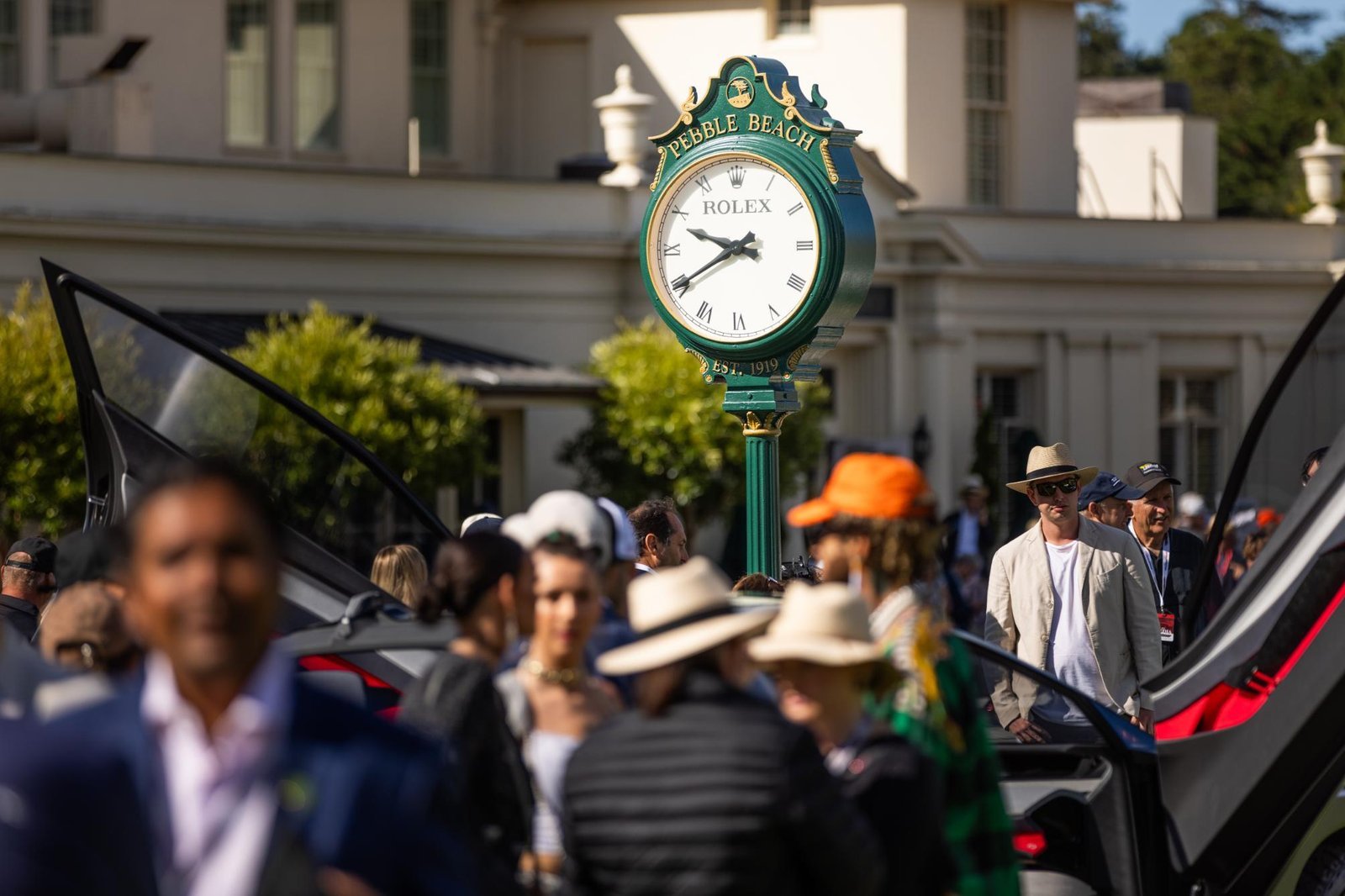
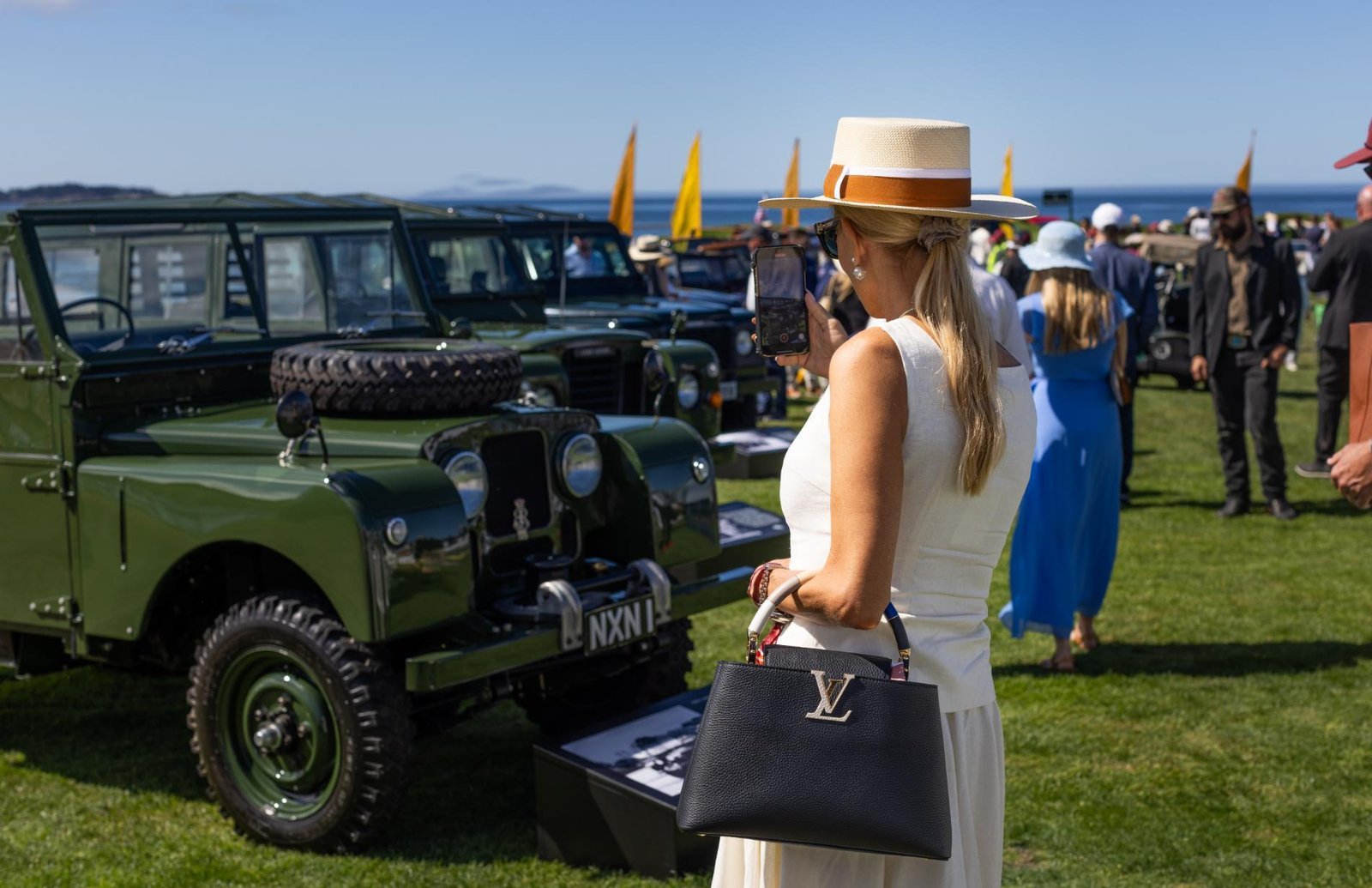
Four kinds of audience, ten days, one peninsula. Photo: Rolex
At the same time, Sunday at Pebble Beach draws around twenty thousand people, and roughly a third of the week’s programme is free. There is a whole pyramid: the collector who shows, the buyer who came to decide, the enthusiast who saved all year for a ticket and the local family watching the Tour from the pavement. All four share the same tarmac for ten days.
A generational shift is under way, and it shows in the prices. The buyer in his early forties does not chase the car his seventy-year-old counterpart wants. He wants what marked his adolescence, which has pushed the market towards the 1980s and 1990s, with direct consequences for what pre-war classics can achieve at auction.
2024: when wear became a virtue
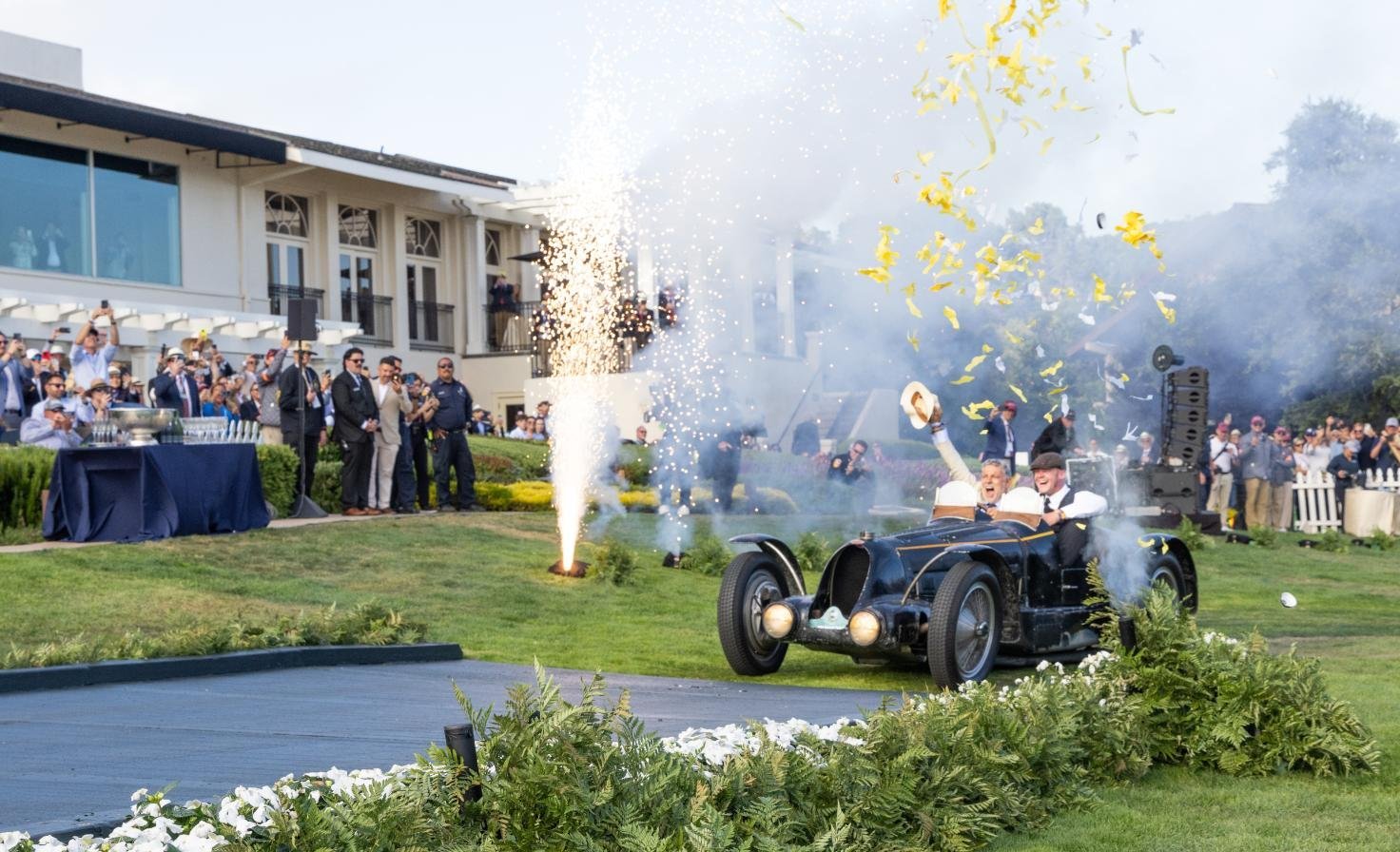
The 73rd edition gathered 214 cars from 16 countries and 29 American states, and ended with a decision that rewrote the manual. For the first time in the history of Pebble Beach, Best of Show went to a preservation car: a 1934 Bugatti Type 59 Sports, shown by Fritz Burkard of The Pearl Collection in Zug, Switzerland. It was the first Type 59 built, a factory racer with Grand Prix victories, later owned by King Leopold of Belgium, who had it redressed in the livery it still wears. Unrestored, with every mark of its life in plain sight. “A car can only be once original,” said Burkard, who also became the first European owner to win.
Monterey, 2024: the year the criteria changed. Photo: Rolex
For decades, Pebble Beach rewarded the car returned to its factory state. In 2024, it rewarded the car that refused to forget what it had lived.
The auctions told another story: 391.6 million dollars across the week, down almost 3 per cent on the year before, with cars above a million performing worse than usual. The top sale was a 1960 Ferrari 250 GT SWB California Spider, at 17 million dollars. The money had not left the market. It had moved towards the more recent.
The conversation that stayed
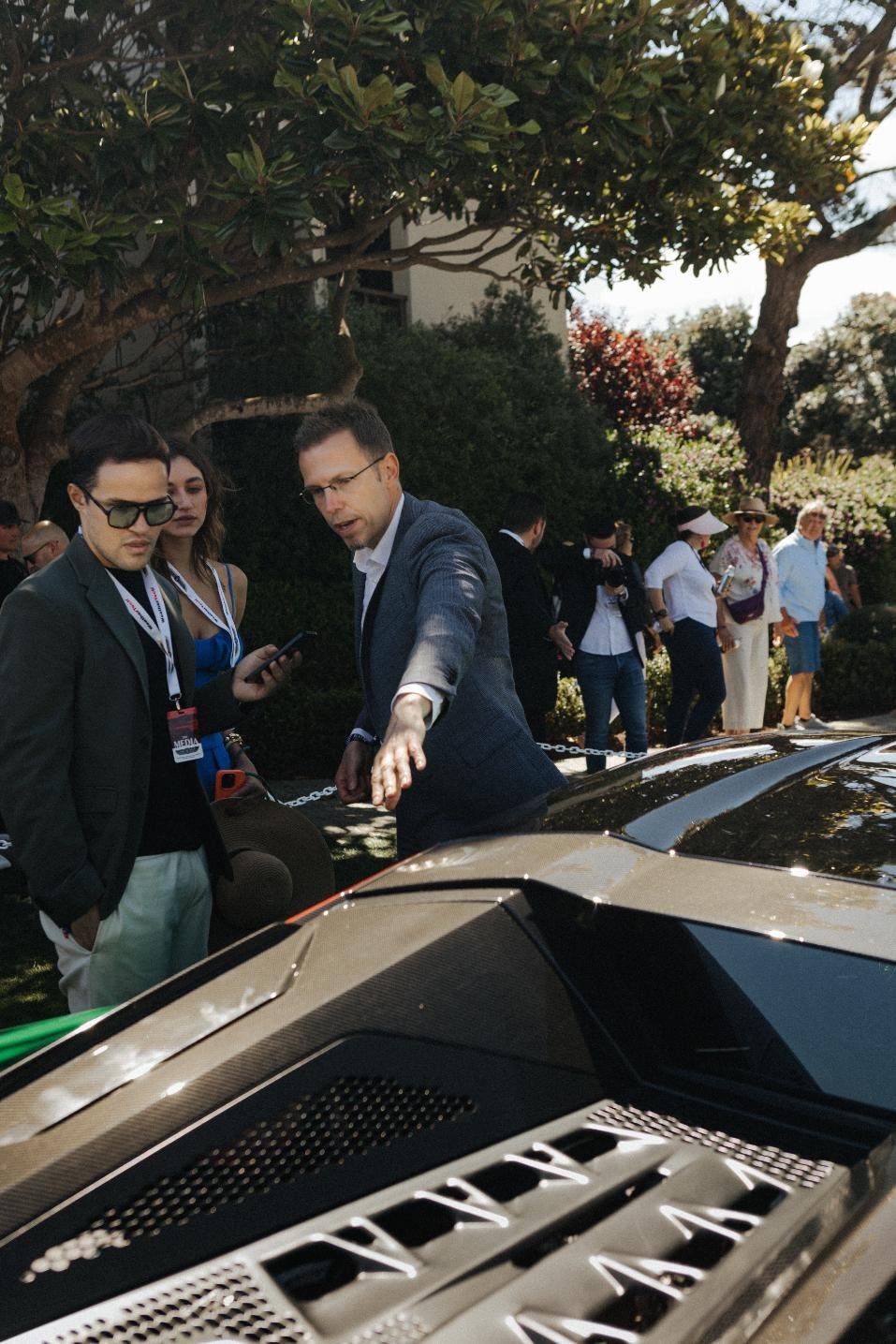
On the Friday of that week, The Quail staged 21 premieres. The one that drew everything was Lamborghini’s: the Temerario, successor to the Huracán, with 920 PS and a twin-turbo V8 that revs to 10,000 rpm, a rarity in a forced-induction engine. There I spoke with Rouven Mohr, the marque’s chief technical officer. He said little about numbers and a great deal about what the house refuses to abandon. Best of Show at The Quail that year went to a 1937 Delahaye Type 135 belonging to Sam and Emily Mann.
The Quail, 2024: with Rouven Mohr, Lamborghini’s chief technical officer
2025: wood and 8,500 rivets
The 74th edition was larger: 229 cars, including 55 international entries from 22 countries, before some twenty thousand spectators. The winner was a 1924 Hispano-Suiza H6C Nieuport-Astra Torpedo, shown by Penny and Lee Anderson Sr. of Naples, Florida, their second Best of Show after a Figoni-bodied Duesenberg J in 2022, and the marque’s first since 1989.
The car was commissioned by André Dubonnet, heir to the aperitif and an amateur racer, who drove it in the Targa Florio and the Coppa Florio. Its body came from the aircraft maker Nieuport-Astra: narrow strips of mahogany, each carved by hand and joined to the inner ribs by 8,500 rivets, like the fuselage of an aeroplane. A later owner had added pontoon wings; the Andersons returned it to its original torpedo form. “The body is meticulously hand-crafted, light, and lovely,” said the Concours chairman, Sandra Button. Seeing it up close at dawn, with dew still on the wood, is the image I carry from that edition.
At the auctions, 432.8 million dollars, the second-highest total in the event’s history, with eight Ferraris among the ten most expensive cars. The top lot was a Ferrari Daytona SP3 Tailor Made, sold for 26 million dollars, with all proceeds going to the Ferrari Foundation. At The Quail, Lamborghini unveiled the Fenomeno, limited to 29 examples and powered by the most potent V12 the house has built; Bugatti revealed the Brouillard, the first car of its Programme Solitaire, named after Ettore Bugatti’s favourite horse. Best of Show at The Quail went to a 1996 Ferrari F50 GT1.
2026: the 75th
I returned for the anniversary. The edition, on 16 August, brought 218 cars to the fairway, 33 of them from 14 countries, across 25 classes, with Ferrari as the featured marque and a new class devoted to Japanese motorsport. The most conservative concours in the world had opened a door that had stayed shut, and it led to Japan.
Best of Show went to a 1935 Duesenberg SSJ Special Speedster, one of only two built and originally owned by Clark Gable, shown by Harry Yeaggy of Cincinnati after a recent restoration to its original black lacquer and saddle leather. Yeaggy had won once before, in 2007, with the Duesenberg SJ “Mormon Meteor”. “I won once before, 19 years ago, but I appreciate it a lot better now,” he said. Duesenberg now holds eight Best of Show trophies, more than any other American marque.
1935 Duesenberg SSJ Special Speedster, Best of Show at the 75th Concours. Photo: Pebble Beach Concours d’Elegance
The Concours raised more than 4.3 million dollars for charity in 2026, bringing its total to over 50 million, more than half of it in the past decade, for some 130 local organisations. Gooding Christie’s, its official auction house, reported more than 159 million dollars in sales, led by a 1964 Shelby Cobra Daytona Coupe at nearly 43 million. At The Quail, Best of Show went to a Ferrari 625/250 Testarossa.
What remains after Sunday
After three editions on the lawn, what stays is not the Best of Show. It is the sense that Monterey works as a barometer measuring two temperatures at once. One is financial, and it lives at the auctions: 471.2 million dollars in 2022, 391.6 million in 2024, 432.8 million in 2025. The other is cultural, and it lives on the lawn: in 2024 an unrestored car won for the first time, in 2025 a body of mahogany and rivets, and in 2026 a class for Japanese motorsport opened. In three years, the most traditional event in the calendar changed its mind about what perfection is.
For those planning ahead: the 76th Concours takes place on 15 August 2027, celebrating the Delage centenary and forty years of the Ferrari F40. From 2028, the Concours moves from the third Sunday of August to the second, so 2027 is among the last editions in its traditional place. Hotels in Carmel and Monterey are often taken up to two years in advance; that, not the ticket, is the real constraint.
The ramp, late on Sunday afternoon. Photo: Rolex
For a first visit, the advice is short: arrive in the dark, on Thursday and on Sunday, and bring a coat. The rest of the day belongs to the crowd; the two hours before dawn belong to the cars. The collector car does not survive because it is expensive. It survives because someone decided, on an August Sunday, with the fog still low over the Pacific, that its story deserved to go on being told.
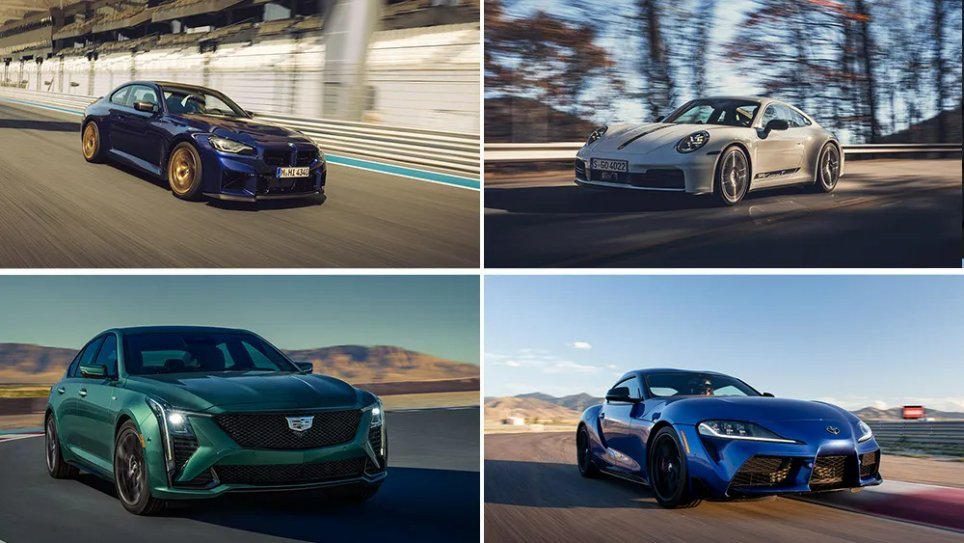
The manual gearbox has gone from rule to rarity. In late 2026, BMW M, Porsche, Nissan and Lotus still build cars that let the driver choose the gear, while the Toyota GR Supra and BMW Z4 have already taken their last bow.
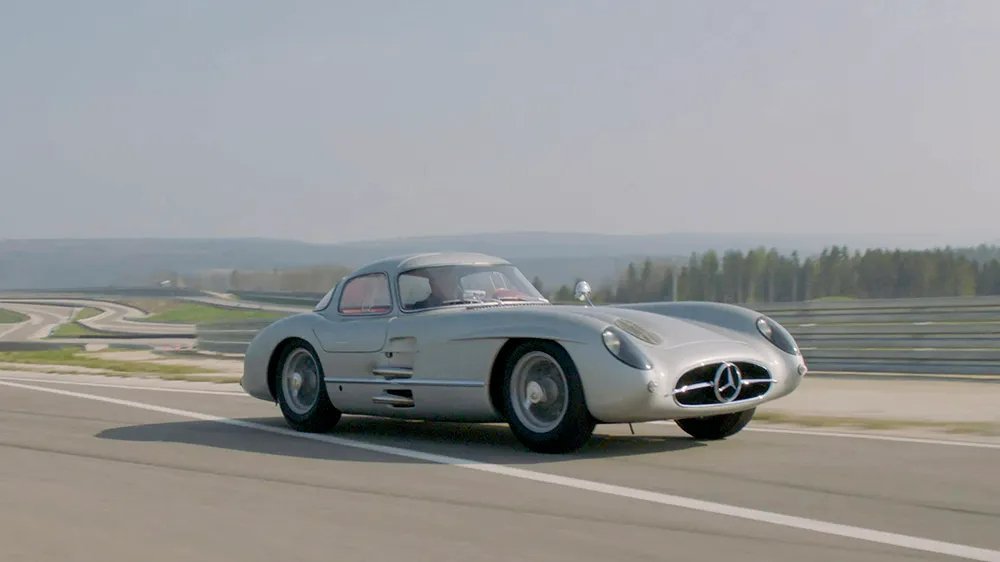
A Mercedes-Benz built in two examples still sits alone at USD 143 million. Below it, 2026 has rearranged the table: a Shelby Cobra Daytona Coupe, a white Ferrari 250 GTO, a McLaren F1 GTR and Ferrari's first electric car have all entered the ranks of the most valuable cars ever sold.
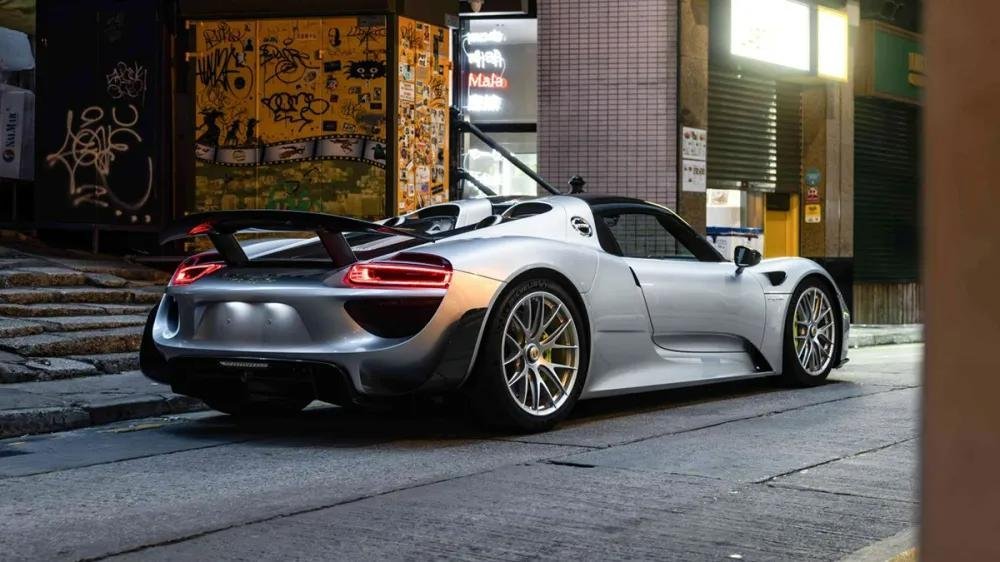
What began in March as a careful hint from Michael Leiters became, in October, a concept on a pier in Queens: the mid-engined Mission S previews a permanent Porsche model line above the 911, the first since the 918 Spyder.