
Design / Reportage
Porsche 914: the value of taking another shape
The Volkswagen-Porsche collaboration offers a different route through sports-car history, defined by engine placement and radical proportions.

THE CURATED EDITION.
Reportage /
Beyond maximum speed, the aircraft raises questions about cabin planning, real-world routing and how long-distance travel is organised.
WAYFARER · DESIGN
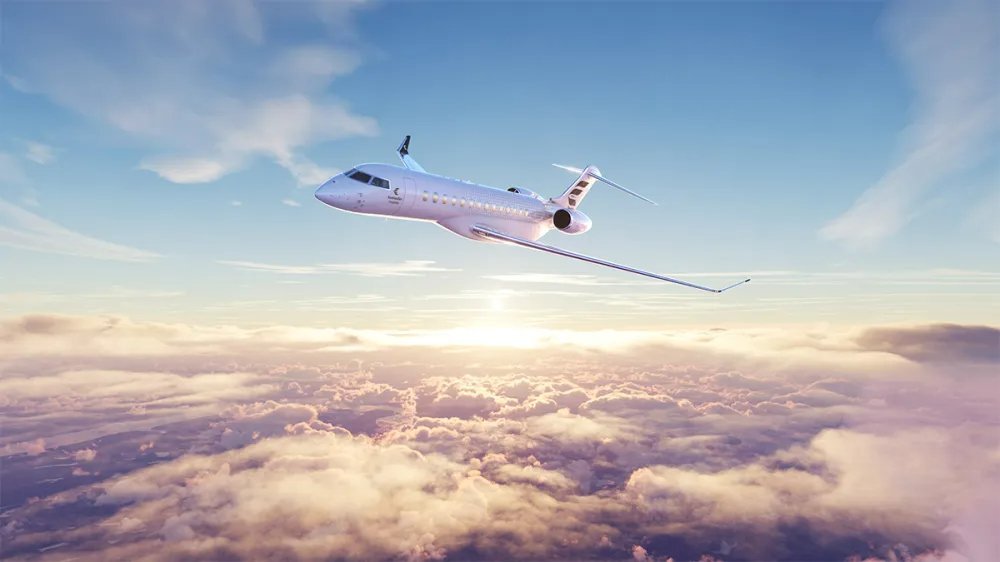
A long-range aircraft changes a journey only when its engineering survives contact with the itinerary. Bombardier's Global 8000 is usually introduced through speed and distance, but the more useful story lies between those figures. Range determines which connections might disappear. The cabin determines how the hours that remain can be used. Neither number nor interior should be read in isolation.
Bombardier states a maximum speed of Mach 0.95 and a range of 8,000 nautical miles for the Global 8000. The aircraft entered service in December 2025, and the manufacturer delivered the first example to fleet customer NetJets in March 2026. It has moved beyond a future programme into an operating aircraft.
The distinction matters, but it does not make a published range a promise for every departure. Payload, winds, airfield conditions and the operator's planning affect an actual flight. A maximum-speed figure and a maximum-range figure are different performance measures, not a guarantee that both will be achieved together. The meaningful unit is the planned mission.
For a traveller, the advantage of long range is not simply the distance covered. It may be the removal of a technical stop, a change in departure timing or a more direct relationship between two cities. Those benefits should be considered against the actual route, rather than inferred from a world map with a broad circle drawn on it.
Bombardier presents the aircraft with four living areas and a separate crew-rest space. Its cabin concept allows work, dining and rest to occupy distinct settings. A manufacturer-published cabin altitude of 2,691 feet at an aircraft altitude of 41,000 feet is another part of the proposition.
That pressure specification is a technical attribute, not a medical guarantee. It should not be translated into a promise that jet lag disappears or that every passenger arrives refreshed. Long-distance fatigue involves the itinerary, sleep and individual circumstances as well as the aircraft environment. A better cabin can improve the conditions of a journey without controlling every outcome.
The spatial arrangement is easier to judge directly. A distinct rest area matters if it remains usable while another passenger is working. A dining space matters if movement through the cabin does not constantly interrupt it. The quality of an interior is partly the quality of the separations it makes possible.
Aircraft interiors must solve constraints that a hotel room does not share. Weight, safety and the demands of movement affect every surface and fitting. This makes the design interesting in its own right: an apparently domestic space is the visible result of tightly managed engineering conditions.
The most persuasive cabin does not conceal those conditions behind residential styling alone. It uses them to create a clear sequence of functions. A table, a seat and a sleeping area should support the duration and purpose of the flight, not simply photograph well while the aircraft is parked.
The Global 8000's headline figures establish an ambitious envelope. The traveller's experience is made inside that envelope, through a route, an operating plan and a considered cabin. Speed shortens one part of the journey. Design gives the remaining time a structure.
Details and further reading: Bombardier delivery to NetJets · Manufacturer entry-into-service presentation.
Instagram: @bombardier_jets.
GABRIEL SILVEIRADO, FOR WAYFARER.
CONTINUE READING
Design / Reportage
The Volkswagen-Porsche collaboration offers a different route through sports-car history, defined by engine placement and radical proportions.

Design / Reportage
The first M with an integrated electronic viewfinder shifts the focusing experience without removing the photographer’s role.
Design / Reportage
Amor à Vida, Sirena 42M and Sunreef 100 Eco make a case for reading yachts through their layouts and engineering briefs.