
Design / Reportage
Bombardier Global 8000: the journey inside the range figure
Beyond maximum speed, the aircraft raises questions about cabin planning, real-world routing and how long-distance travel is organised.

THE CURATED EDITION.
Reportage /
The Volkswagen-Porsche collaboration offers a different route through sports-car history, defined by engine placement and radical proportions.
WAYFARER · DESIGN
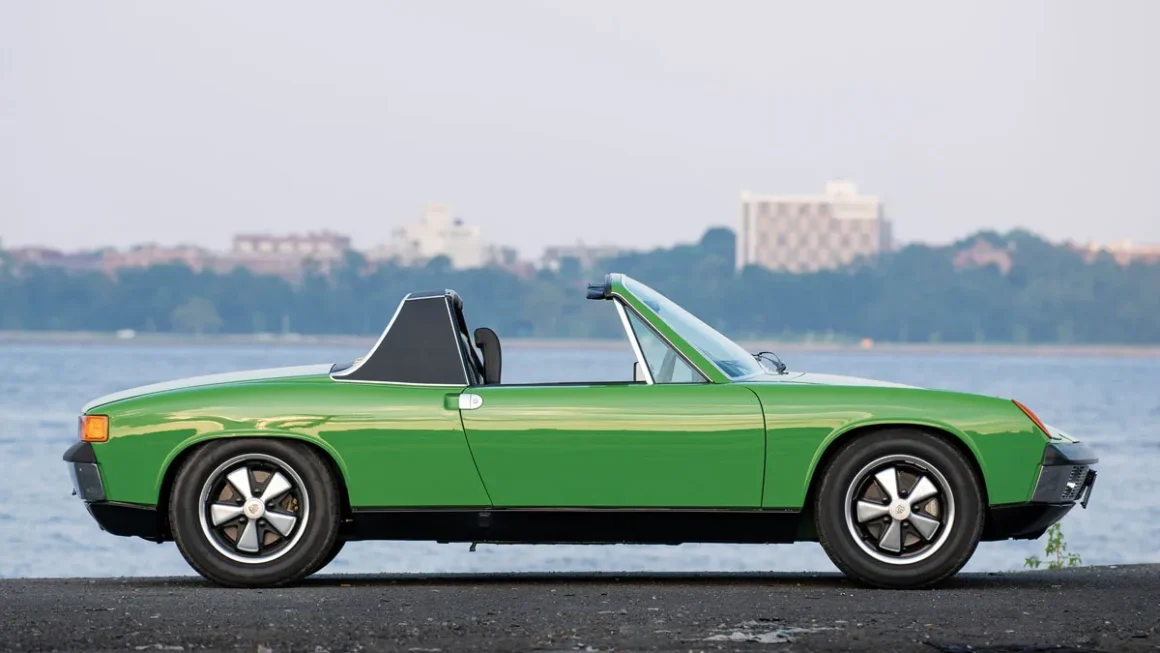
A Porsche does not have to resemble a 911 to explain something important about the company. The 914 makes that point through its proportions before the engine is started. Low, angular and organised around a central engine, it belongs to a different design conversation. Its appeal is not a diluted version of the better-known model. It is the evidence that the same manufacturer could ask a different question.
Introduced in 1969, the 914 emerged from a collaboration between Volkswagen and Porsche. Porsche's historical account distinguishes the four-cylinder version, with a Volkswagen engine, from the 914/6, with a Porsche six-cylinder engine. The arrangement was commercially unusual, but it gave the car a clear architectural basis: the engine sat ahead of the rear axle.
That position matters more than the badge dispute that often accompanies the model's history. A sports car is a distribution of mass, space and controls before it is a symbol. Moving the engine changes the problem that the designer must solve, from the shape of the passenger compartment to the volumes required around it. The 914's appearance follows a different set of conditions from those of a rear-engined 911.
Heinrich Klie's design gave the car an unusually direct silhouette. The removable roof panel, low front and compact cabin establish a series of distinct volumes rather than a flowing imitation of the 911. The car's visual independence is part of its historical value. It does not need later approval from a more famous relative to become coherent.
The shape also demonstrates why automotive history becomes less interesting when it is told only through winners. A model can be commercially complicated, critically divisive and still offer a persuasive answer to a design problem. The 914 is worth examining for the decisions that produced it, not merely for the opinions that greeted it.
The four-cylinder and six-cylinder versions should not be treated as interchangeable collectibles. Their mechanical differences, production histories and subsequent modifications give individual cars very different identities. Porsche's retrospective records more than 115,000 four-cylinder examples and a much smaller run of the 914/6.
For anyone studying a particular car, originality is a question to investigate rather than a word to accept. Engine substitutions, altered bodywork and competition-style conversions can change both the driving proposition and the historical one. A carefully developed modified car may be compelling, but it should not borrow the identity of a factory-built version without documentation.
The temptation is to conclude a rediscovery with a prediction about values. That would flatten the story. The 914's significance is already present in its engineering and design, independent of the next auction result. Its place in a collection can be justified by the way it broadens an account of Porsche, rather than by the hope that an overlooked model will become expensive.
The car offers another way to understand the sports-car idea: less dependent on inherited outline, more explicit about layout and proportion. It asks to be judged on the shape it took, not the shape it declined to copy.
Details and further reading: Porsche Museum history of the 914.
Instagram: @porsche_newsroom.
GABRIEL SILVEIRADO, FOR WAYFARER.
CONTINUE READING
Design / Reportage
Beyond maximum speed, the aircraft raises questions about cabin planning, real-world routing and how long-distance travel is organised.
Design / Reportage
The first M with an integrated electronic viewfinder shifts the focusing experience without removing the photographer’s role.
Design / Reportage
Amor à Vida, Sirena 42M and Sunreef 100 Eco make a case for reading yachts through their layouts and engineering briefs.