Brickell after hours: how Miami’s financial district became a neighbourhood
Brickell no longer empties at six. Residential towers by Arquitectonica and Adrian Smith + Gordon Gill, and dining rooms from Amazónico to Seia, have turned Miami's banking district into a place people choose to live.
A financial district becomes a neighbourhood the night its streets stop emptying at six. Brickell has crossed that line. For decades it was Miami’s counting house, a canyon of glass towers and regional headquarters along the most powerful business corridor in the American southeast. Today the lights stay on for different reasons: people live here, eat here and, increasingly, intend to stay.
The change has been fast, even by Miami’s standards. Global capital, a run of residential towers and a dining scene that now draws the rest of the city south of the river have given the district what it lacked: an evening.
Towers with a different purpose
The skyline is the clearest evidence. On South Miami Avenue, Cipriani Residences Miami, designed by Arquitectonica with interiors by 1508 London, topped out this summer at more than 80 storeys. It holds 397 homes, is more than 80 per cent sold and expects its first residents in the summer of 2027. Its name is a statement of intent: the Venetian family that taught New York how to have lunch now proposes to teach Brickell how to come home.
A few blocks away, The Residences at 1428 Brickell is climbing towards 70 storeys. Its west face, a spine of some 500 photovoltaic windows, is designed to generate power for the building’s common areas, and completion is planned for late 2028. On the water at 175 SE 25th Road, Una Residences, a 47-storey tower by Adrian Smith + Gordon Gill, brought the first new waterfront condominium to Brickell in more than a decade.
The buyers have changed with the buildings. Financiers, technology founders and international investors increasingly treat Brickell as a primary address rather than a winter one. The arrival of firms such as Citadel, which moved its headquarters to Miami, brought a professional class with every reason to live near the office and fewer reasons to leave on Friday.
Where the evening begins
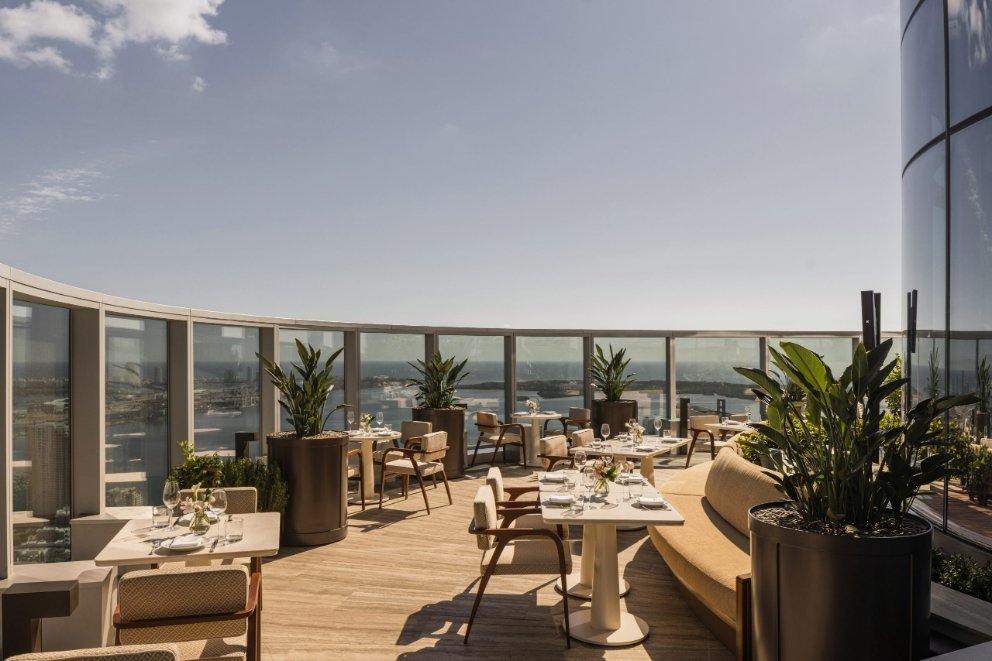
FIFTY-FOUR FLOORS ABOVE THE BAY, ITALY AT EYE LEVEL WITH THE CLOUDS. IMAGE: PRESS
The dining rooms followed the residents. Amazónico, the house born in Madrid and since exported to London and Dubai, opened on Brickell in September 2025 with its jungle interiors, live music and a South American menu built for long tables. Claudie, at 1101 Brickell, brings a French Mediterranean kitchen and late DJ sets that make it a weekend fixture.
For something quieter, Panamericano, on the second floor at 900 South Miami Avenue, is a library-lined speakeasy devoted to rum, mezcal and pisco, with a ceviche martini that tells you everything about its sense of humour.
The most telling arrival came in March 2026. Seia occupies the 54th floor of 830 Brickell, a modern Italian dining room overseen by The Bastion Collection under executive chef Salvatore Martone, a former pupil of Joël Robuchon. Upstairs, on the 55th, Seia Club admits members by invitation only. That a district once synonymous with the business lunch now supports a private club in the clouds says much about who lives below.
Why here, why now
Several forces converged. Florida’s tax climate drew companies and high earners from the northeast. Developers answered with supply. Restaurateurs and hoteliers, sensing a resident rather than a commuter population, followed. Each wave made the next more likely, until the district reached the point where it no longer needed the working day to justify itself.
On any ordinary night, Brickell now shows its new face plainly: full tables, lit windows in towers that did not exist a few years ago, and a steady flow of neighbours rather than visitors. The old financial district has become a complete place, where business, society and home keep the same hours. The streets no longer empty at six, and nobody seems in a hurry to leave.
The writer and designer behind Kitten maps a Los Angeles of small rituals: the counter at Petit Trois, the red booths of Musso & Frank, a panorama painted by hand and, above all, the car.
From the Pony Line bar at the Four Seasons to Julia's 22 seats in Villa Crespo, by way of Coppola's hidden garden, Casa Cavia and the Colección Amalita: a Buenos Aires for those who take their time.
Two days in the South Bay, based at Rosewood Sand Hill and its Asaya spa, by way of the gardens of Filoli, the Ridge vineyard on Monte Bello and the tables of Palo Alto and Menlo Park.