WAYFARER Edition · Style | Asnières, Paris and Shanghai
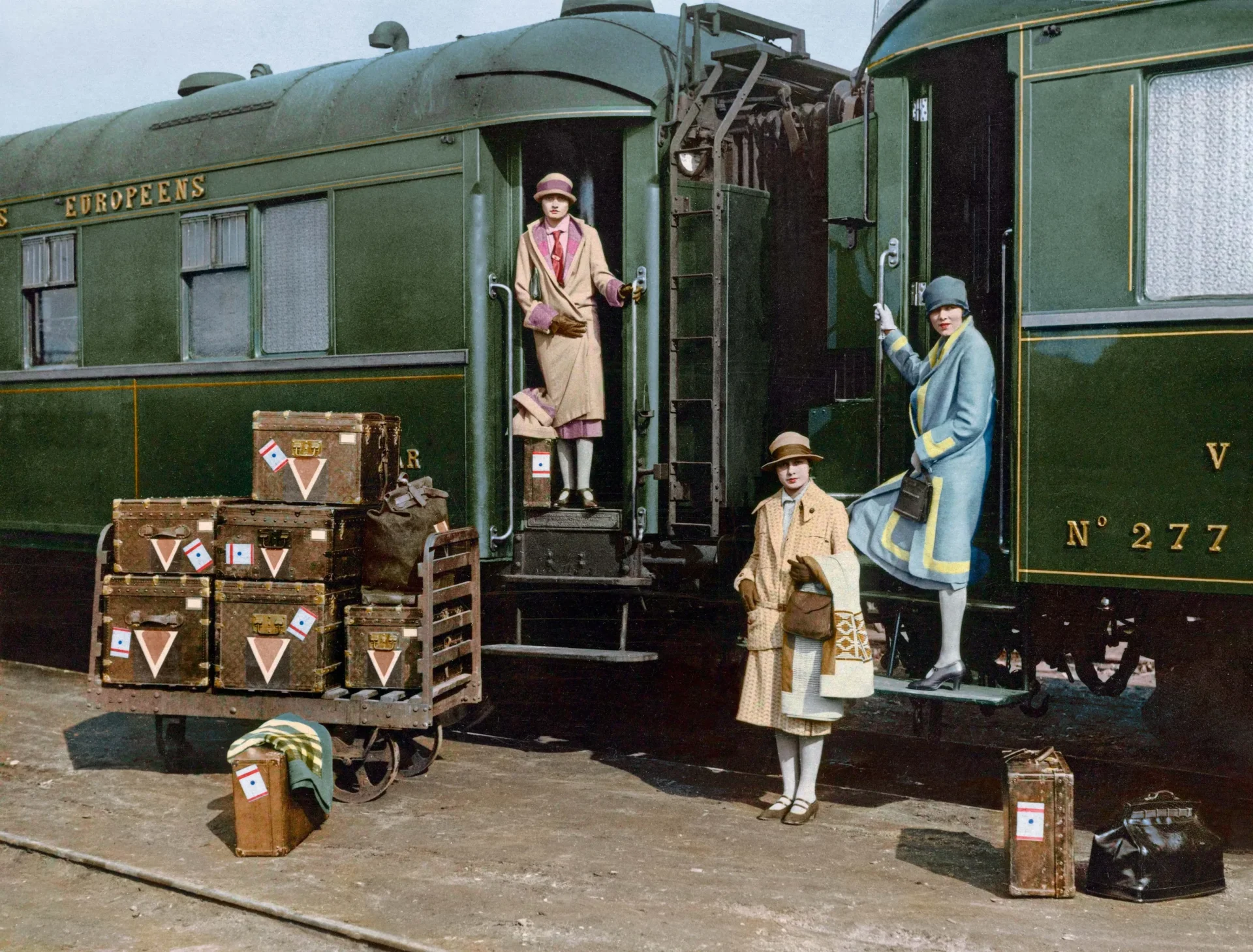
Some fashion stories do not begin on a runway but in a workshop. Louis Vuitton’s begins in Asnières, north-west of Paris, where in 1859 the founder established the house that still makes the maison’s trunks and special orders. It is there that savoir-faire stops being an abstraction and becomes a gesture, repeated generation after generation.
It was there too, some 130 years ago, that Georges Vuitton, the founder’s son, faced a problem that sounds strikingly modern: the growing counterfeiting of his father’s creations. His answer, in 1896, was the Monogram, crossing Louis Vuitton’s interlaced initials with three stylised floral motifs on the brown and beige already associated with the name. More than ornament, it worked as both signature and tribute.
A symbol that lasts without standing still
“What makes the Monogram so enduring is that it is the visible expression of a history and a savoir-faire. It immediately evokes an emotional and cultural narrative, yet it remains deeply tied to Louis Vuitton’s original mission: creating objects for travel,” says Pierre-Louis Vuitton, the founder’s sixth-generation descendant, now responsible for the maison’s savoir-faire.
For him, the symbol’s strength lies in its refusal to be held by the past. “It is instantly recognisable, but it has never been anchored in nostalgia. It stays alive through new uses and interpretations. From the moment the patent was filed in 1897, Georges Vuitton did not see it as fixed. That ability to stay true to its identity while opening to contemporary readings is what keeps its force intact.”
On Asnières he is direct: “It is not only part of the house’s history, it is one of the places where that history is still alive. On one side it is a place of conservation, where gestures, techniques and patterns are handed down. On the other it is a place of evolution, with new special orders created every year.”
The invisible architecture of a trunk
A Louis Vuitton trunk is built in successive stages, each calling for its own craft. It begins with the frame, which sets shape, balance and strength. Then come the cutting and preparation of materials, the application of the canvas, the assembly, the placing of reinforcements such as the lozine, the interiors, the hardware and finally the finishes that give the piece its character.
“Some of these stages depend especially on the artisan’s hand and judgement,” Pierre-Louis Vuitton explains. “Applying the canvas to the frame is not a purely technical gesture: it requires precision, regularity and a deep understanding of tension, alignment and proportion. The same goes for the lozine, which is both practical and aesthetic, and for the malletage, the quilted interior that must protect and refine at once.” A single trunk can bring together several specialists, and that meeting of crafts, he says, is what makes it exceptional.
Personalisation as a conversation
From the start, Louis Vuitton trunks were marked and adapted to meet both practical needs and the identity of whoever ordered them. The logic remains. “Some clients want discreet touches, initials, colours, stripes or changes to the interiors. Others bring very specific functional or aesthetic requests that call for a deeper dialogue with the atelier,” he says. “Then personalisation becomes almost a co-creation, in which the object has to answer a very precise vision. The limit is not decoration, it is coherence.”
If the trunk once answered a concrete need, to travel and to protect, its role has widened. “Many clients also see it as an object of memory, of transmission and of self-expression. But when we design a trunk we always keep in mind that it must remain, above all, an object made for travel.”
One suitcase, thirteen years, a hundred destinations
Travel is also the starting point of The Suitcase, the new book by the artist Bruno Aveillan, co-published by Éditions Flammarion and Éditions Noir and released this November. Its protagonist is his own Louis Vuitton Alzer, photographed in more than a hundred places over thirteen years, including settings as unlikely as remote deserts and polar ice.
“Photographing it where it would naturally be expected held little interest for me,” Aveillan says. “What fascinated me was the strange poetry that can appear when an object is taken out of its usual setting. The project was never commissioned: it grew freely, instinctively, through my travels, my curiosity, chance and encounters along the way. That is how this old trunk ended up in remote deserts, dense jungles, polar ice at minus 35 degrees or an abandoned industrial site in the heart of the Pampas.”
“I did not travel the world to photograph a suitcase; I took a suitcase with me to photograph the world,” he goes on. “Little by little it became a discreet thread able to connect places, cultures and moments that are deeply different, without ever lessening what makes each one singular.”
In a time when everything seems to need to be faster, lighter and more functional, he believes the object carries another kind of value. “It is a familiar presence, a sense of continuity, an emotional bond that grows stronger with time. It reminds me that an object’s value is not measured only by the service it gives, but by the stories it becomes part of and the memories it slowly comes to hold. Perhaps the same is true of travel itself.”
Two exhibitions, two continents
Since 13 November, Aveillan’s project has taken physical form in the free exhibition “La Valise Bruno Aveillan” at LV Dream in Paris.
In parallel, the celebrations continue in Shanghai, where the travelling exhibition “Visionary Journeys” revisits the house’s repertoire through travel, craft, fashion and innovation. Housed in a ship-shaped scenographic structure called The Louis, designed by Shohei Shigematsu of OMA, it spreads across two floors and leads visitors through a succession of themed rooms, from the house’s origins to its most recent chapters.
In Asnières the workshop stays open, and the stories the runway tells later still come out of it. Some, like Aveillan’s suitcase, take thirteen years to write.
The details
La Valise Bruno Aveillan: LV Dream, 26 quai de la Mégisserie, Paris; free entry; open since 13 November
Book: The Suitcase by Bruno Aveillan, Éditions Flammarion and Éditions Noir
The WAYFARER Edition editors.