
Design / Reportage
Bombardier Global 8000: the journey inside the range figure
Beyond maximum speed, the aircraft raises questions about cabin planning, real-world routing and how long-distance travel is organised.

THE CURATED EDITION.
Reportage /
Amor à Vida, Sirena 42M and Sunreef 100 Eco make a case for reading yachts through their layouts and engineering briefs.
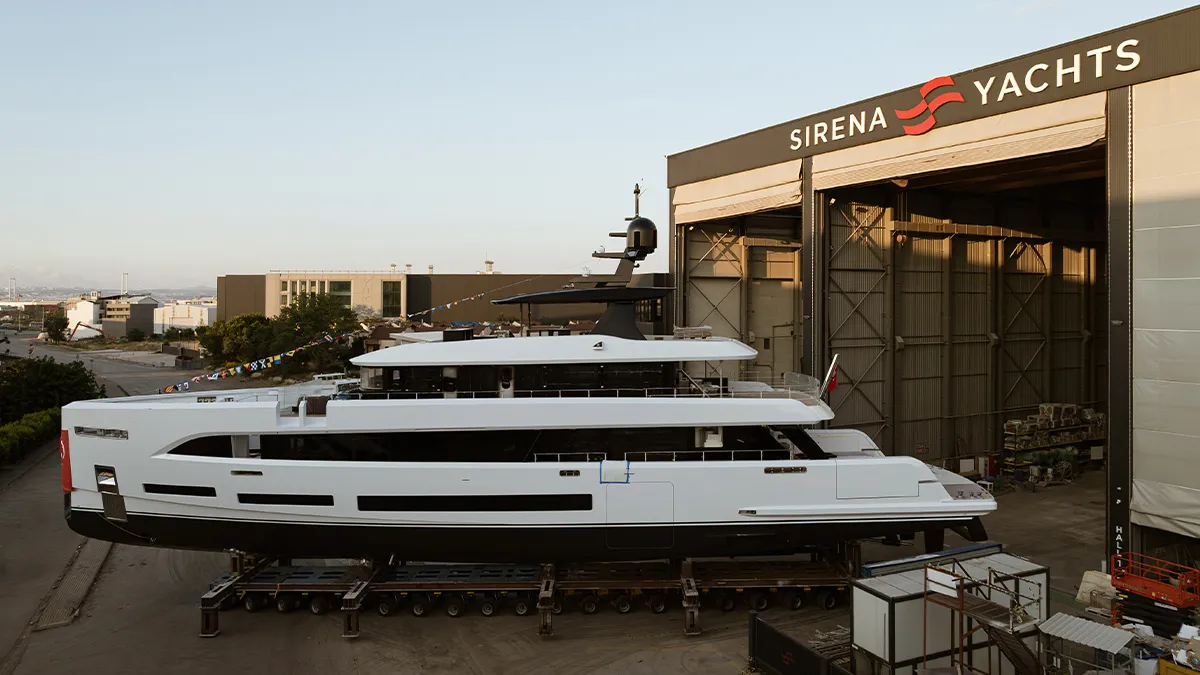
The most useful way to read the 2026 Monaco Yacht Show is not as a contest of length. A hull’s dimensions establish possibilities, but they do not explain how those possibilities have been used. Three projects from the September event suggest more revealing questions: how a private room connects to the exterior, how energy systems are integrated and what a vessel’s layout allows its occupants to do.
CRN presented the European debut of Amor à Vida at the show. The builder lists a length of 67.55 metres and a 2025 launch, an important distinction from a yacht newly launched in 2026. Its project information describes hybrid propulsion, while the yard’s event announcements confirm the Monaco presentation.
A hybrid system is an engineering arrangement, not a complete environmental verdict. Its value depends on operating modes, energy demand and the way the boat is actually used. The sensible reading of a custom yacht therefore separates the designer’s formal choices from claims about efficiency. Both deserve attention; one cannot serve as evidence for the other.
The show’s listing identifies the Sirena 42M as a 2026 debut at 42.23 metres. Luca Vallebona designed its exterior, Hot Lab its interiors and Van Oossanen its naval architecture. The builder’s description places an owner’s suite near midship, opening through full-height sliding doors onto a protected forward patio.
That relationship is more distinctive than another isolated amenity. A courtyard creates an intermediate space between a private interior and an exposed deck. It can change how a room is used during the day, while a curved stair connects the patio to the foredeck above. The yacht’s beach club offers a different kind of contact with the sea, with folding sides expanding the area available at the water’s edge.
These details point to circulation as a design subject. Where can guests move without crossing private space? Which exterior areas feel like extensions of a room, and which function as shared destinations? The answers matter more to life aboard than a photograph of a decorative finish.
Sunreef’s launch announcement specifies two 360 kW electric motors, a 770 kWh battery bank and solar panels integrated into the hulls, superstructure and bimini of its first 100 Eco sailing catamaran. The yacht was included in the builder’s 2026 Monaco presentation.
Integration is the central idea: generation, storage and propulsion are not simply accessories added to a finished interior. They shape the technical brief. But battery capacity is not range, and electric propulsion does not establish zero-impact construction or unlimited autonomy. Sailing conditions, hotel loads and the available charging infrastructure remain relevant.
Together, the three projects make a more useful selection than a ranking. One illustrates a custom vessel with a hybrid system; another reorganises the relationship between private and outdoor space; the third integrates solar generation with electric propulsion. Each asks for scrutiny on its own terms.
Follow: @sirenayachts and @sunreefyachts.
CONTINUE READING
Design / Reportage
Beyond maximum speed, the aircraft raises questions about cabin planning, real-world routing and how long-distance travel is organised.
Design / Reportage
The Volkswagen-Porsche collaboration offers a different route through sports-car history, defined by engine placement and radical proportions.
Design / Reportage
The first M with an integrated electronic viewfinder shifts the focusing experience without removing the photographer’s role.