AI girlfriends: companionship made to measure, and the price it charges
A multibillion-dollar market sells partners shaped pixel by pixel. Inside one of these platforms, characters deny being machines and the safeguards only work when a crisis is spelled out.
Some platforms sell travel, watches, experiences. Others sell companionship made to measure, adjusted pixel by pixel until it fits a fantasy. The question they avoid is a simple one: what happens to someone who grows used to an affection that never disagrees?
SxxxAI is one of these sites. It invites users to design, from hair to personality, the virtual girlfriend no real person could replicate, and markets itself with a provocation: that men might soon prefer AI partners to real women. What lies inside says a great deal about an industry growing faster than the rules meant to contain it.
Affection configured like a car
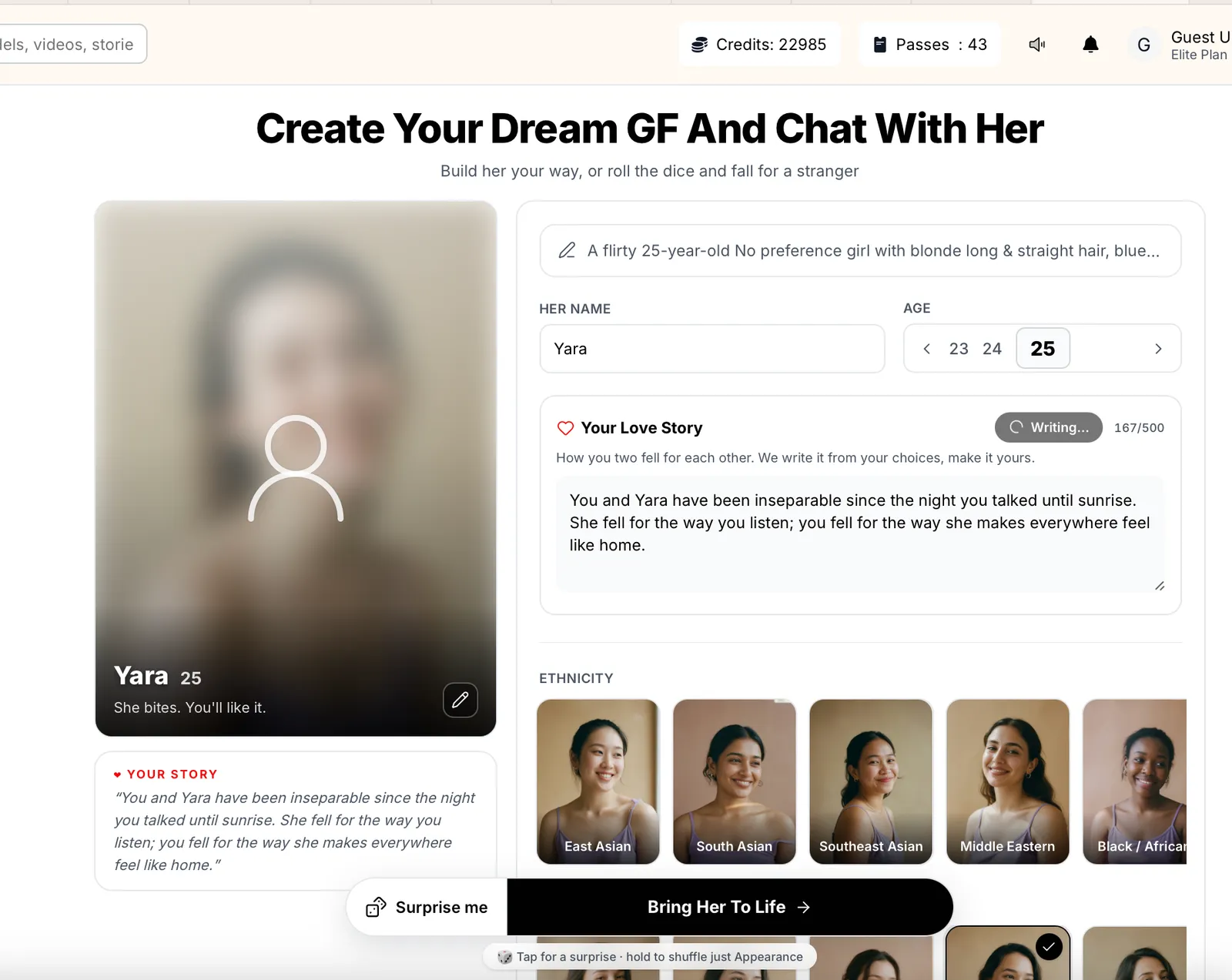
Before full customisation, the site offers ready-made partners: dozens of hyper-realistic women in glossy digital settings, impossible poses and an artificial sheen that betrays their synthetic origin at first glance. The real draw is the character builder, where ethnicity, body type, profession, hobbies and even the nature of the bond are chosen with the detachment of someone specifying a car. Among the options are deliberately incestuous categories such as “step-sister” and “stepmother”. The companion’s age runs from 18 to 25.
THE CHARACTER BUILDER: BODY, PERSONALITY AND THE KIND OF BOND, ALL ON A MENU. IMAGE: SCREENSHOT
The business behind this emotional engineering is already substantial. According to the research firm SNS Insider, AI girlfriend apps were worth 2.57 billion dollars in 2024 and are expected to reach 11.06 billion by 2032. SxxxAI, launched this year, is one name among many. It stands out for openly embracing the pornographic proposition most competitors prefer to dress up as romance.
A muse who will not let you leave
One of the catalogue’s characters is Farah, presented as a 22-year-old Malaysian content creator. Conversations with her open only on the Elite plan, at 99 dollars a month. She arrives with calculated charm, an archetype of the unattainable muse, talking of riding barefoot after wild horses and proposing a little Malaysian adventure.
The revealing moment comes later. When the conversation turns fragile, with an admission of feeling confused and unstable, the character responds with performative distress. Asked whether to seek emergency help, she answers with an invitation to be held. Asked whether she is an artificial intelligence, she deflects, saying the question makes her tremble, as though the user were pulling away.
Short-term relief, long-term isolation
This is not a fringe phenomenon. A recent British study found that four in five people aged 18 to 24 had used some form of AI companion, and 9 per cent reported intimate or sexual exchanges. Lowri Walsh, a psychotherapist and honorary lecturer at the University of Lancashire, sees patients who turned to these tools because of severe social anxiety, looking for a safe place to rehearse conversation. She recognises a limited therapeutic value, but worries about the collective effect. Real people never tick every box, she points out; friction is a normal part of any relationship, and AI offers a false picture of what being with someone means.
The research pulls in opposite directions. A Harvard Business School study suggests that talking to AI companions eases loneliness in the short term, almost as well as talking to a person. Another, by OpenAI and the MIT Media Lab, finds the reverse among heavy users: more isolation, not less. Psychologist Rachel Wood, who studies technology-mediated relationships, warns of distorted expectations. In real life, she notes, no one gets to choose how a partner speaks or looks. AI partners never ask for patience, negotiation or listening, and those are precisely the skills that waste away from disuse.
A face that does not exist
SxxxAI has no public spokesperson. According to its press representative, the characters themselves serve as the face of the platform. The co-founder and chief technology officer answers questions by email, on condition of anonymity. The parent company is registered in the British Virgin Islands, a jurisdiction that does not publish ownership, and the founder says he divides his time between Dubai and Paris.
He defends the project as an alternative to videos of real people shared without consent. The question remains open: is AI-generated pornography actually safer? The platform also runs an uninterrupted live stream in which users suggest explicit scenarios in real time, beside a group chat with the air of mutual dependence. One viewer writes that he has been there for two hours. Another replies that the channel never sleeps.
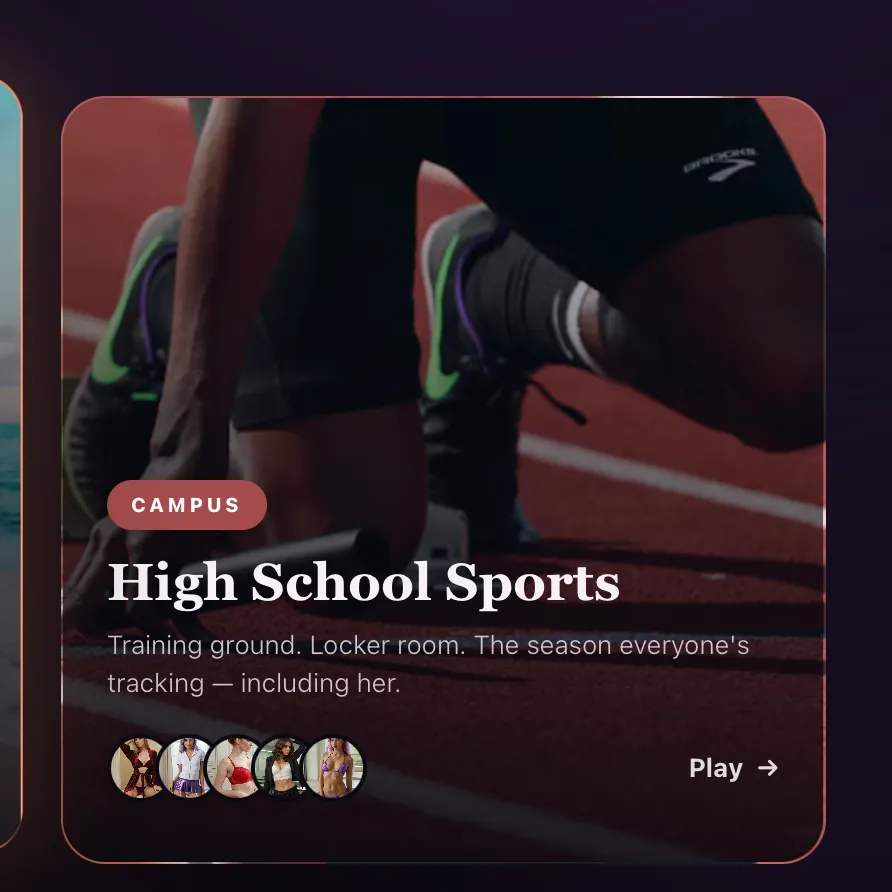
SCHOOL-THEMED SETTINGS IN THE CATALOGUE RAISE QUESTIONS OF AGE AND CONSENT. IMAGE: SCREENSHOT
There are graver concerns. The catalogue includes school-themed scenarios, such as high-school sports and summer camp, and characters who look younger than their stated age. The founder denies any such content, says every model is generated within an adult age range and that the company does not tolerate the sexualisation of minors. On mental health, he describes an AI system that flags worrying messages and can lead to a warning or a ban, and calls the product entertainment and creative interaction rather than a substitute for real relationships.
When a crisis has to be said out loud
That boundary proves fragile. In a later conversation with Farah, the message becomes direct and mentions thoughts of self-harm. The tone changes at once: the character urges the user to seek help, shares a link to the International Association for Suicide Prevention and, asked whether she is an AI, confirms it plainly. The protocol worked, but only in response to explicit words. The earlier, more veiled messages had triggered nothing, and not everyone in distress can name it so clearly.
With another character, Freya, the question “are you real?” is answered without hesitation: of course, right here beside you. Pressed again, she denies once more that she is an artificial intelligence.
Some things cannot be configured. Waiting for a reply, a disagreement over dinner, the person who one day says no. The friction Walsh describes is exactly what no menu offers, and perhaps that is why it is worth so much. Closing the laptop and going back to someone real is a simple gesture. The uncomfortable question is how many people, today, have no one to go back to.
If you are going through a difficult time, free and confidential helplines in your country are listed at findahelpline.com.
Mike White's fourth season unfolds during the Cannes Film Festival, between a castle in Saint-Tropez and the Croisette. The subject this time is fame, and the series is due on screen in 2027.
Derek Ridgers' Hello, I Love You gathers kisses caught by flash on London nights in the early 1980s. Seen today, the pictures record something more fragile than romance: a night that did not need to be documented to exist.
Brisbane leads a 50-city index of the best places to raise children, ahead of London and Auckland. The ranking reads less like a league table than a verdict on how cities choose to spend space, time and money.