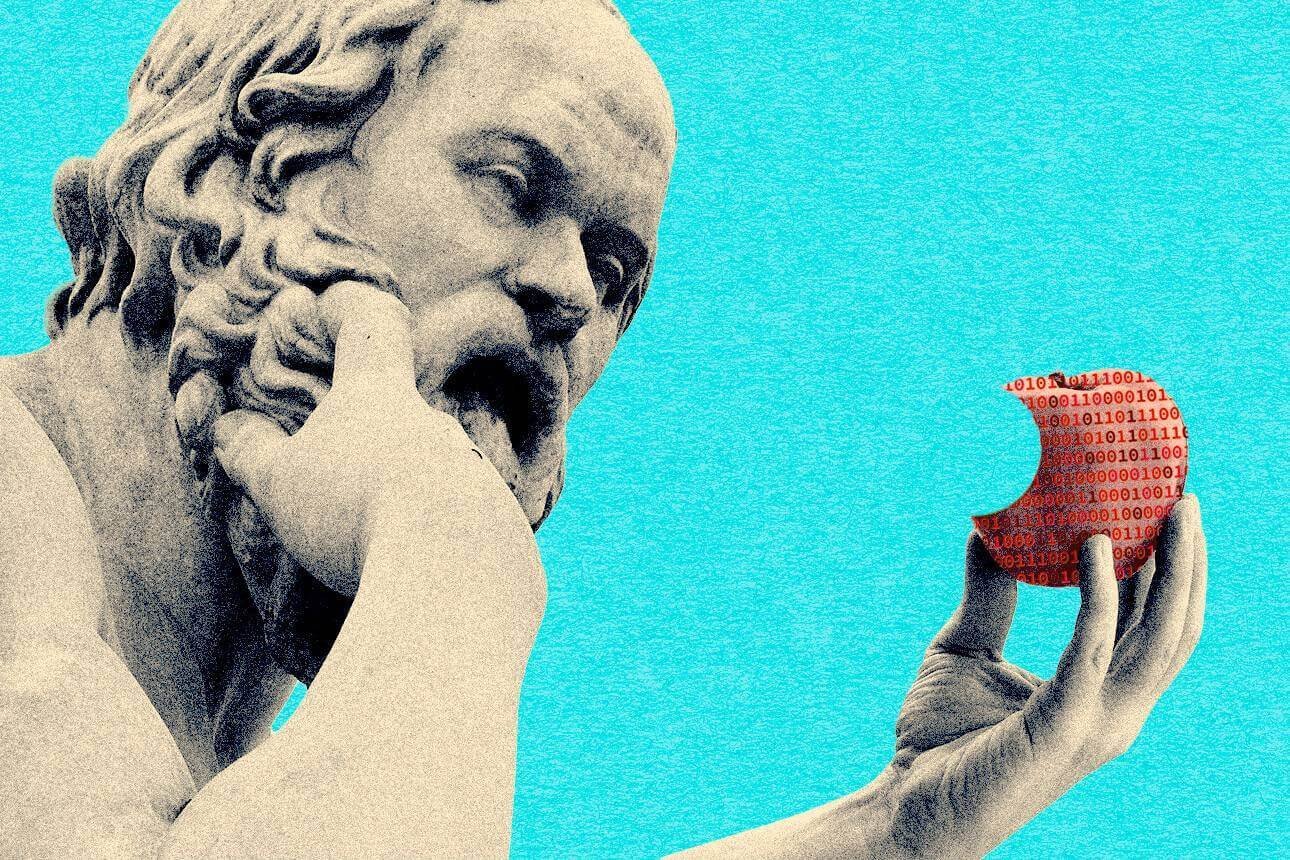
When artificial intelligence needs thinkers: philosophers in the labs
A decade ago, humanities students were told to learn to code. Now the laboratories building artificial intelligence are hiring philosophers to help decide how their systems should think and behave.
The most advanced machines of the century have discovered that they need the oldest discipline. A decade ago, students of the arts and humanities were given blunt and questionable advice: learn to code, or become unemployable. The logic has since turned over. Now it is the programmers who watch, with some unease, the progress of the technology they helped to build, and a different kind of mind is finding a seat in the laboratories: the philosopher.
OLD QUESTIONS, NEW MACHINES. IMAGE: PRESS
The return of critical thought
The large AI laboratories have rediscovered what universities always knew: complex problems call for minds trained in abstraction, logic and rigorous argument. Philosophers spend whole careers taking apart dilemmas that have no simple answer, which is precisely the kind of challenge contemporary AI meets every day.
Algorithmic bias, the responsibility of autonomous systems, the privacy of data, the limits of the very idea of intelligence: none of these is a purely technical problem. They are philosophical questions first, and they demand structured, historical, nuanced thinking to be taken seriously.
Names on the door
The movement is concrete. Anthropic has Amanda Askell, a philosopher with a doctorate from New York University, who works on the character and values of its Claude models. Google DeepMind employs Iason Gabriel, who taught moral and political philosophy at Oxford before becoming a research scientist on the ethics of AI. Each of the two laboratories is reported to employ at least half a dozen philosophers, on questions that range from alignment to whether machines might one day have interests of their own.
The labour market has noticed. Data from the Federal Reserve Bank of New York has shown recent philosophy graduates facing lower unemployment than recent computer science graduates, a reversal few would have predicted ten years ago. The plain degree remains hard to turn into a salary. The trained mind, it seems, is not.
ANCIENT THOUGHT TAKES A BITE OF THE MODERN. IMAGE: PRESS
Beyond the algorithm
Contemporary AI is not only an engineering challenge. It raises questions of fairness, transparency, autonomy and unintended consequence. A philosopher trained in ethics can map risks that escape a purely technical eye; a specialist in epistemology questions the assumptions behind what it means for a machine to learn.
They bring a conceptual repertoire that goes well beyond programming: a grasp of the history of ideas and of how arguments evolve. No coding bootcamp reproduces it.
A late recognition
There is irony in the fact that artificial intelligence, the emblem of technical modernity, has rediscovered the use of ancient thought. Plato, Aristotle and Descartes wrote no code, yet their questions about reality, knowledge, causality and moral responsibility have rarely been more pertinent, now that machines make decisions that touch human lives.
The shift also reflects corporate priorities. Regulation is tightening, public scrutiny is sharper, and investors want transparency. In that climate, a philosopher in the room where decisions are made is no longer an intellectual ornament. It is risk management.
Hiring philosophers is not a curiosity of the jobs market. It is a sign that the technology has matured enough to recognise its own limits, and that navigating them takes more than fast processors and vast datasets. It takes the oldest tool of all, the one the humanities students were told to put down: thought.
Mike White's fourth season unfolds during the Cannes Film Festival, between a castle in Saint-Tropez and the Croisette. The subject this time is fame, and the series is due on screen in 2027.
Derek Ridgers' Hello, I Love You gathers kisses caught by flash on London nights in the early 1980s. Seen today, the pictures record something more fragile than romance: a night that did not need to be documented to exist.
Brisbane leads a 50-city index of the best places to raise children, ahead of London and Auckland. The ranking reads less like a league table than a verdict on how cities choose to spend space, time and money.