A shared hotel name does not make three addresses equivalent. In Gordes and Saint-Tropez, Airelles brings together a hillside property, a large garden estate and a compact town house. Their differences are the useful starting point for a stay in the south of France.
The decision is not simply between Provence and the Riviera. It is also between a view over a valley, time spent within extensive grounds, and a room from which the town’s streets remain close at hand.
La Bastide: the Luberon through the interior
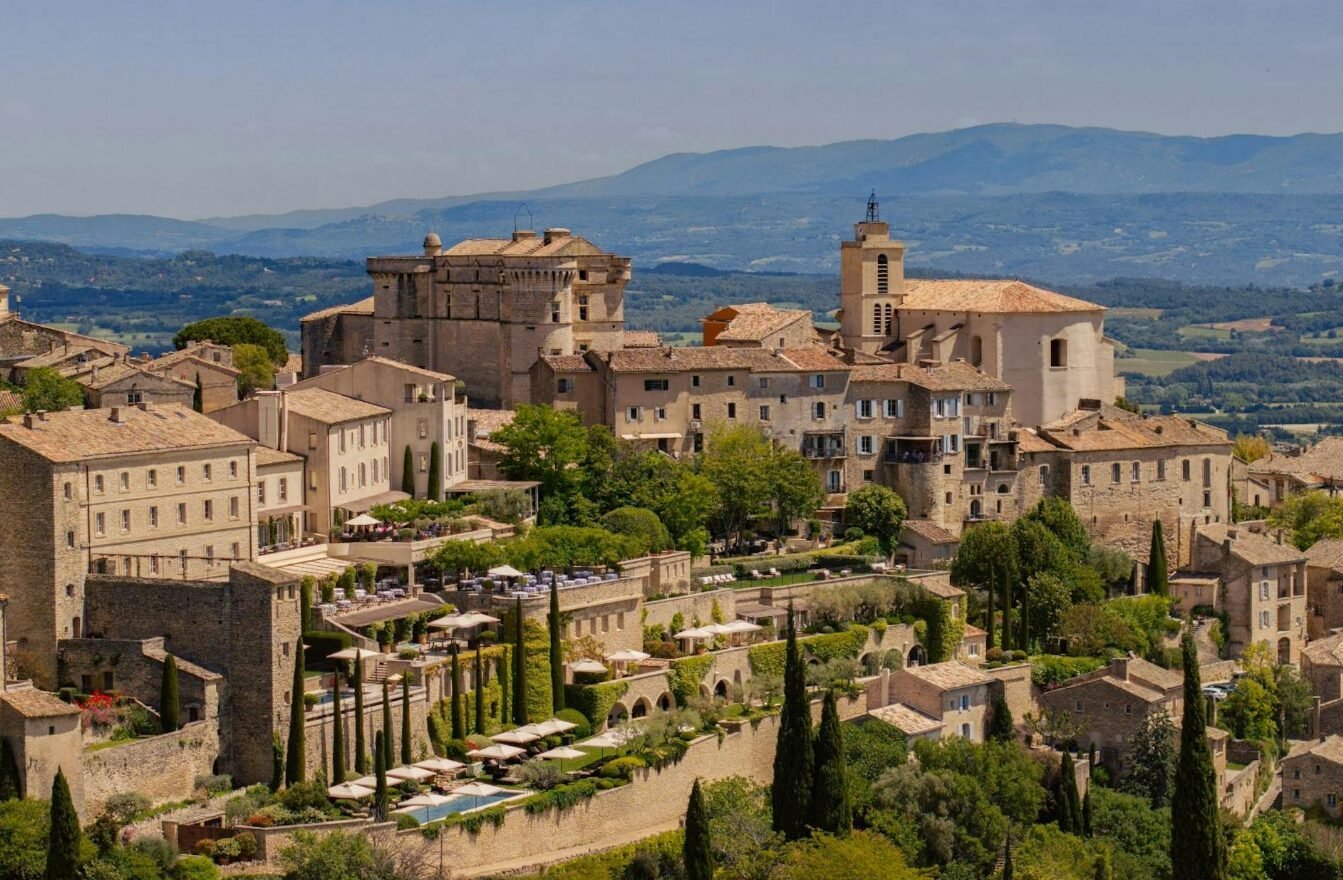
At Gordes, La Bastide’s terraces and gardens follow the hillside above the valley. Its street façade gives little indication of the spaces beyond it. The property’s relationship with the village and the landscape supplies the framework for the interiors.
Christophe Tollemer’s design brings together European antiques, period artworks, carved wood and Pierre Frey textiles. La Bastide opened as an Airelles property in 2015. The intervention interprets a Provençal house through specific objects and craft, rather than applying a neutral hotel interior to a historic shell.
The property description lists 34 rooms and six suites, with outlooks towards the village or the valley. Village-facing and valley-facing rooms keep the setting present in different ways.
Food introduces another choice within the address. La Table de La Bastide is described by the property under Pierre Marty, with a Mediterranean and Provençal direction. Its repertoire follows the season.
La Messardière: an estate above the coast
Château de La Messardière operates at another scale. Its 13-hectare park, planted with umbrella pines and cypress trees, sits above Saint-Tropez with Pampelonne Bay in the distance. The grounds are a central part of the address, not merely landscaping between buildings.
The hotel lists 86 rooms and suites with pool, garden or sea outlooks. For a visitor, the distinction between an estate stay and a town-centre hotel matters as much as the room category. Plan movements between the grounds, Saint-Tropez and the beach rather than assuming they are the same location.
Pan Deï Palais: the town-house alternative
Pan Deï Palais offers twelve rooms and suites within Saint-Tropez. The smaller scale changes the experience before any discussion of furnishings. It puts the town’s streets, rather than a large private park, at the centre of the stay.
The house dates to 1835. Airelles connects its origins to General Jean-François Allard and Bannu Pan Deï, whose history links Saint-Tropez with India. Indian rugs, period furniture and dark wood panelling form part of the property’s interior description.
Those references have a biographical context; they are not simply a generic decorative theme. Outside, olive trees and a mosaic pool return the house to its Mediterranean setting. The combination is more specific than an interchangeable Riviera room.
Three scales of hospitality
The contrast becomes clearest at the threshold. Gordes brings the village façade into contact with terraces over the Luberon. La Messardière opens into a park, while Pan Deï brings the visitor back to a house within Saint-Tropez. Landscape, grounds and streets organise three different daily rhythms.
The houses’ interiors reinforce that distinction. Tollemer’s textiles and antiques give La Bastide a layered domestic language; Pan Deï’s Indian references follow the history of Allard and Bannu Pan Deï. A shared collection does not erase the biography of an individual address.
La Bastide makes the valley part of the daily view. La Messardière gives the grounds a larger role. Pan Deï keeps the scale closer to a house within the town. None is a substitute for the other.
Match the address to the day
At La Bastide, the choice between a village-facing and a valley-facing room changes the daily view without changing the location in Gordes. At La Messardière, the estate’s grounds become part of the stay, while journeys to the town and beach remain separate movements. At Pan Deï, the smaller house places Saint-Tropez’s streets closer to the everyday sequence.
Those differences suggest a more useful comparison than a single hierarchy of room counts. Consider where breakfast, an afternoon outdoors and an evening walk will take place, then assess the room within that pattern. The design histories remain important, but they do not replace geography. A layered Provençal interior, an extensive park and a house with Indian references describe three distinct relationships with place, even when the properties share a collection name.
La Bastide, Gordes · Château de La Messardière · Pan Deï Palais.
La Bastide, Gordes · @airellesgordes