Fairmont Austin: finding smaller places within a large hotel
A rooftop, a live-fire kitchen and a separate service floor give the downtown property different scales. The choice is less about the size of the building than how its spaces fit a stay.
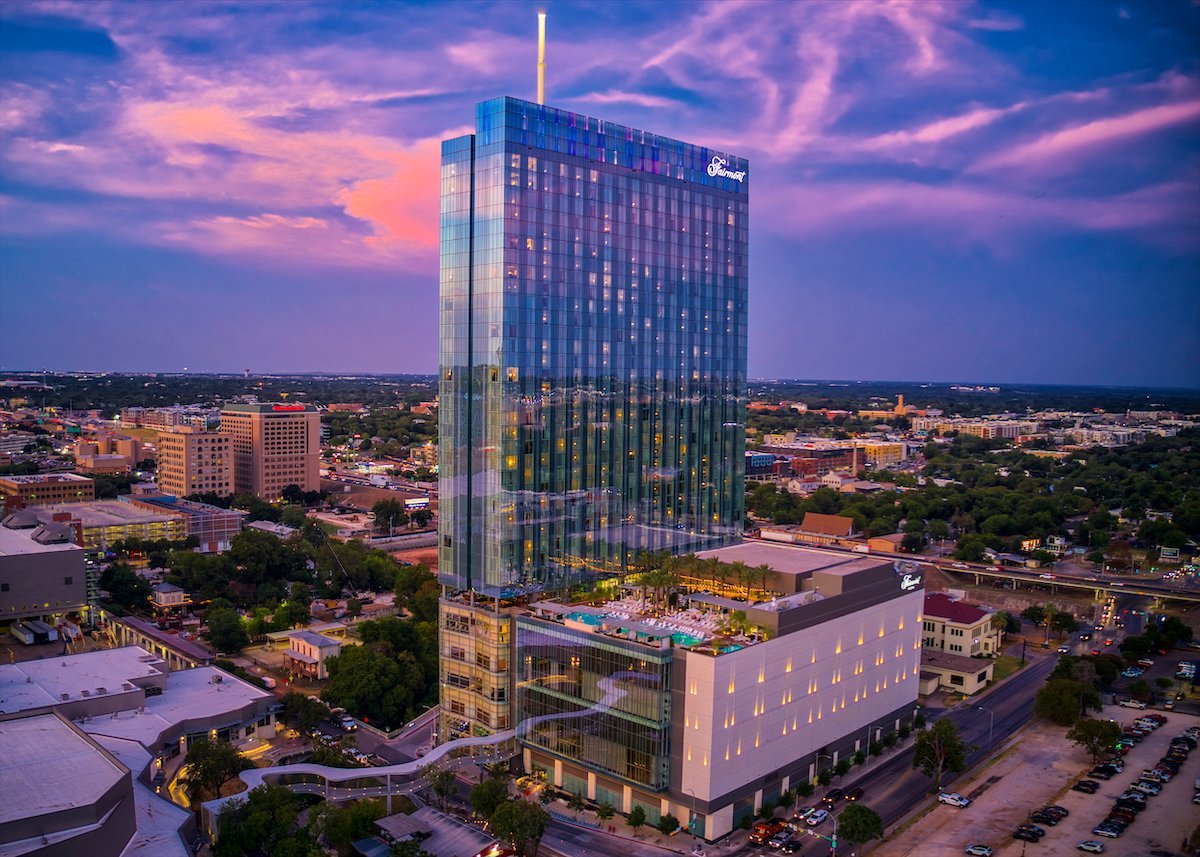
A hotel with 1,048 rooms has to work at more than one scale. At Fairmont Austin, the useful distinctions are between spaces within the building: a restaurant organised around fire, an outdoor pool terrace and a separate set of rooms and services above the main public floors.
The downtown property stands at 101 Red River Street, near Waller Creek and Palm Park. Its relationship with Austin begins outside the lobby, but the hotel’s internal organisation determines how a guest moves between a working day, a meal and time outdoors.
Garrison: fire provides the kitchen’s structure
Garrison describes its cooking through local ingredients, wider culinary references and live fire. The published menu discussed here includes embered Texas corn, dry-aged duck and an oak-grilled porterhouse steak. These are different ingredients brought into relation by a method of cooking.
The menu also lists tuna tartare with nori, caviar and umeboshi, and duck toast with truffle aïoli and horseradish vinaigrette. The combinations give a more precise account of the kitchen than an unsupported promise of an exceptional meal.
A menu records an offer, not an independent tasting. Seasonal changes and a particular evening’s service should be confirmed directly. The editorial interest is the contrast between a familiar steakhouse vocabulary and ingredients that introduce other registers of acidity, texture and seasoning.
The rooftop has its own conditions
The pool terrace offers an outdoor interval within the downtown setting. Its cabanas are separately reservable and have different capacities, from smaller arrangements for two to seven guests to a Grand Cabana for up to ten.
The hotel’s published offer includes day passes for non-resident guests subject to availability. Pool access, a cabana reservation and food-and-drink spending are distinct parts of the visit. They should not be treated as one automatic entitlement attached to arriving at the building.
That distinction becomes important when the stay includes a group. A room reservation answers where to sleep; it does not by itself settle which outdoor space will accommodate everybody during the day.
Fairmont Gold changes the service model
The hotel locates its Fairmont Gold rooms and suites on floors 33 to 35, with a separate check-in setting and a lounge on the thirty-fifth floor. Published provisions include a dedicated concierge, breakfast, evening canapés and an honour bar.
These features create another pattern of use within the larger hotel. A guest may begin the day in the lounge and return before dinner without relying on the main lobby for every pause. The attraction is a defined service arrangement, not a claim that an upper floor guarantees a better stay for everyone.
Confirm the room category, lounge eligibility and what is included in the rate before booking. A loyalty benefit and a Gold-room reservation are not necessarily the same arrangement.
Choose the scale that suits the day
Fairmont Austin’s size is a fact to plan around rather than disguise. Its kitchen, terrace and service floors provide smaller units within that scale. The most coherent stay begins by choosing which of those units is useful, then leaving room for the city beyond them.
A large hotel as a sequence of smaller decisions
The restaurant, terrace and Gold floors do not reduce the hotel’s room count. They offer different ways of structuring time within it. A meal organised around the kitchen’s cooking, a reserved outdoor space and a lounge used between appointments each establish another unit of the day.
The surrounding city remains the other half of that sequence. Waller Creek, Palm Park and the Red River address give the building a downtown context that cannot be replaced by an upper-floor view. The useful planning question is how much of a particular day should happen inside the hotel and how much should lead beyond it. Fairmont Austin makes most sense when its internal variety supports that choice, rather than when every facility is treated as something that must be used.
Fairmont Austin · 101 Red River Street, Austin, Texas, United States.
Four Seasons, Aman, Maybourne, Belmond and Mandarin Oriental now sell the journey as part of the stay, from helicopter transfers into London to 23-day circumnavigations at $238,000 a head. Who flies, why, and what is really being bought.
Airlifted by helicopter to the summits, monumental bronzes by Coderch & Malavia turn Courchevel's slopes into an open-air gallery, with Arman back in 1850.
Opened in May 1967 with Brigitte Bardot among the guests, the Byblos hosted Mick and Bianca Jagger's wedding party, a Helmut Newton shoot and six decades of nights at Les Caves du Roy. It turns sixty in 2027, still in the same family's hands.
In Tribeca, individual rooms, Japanese references and a guest-only courtyard give a downtown hotel its own material language. The identity is in the differences.
Monaco in November, Sicily in December, Mallorca in January, Crete before Lent: the winter Mediterranean, without the queues and under a different light.