TRAVEL
The Drake Passage is often the first image that comes to mind when a journey to Antarctica is discussed. The crossing between the southern tip of South America and the Antarctic region can take around two days by ship, with conditions ranging from relatively calm water to a much more demanding sea. It is part of the journey, but it should not become its only subject.
An expedition is also defined by the people explaining the landscape, the ship’s capabilities and the conditions under which visitors can leave it. Those choices begin before departure. They determine whether the traveller encounters Antarctica as a sequence of views or understands something about the environments and communities of knowledge behind them.
A different polar audience
Ricardo Alves, whose work with Velle connects him with expedition operators including Scenic, described a change in the way travellers approach remote destinations. Polar journeys are no longer considered only by experienced adventurers. They also attract people seeking nature, knowledge and a high standard of accommodation within the same trip.
That change does not remove the expedition’s character. Weather and ice still affect operations, and the day cannot be planned as if every landing were a reserved attraction in a city. The role of the hospitality is to support the journey, not to suggest that the destination has become predictable.
Alves’s central distinction brings three elements together: safety, knowledge and environmental respect. Naturalists, biologists, glaciologists and historians give a landing or a lecture an educational purpose. The time between excursions can be as useful as the excursion itself when a specialist helps explain what has just been seen.
The Drake is a crossing, not a promise
The expressions Drake Lake and Drake Shake describe very different experiences of the same passage. They are informal names, not conditions an operator can guarantee. The water’s exposure to Southern Ocean systems makes the crossing an important practical consideration when selecting a voyage.
Some itineraries use a flight from Punta Arenas to King George Island to avoid a full sea crossing. That changes the experience but introduces another dependency: the weather must allow the aircraft to operate. A flight-based option is not a way to remove every uncertainty from a polar journey.
For a ship departure through Ushuaia, the journey may include connections through Buenos Aires and pre- or post-voyage accommodation. Those elements deserve attention alongside the Antarctic route. The traveller needs to understand which flights, transfers and hotel nights are included and which remain separate arrangements.
Landing rules are part of the experience
IAATO’s guidance makes clear that visiting is governed by more than the vessel’s itinerary. Its operating framework limits the number of visitors ashore at a site and requires appropriate supervision. Ships carrying more than five hundred passengers do not conduct landings under that framework; a vessel carrying fewer people still has to organise groups within the applicable shore limits.
The often-cited maximum of one hundred visitors ashore is not permission to approach every animal or enter every area. Species-specific distances, site conditions and instructions from the expedition team continue to apply. The minimum ratio of one guide to twenty visitors is another part of the organisation, not a substitute for responsible behaviour.
Biosecurity gives that responsibility a practical form. Boots, pockets, Velcro and equipment are checked so that seeds and other material are not carried between environments. Guidance connected with avian influenza can prohibit sitting or kneeling and placing bags on the ground. Rules may change with conditions, and the current briefing takes precedence over a general description written before the voyage.
Nothing should be taken as a souvenir from the landing site. The point is not simply to leave an attractive view unchanged, but to avoid introducing material or disturbing systems whose vulnerability may not be immediately visible.
Places that give the route its character
Port Lockroy connects the landscape with a history of human presence and a working heritage programme. Its post office has become a recognisable part of Antarctic journeys, but the site is more than an opportunity to send a postcard. Access depends on the operating programme and conditions.
Deception Island introduces a volcanic setting, with a caldera entered through Neptune’s Bellows. Its history and geology make the place distinctive; references to geothermal water should not be read as a general invitation to bathe without the expedition team’s approval.
The Lemaire Channel offers another scale, with steep landforms framing a narrow route through the water. Whether a ship can pass depends on the ice and the day’s conditions. A place named on a route is not a guarantee that it will be accessible.
Gentoo, Adélie and chinstrap penguins provide opportunities to understand different species rather than simply collect photographs of a colony. Crossing the Antarctic Circle supplies a geographical milestone, but the character of a journey is not determined by that line alone.
Brazil’s Comandante Ferraz station on King George Island adds a scientific connection. Rebuilt after the 2012 fire and reopened in 2020, it belongs to the research history of the region, not to an assumption that expedition passengers can visit an operating station whenever they wish. The humpback whales encountered in the Southern Ocean also connect these waters with migration routes extending towards Brazil.
Scenic Eclipse as one expedition model
Scenic Eclipse, introduced in 2019, provides a particular example of how accommodation and expedition operations can be combined. The 168-metre vessel has 114 balcony suites and uses a lower passenger capacity for Antarctic operations than its general maximum.
Polar Class 6 construction, stabilisation and dynamic positioning contribute to the way the ship operates. Dynamic positioning can reduce the need to anchor in some circumstances, but no single technical feature makes a voyage environmentally impact-free or removes the expedition team’s responsibility for decisions.
The accommodation and multiple dining venues give passengers different settings between excursions. Their function is not to replace the landscape outside. They support longer days, briefings and the ability to return from an outing without abandoning the standards of a well-run hotel stay.
Smaller craft and optional experiences
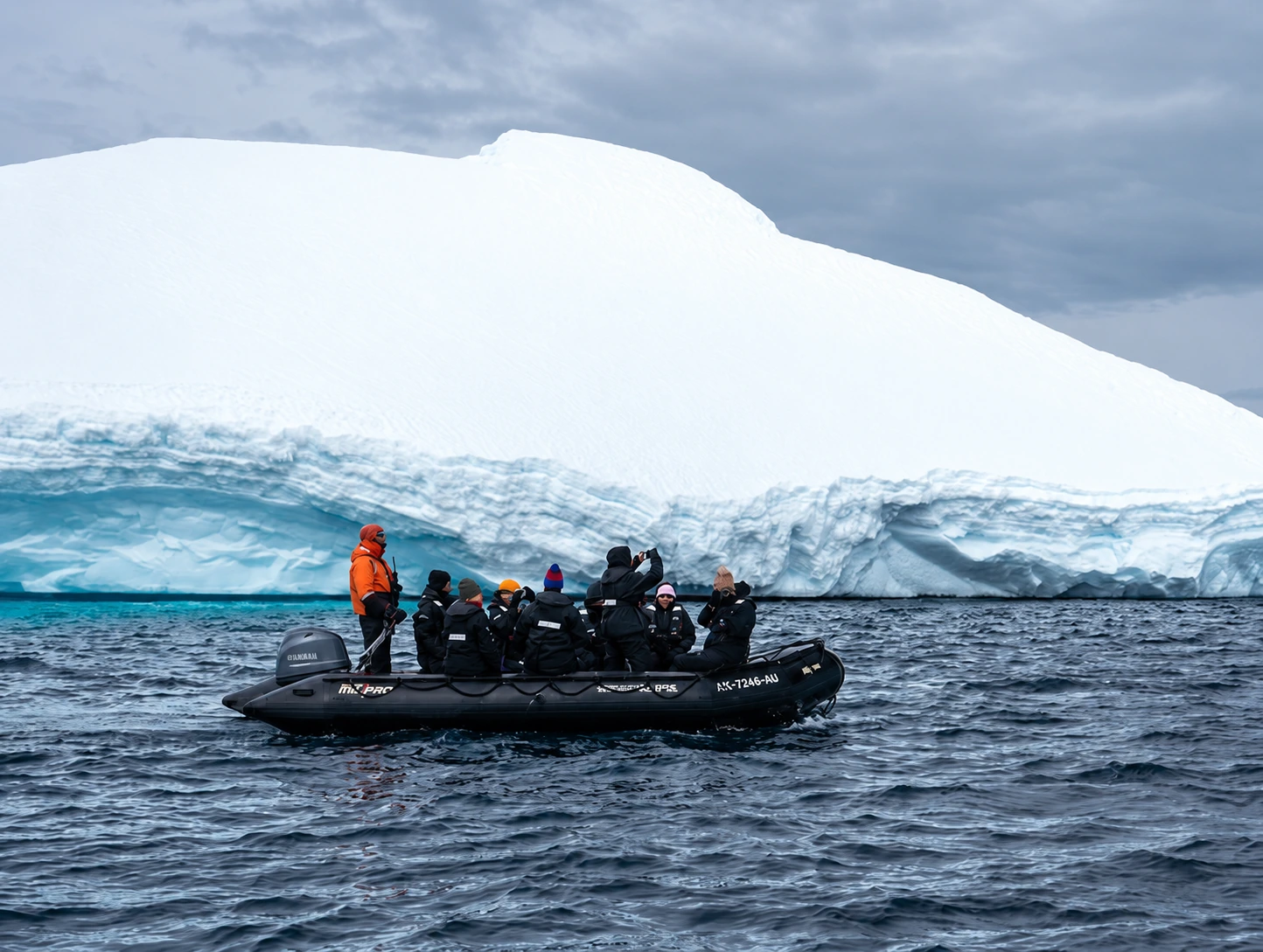
Zodiacs connect the vessel with landings and closer observation from the water. Kayaking and stand-up paddleboarding introduce another pace where conditions and the operator’s arrangements permit them. Each activity remains subject to an operational decision, not simply a guest’s preference.
The ship’s helicopters and submersible offer additional perspectives, with availability, extra charges, weather and applicable permissions affecting their use. Equipment also differs between vessels. Scenic Eclipse and Scenic Eclipse II should not be treated as identical inventories with every option automatically included on every sailing.
The wider programme extends beyond one Antarctic route. Patagonia, South Georgia and combinations involving other South American destinations create different balances of time at sea, wildlife, landings and travel before or after the expedition. A future vessel programme, including Scenic Ikon, belongs to that longer-term development and should not be described as an already completed stay.
Choosing beyond the map and the price
Alves identifies a common mistake in comparing voyages: concentrating on the itinerary and headline price without examining the expedition structure. Two routes with similar place names may have different specialists, landing opportunities, group sizes and arrangements ashore.
It is worth comparing the number and background of the expedition team, the approach to lectures and scientific interpretation, the vessel’s passenger capacity and the activities actually included. Food, drinks, transfers, flights and hotel nights also need to be read as individual terms rather than inferred from the appearance of a suite.
Preparation includes the operator’s medical and equipment requirements and suitable arrangements for the remoteness of the journey. These are matters to confirm with the provider and the relevant professionals, not details resolved by a general packing paragraph in an article.
The Antarctic season broadly runs from November to March, but different periods offer different light, wildlife activity and ice conditions. The question is therefore not only when a ship departs. It is what the traveller hopes to understand and how the selected voyage supports that purpose.
A well-chosen expedition does not make Antarctica less remote. It gives the traveller better conditions for encountering that remoteness: a capable ship, informed guides, realistic expectations and a clear understanding of the rules ashore. The Drake remains the Drake. The difference is the preparation and perspective brought to the other side.
Further information: Antarctic visitor guidelines · operating bylaws · preparation resources · guidelines library.
Instagram: IAATO.
Reporting: WAYFARER editorial; interview contribution: Ricardo Alves, Velle
Cover: A Zodiac excursion at Pleneau Bay, Antarctica. Image courtesy of Scenic Group.