Armani Hotel Dubai: a restrained room inside a monumental tower
At Burj Khalifa, Giorgio Armani’s interior vocabulary supplies a counterpoint to the scale of Downtown Dubai. Room layouts and distinct dining spaces make that contrast practical.
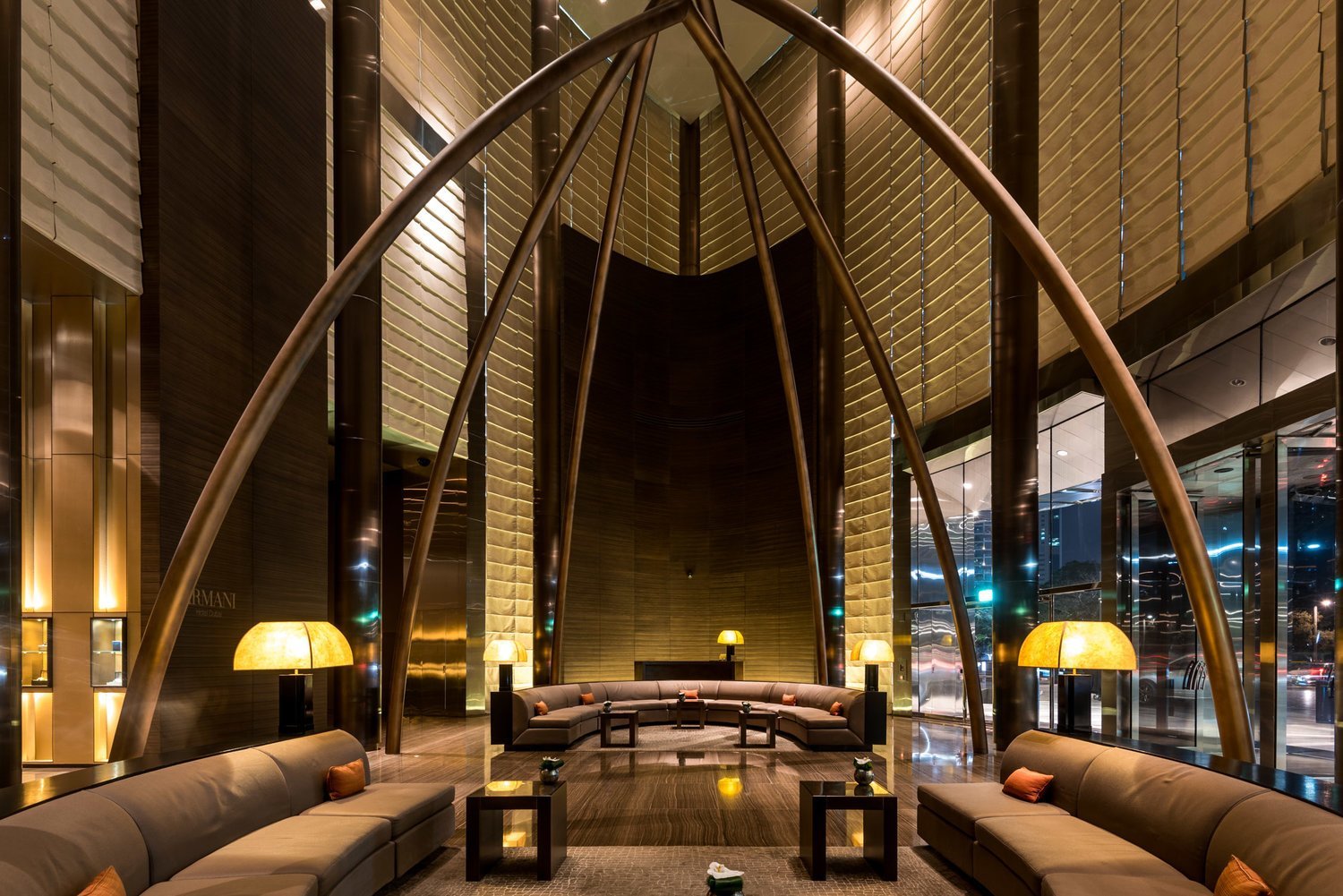
The scale of Burj Khalifa and the restraint of an Armani interior offer different kinds of presence. Armani Hotel Dubai places them together, using a recognisable design vocabulary inside a tower whose outline already dominates its setting.
The interiors described in February 2025 used soft lighting, contemporary furniture and a controlled material palette. Curved windows brought the city into the room without requiring equally emphatic decoration. The interest lies in that contrast, not in matching the tower’s height with gestures inside.
Fashion translated into a room
A fashion house can enter hospitality through recognisable objects, but the more demanding task is coherence. Lighting, furniture and circulation have to work together over the length of a stay. An interior cannot rely only on the immediate recognition of a name.
Armani’s approach uses restraint to separate the room from the urban setting around it. The window provides the larger scene; the furnishings establish another scale, one related to a person sitting, working or moving through the space.
The hotel lists 160 rooms and suites. That shared design direction does not make them interchangeable. A traveller choosing between categories should look beyond the general atmosphere to the floor plan, the outlook and whether the room has a separate place to sit.
The specification matters
The Deluxe category is listed at 45 square metres with a king-size bed, a workstation and separate shower and bathtub. The hotel also states that rollaway beds are unavailable in this category. That detail is useful for families: a stated occupancy allowance should not be read as a promise of an extra bed.
Several dining directions, not one menu
Italian cooking at Armani/Ristorante and Indian cooking at Armani/Amal form part of the hotel’s current published dining offer. Hashi’s Japanese direction also belongs to the hotel’s dining history. They should be considered as distinct restaurant choices rather than evidence of a single, universal hotel menu.
For more informal Italian food, Armani/Deli presents itself as a market-style space with bread, charcuterie, cheeses and changing dishes. However, its own page marked it temporarily closed when checked in October 2026. Do not build a dining plan around an older description without confirming reopening.
Downtown as the wider setting
A window does the expansive work
The curved glazing described in the February 2025 account gives the room a different geometry from a conventional flat window. The city enters through an arc, while the furniture remains comparatively restrained. The contrast makes the tower’s scale perceptible without repeating its monumental outline indoors.
Armani bath products extend the house vocabulary into smaller daily objects. Such details work differently from the skyline: one is encountered close at hand, the other across a broad distance. The interior’s coherence depends on allowing both scales to remain distinct.
The address works at two scales: a relatively restrained interior and a district built around large architectural gestures. Its design offers a counterpoint to that setting. The room does not need to imitate the monument to remain legible within it.
Armani Hotel Dubai · Burj Khalifa, Downtown Dubai, United Arab Emirates.
Four Seasons, Aman, Maybourne, Belmond and Mandarin Oriental now sell the journey as part of the stay, from helicopter transfers into London to 23-day circumnavigations at $238,000 a head. Who flies, why, and what is really being bought.
Airlifted by helicopter to the summits, monumental bronzes by Coderch & Malavia turn Courchevel's slopes into an open-air gallery, with Arman back in 1850.
A USD 350,000 contribution or a USD 800,000 bond: Argentina's new programme brings citizenship by investment to South America, and with it a passport that opens 169 destinations without a visa.
René Lalique’s 1920 house connects six individual suites with a restaurant and the nearby museum. Luiza Rodas’s visit follows a material through several settings.