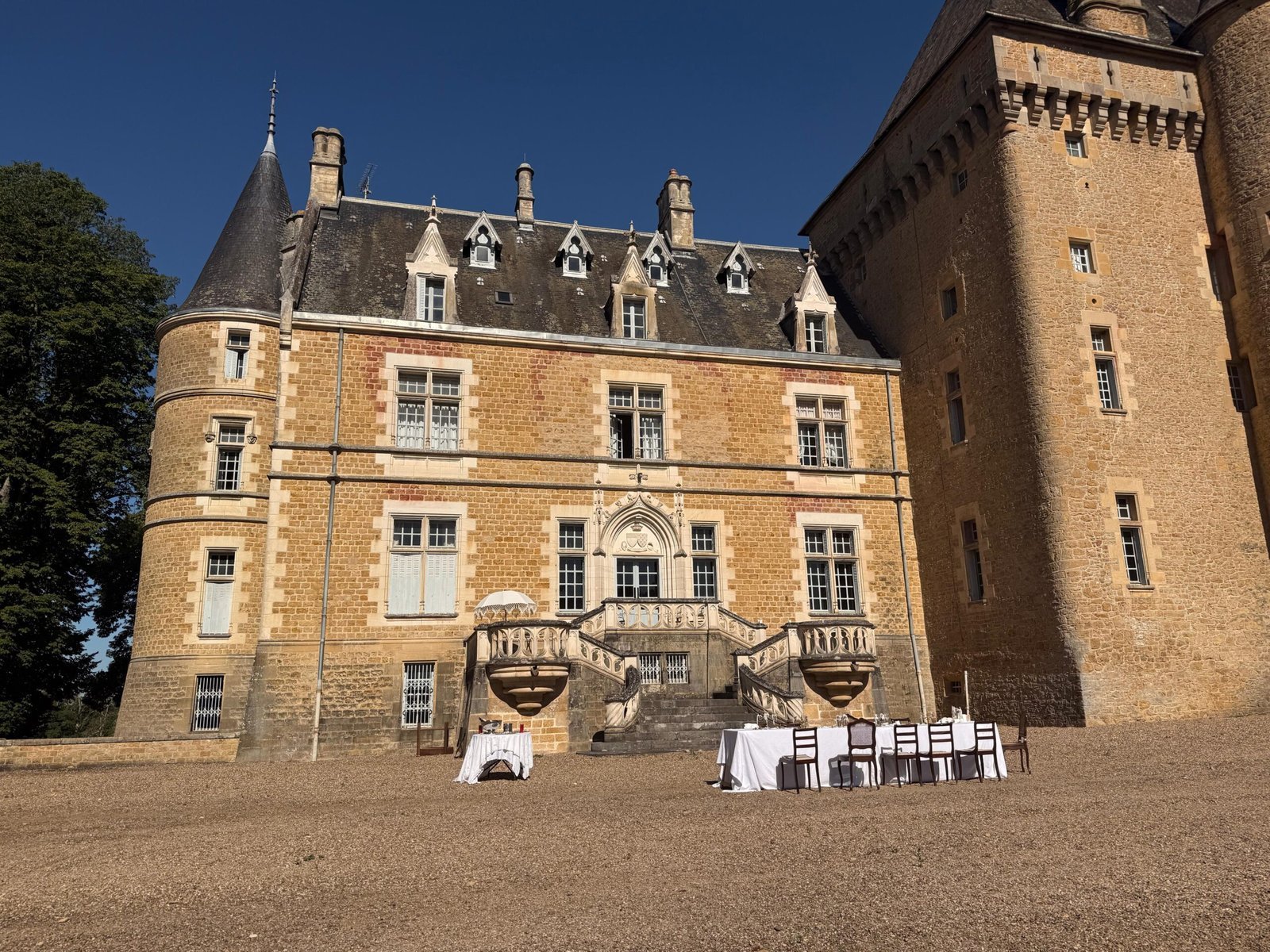
Château du Tremblay: a lived account of a private Burgundy house
Luiza Rodas’s stay placed the hosts, shared meals and surrounding landscape at the centre of the house. It is a personal record, not a permanent programme or a conventional hotel listing.
A private house reveals its character through the people who inhabit it. At Château du Tremblay in Burgundy, Luiza Rodas’s account follows Lua and Louis, the hosts, through rooms, meals and time outdoors. The setting matters, but it is their way of using it that gives the visit its particular rhythm.
Reported by Luiza Rodas.
The estate belongs to the countryside associated with the Morvan and Canal du Nivernais. The shift from Paris to this landscape introduces another pace, with the final route and transfer depending on the arrangements made for a visit. Rodas’s account is of a hosted stay in a private property, not of a conventional hotel with a standard catalogue of inclusions.
Rooms that have a purpose beyond sleeping
Two wings, several floors, bedrooms, living rooms and a library gave the house a sequence of different occupations. The distinction is important in a building of this scale: a bedroom provides an individual retreat, while the shared rooms allow the visit to extend beyond it.
The library introduces a reason to remain indoors that is different from gathering at the table. Living rooms offer another form of company; the grounds take that occupation outside. These spaces are meaningful as parts of a stay, rather than as facilities to count. Their relationship gives the house a domestic structure.
Lua and Louis set the pace
Lua, a Danish host with an artistic practice, and Louis, whose family connection to the property informed the account, were central to Rodas’s visit. Their attention to the shared rooms and the table connected the size of the estate with the more immediate scale of receiving a guest.
That is the distinction between a private house and a setting encountered only through its architecture. The hosts decide how rooms are opened, how people gather and when the day moves from one space to another. In this account, the building did not have to be reduced to a hotel format to become hospitable.
The table and the fields
Rodas recalled meals prepared with local ingredients and dinners by candlelight. The table connected the interior to the surrounding landscape through the work of preparing and sharing food. It was part of the hosted stay, rather than an account of an ordinary restaurant service.
Walks through the fields and evenings outdoors extended that sequence. The grounds were not simply a view from the window: they gave the visit another way of occupying time. Moving between the library, dining table and countryside made the setting part of the day rather than a backdrop to it.
Fluffy, Rodas’s dog, accompanied her and was welcomed during the visit. It is a personal detail that should remain attached to that particular stay, not be turned into a general policy for every future booking.
A setting for gathering
Creative retreats and small ceremonies were discussed as possible uses of the estate. The library, shared rooms and grounds suggest different scales of gathering, but the arrangements and availability require direct confirmation with the hosts.
The building’s history also deserves that precision. An early origin does not establish that every present room survives unchanged from the fifteenth century. Historic houses acquire alterations, extensions and new ways of being occupied. The account does not need to settle the age of every wall to convey the visit’s character.
What distinguishes Château du Tremblay here is the relationship between house, hosts and landscape. Rodas’s observations give that relationship a lived scale: a room used for reading, a table prepared for dinner, and the countryside reached by stepping outside.
From St Andrews and Royal County Down to Cabot Saint Lucia, Hirono and Tara Iti, eleven courses that justify the journey, with how to get a tee time and where to sleep afterwards.
From the Hôtel de Paris in Monte-Carlo to Raffles in Singapore and a Mandarin Oriental in Bangkok marking 150 years, the grand hotels that have stayed relevant for more than a hundred years without surrendering their identity.