Three New York hotels, three rooms worth looking at closely
The Waldorf Astoria ballroom, Lotte New York Palace’s Gold Room and the St. Regis’s King Cole Bar offer different entrances into the city’s hotel history.
A hotel’s public rooms can explain its place in a city more clearly than a bedroom photograph. In New York, the Waldorf Astoria, Lotte New York Palace and the St. Regis offer three such settings, each with a different relationship between architecture, hospitality and social life.
The useful itinerary is not a ranking. It is a way of looking closely at a ballroom, a gilded room and a bar, while remembering that public access and a private event can change what is available on a particular day.
Waldorf Astoria: the ballroom and the clock
The Waldorf Astoria reopened in 2025 after a substantial restoration. Its 1931 Park Avenue building gives the Grand Ballroom a setting unlike an interchangeable event hall: a multi-level room whose balconies and scale recall the theatrical organisation of an opera house.
The room’s history includes ceremonies and society gatherings, with the earliest Tony Awards among its associations. A more recent tennis event connected that ceremonial space with the US Open season, showing that a historic ballroom can accommodate an unexpected use without losing its architectural identity.
Elsewhere, Peacock Alley brings attention to the monumental clock associated with the 1893 Chicago World’s Fair and to Cole Porter’s piano. The hotel’s present public rooms carry objects and stories from more than one chapter of the Waldorf’s history.
The Rob Roy belongs to that longer lineage. Its association with the original Waldorf predates the Park Avenue building, so it should not be used to imply that every historical story began in the current room.
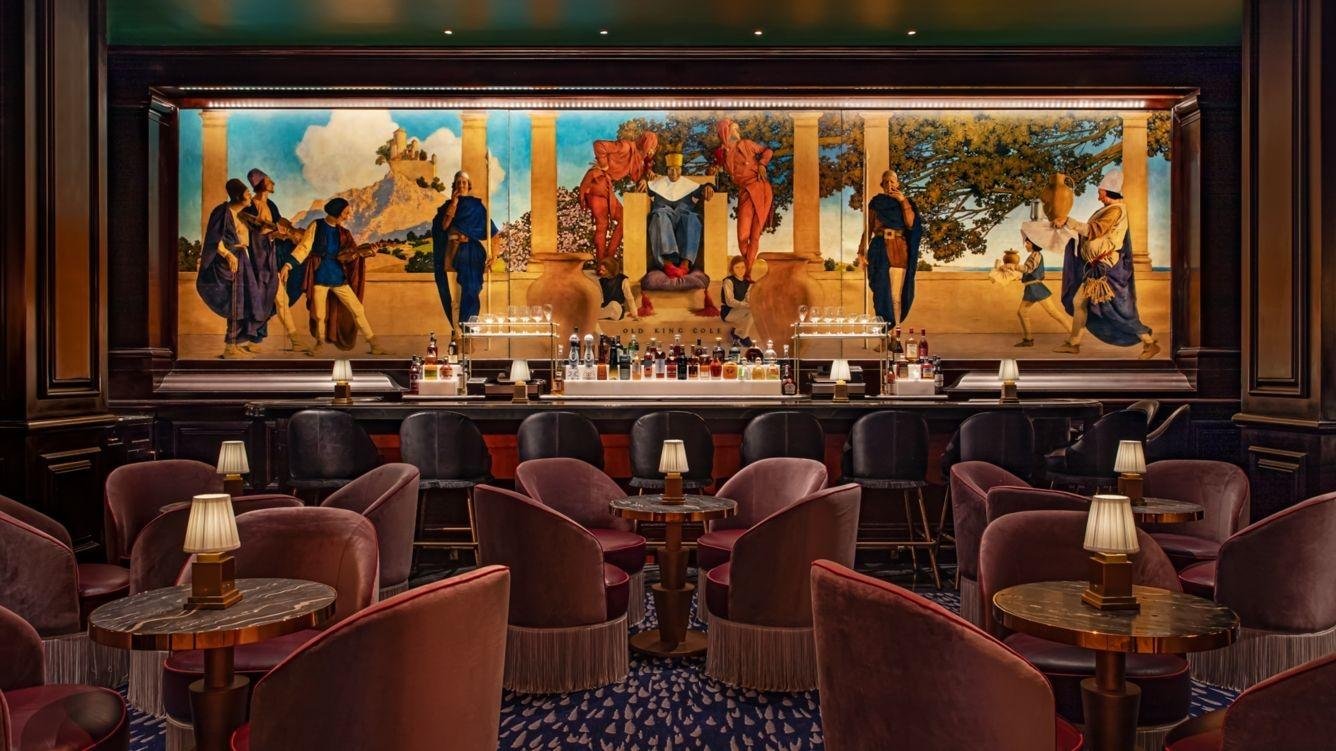
ST. REGIS NEW YORK. Maxfield Parrish’s Old King Cole mural behind the bar.
Lotte New York Palace: inside the Villard Houses
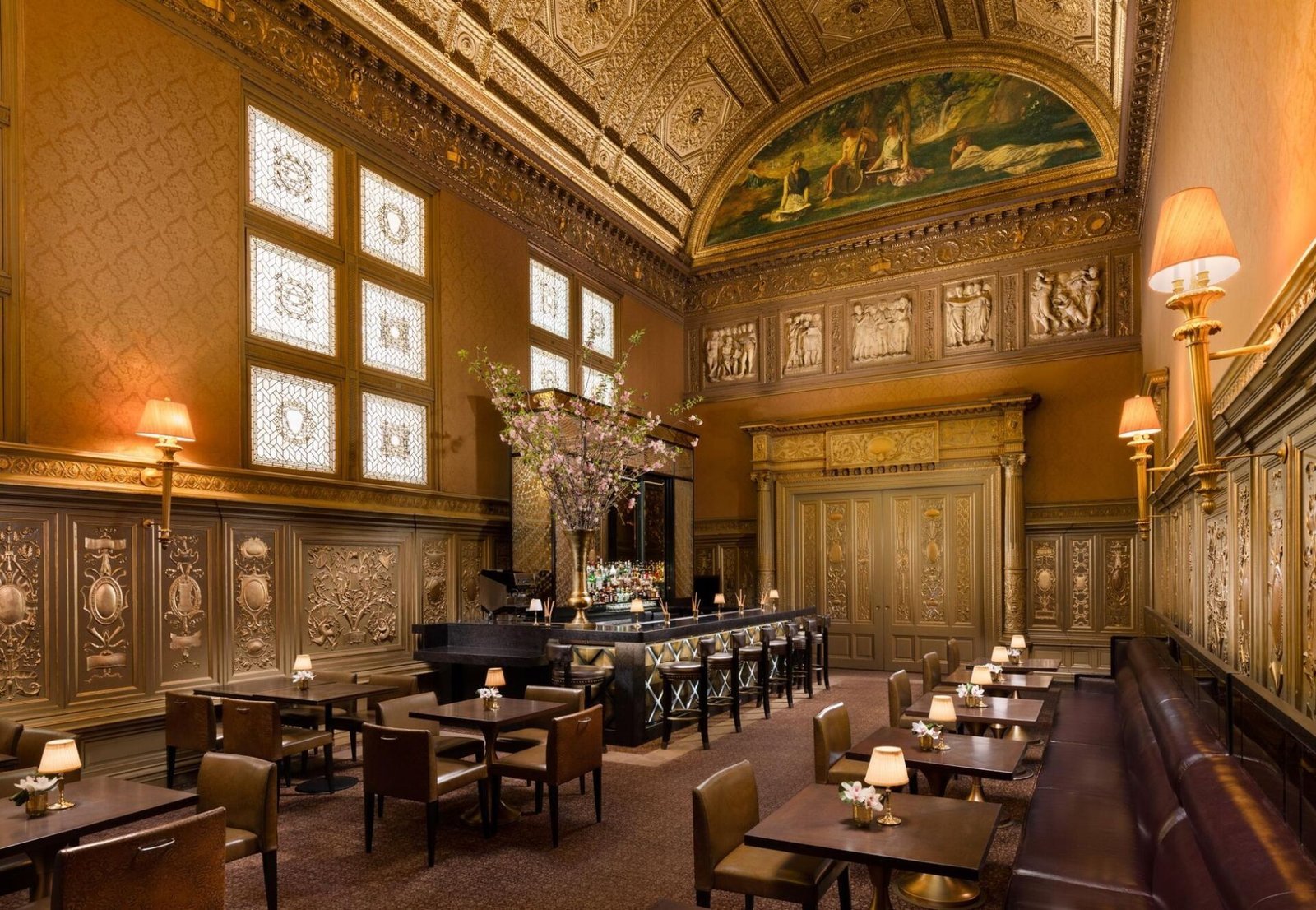
The Villard Houses, completed in 1884, supply the historical counterpoint to the hotel tower. Their courtyard and interiors allow an encounter with a different scale of New York wealth, domestic in origin even when the rooms now serve another purpose.
The Gold Room makes that distinction especially visible. Gilded surfaces, paintings by John La Farge and the upper musicians’ gallery produce a room that rewards looking above the table as well as across it. Its decorative programme belongs to the building, not to a recently added hotel theme.
Food and drink give visitors a present-day reason to enter, but menus and operating arrangements change. Historical tours, when offered, require confirmation with the hotel rather than an assumption that a particular weekly time remains permanent.
St. Regis: the mural above the bar
John Jacob Astor IV’s St. Regis opened in 1904. The Beaux-Arts building expressed an ambition for urban hospitality through materials, services and public rooms, with the King Cole Bar becoming one of its enduring reference points.
Maxfield Parrish’s mural gives the bar a distinctive visual anchor. It is worth looking at as a work in its own right, not merely as the background to a cocktail photograph.
Fernand Petiot’s 1934 Red Snapper connects the address with the history of the Bloody Mary. The broader origins of that drink are contested, so the St. Regis version should be distinguished from a claim that the entire cocktail was first invented there.
Together, these rooms offer a compact reading of the city. The Waldorf presents the scale of collective ceremony, the Palace retains the intimacy and display of an earlier mansion, and the St. Regis condenses a hotel’s identity around a painted room and a drink. Looking at all three reveals differences that a general claim of grandeur would miss.
Four Seasons, Aman, Maybourne, Belmond and Mandarin Oriental now sell the journey as part of the stay, from helicopter transfers into London to 23-day circumnavigations at $238,000 a head. Who flies, why, and what is really being bought.
Airlifted by helicopter to the summits, monumental bronzes by Coderch & Malavia turn Courchevel's slopes into an open-air gallery, with Arman back in 1850.
Fifty years after two sleeping cars were sold at Monte-Carlo's old station, Belmond brings the train back to the Principality: one night from Paris, a morning along the Riviera and an arrival inside the rock, from 10 May 2027.
Monte-Carlo
THE CURATED GLOBE / FROM THE EDITORS
Good stories. Better company.
A considered selection of people, places and ideas from WAYFARER Edition, delivered to your inbox.
Welcome aboard. Your first letter is on its way.
We could not complete your subscription. Please check your email and try again.