The Venice Simplon-Orient-Express returns to Monte-Carlo, where it was reborn
Fifty years after two sleeping cars were sold at Monte-Carlo's old station, Belmond brings the train back to the Principality: one night from Paris, a morning along the Riviera and an arrival inside the rock, from 10 May 2027.
In October 1977, a handful of old sleeping cars stood in the railway yards of Monte-Carlo, waiting for an auctioneer. They had made one last run along the coast from Nice to be there. Sotheby’s had brought the sale to the Principality, Prince Rainier and Princess Grace were in attendance, and among the bidders was an American shipping executive named James B. Sherwood, who had bought the Hotel Cipriani in Venice the year before and had an idea that most people considered romantic at best.
Sherwood left with two carriages. They were among the last survivors of the interwar Orient Express, and they had recently appeared on screen in Murder on the Orient Express. With them he began a search that would take him across Europe, tracking down original Wagons-Lits and Pullman cars, many of them stripped of their marquetry and glass, and restoring them one by one. In May 1982, the Venice Simplon-Orient-Express left on its inaugural journey.
Half a century after that sale, the train is going back. On 10 May 2027, Belmond inaugurates a new route from Paris to Monte-Carlo: one night aboard, a morning along the Côte d’Azur and an arrival at a station set inside the rock of the Principality. The journey becomes a permanent part of the train’s annual calendar, and Monte-Carlo also joins the itineraries that continue on to Venice.
For Pascal Deyrolle, who oversees Belmond’s trains in continental Europe, the decision required little debate. Monaco, he notes, has long held a particular place in the history of European travel, and it is a destination that has always understood the art of arrival. Returning to the city where two carriages started everything, he adds, carries a meaning of its own.
A line with a past
The Venice Simplon-Orient-Express is not the first famous sleeper to point south towards Monaco. From the 1880s, the Compagnie Internationale des Wagons-Lits ran a night service from Calais and Paris to the Riviera, and in December 1922 it was relaunched with new all-steel sleeping cars painted a deep blue. Society named it after its colour. Le Train Bleu carried winter visitors escaping northern skies to Saint-Raphaël, Cannes, Nice and Monte-Carlo, and it entered culture almost at once: the Ballets Russes made a ballet of it, and Agatha Christie set a novel aboard it in 1928, a few years before she turned her attention to the Orient Express.
Le Train Bleu belonged to the interwar decades, and air travel later took most of its passengers. What returns in 2027 is not a revival of that service but something close to its spirit: a night train from Paris that reaches the Mediterranean with the morning, its carriages built in the same era and by the same hands.
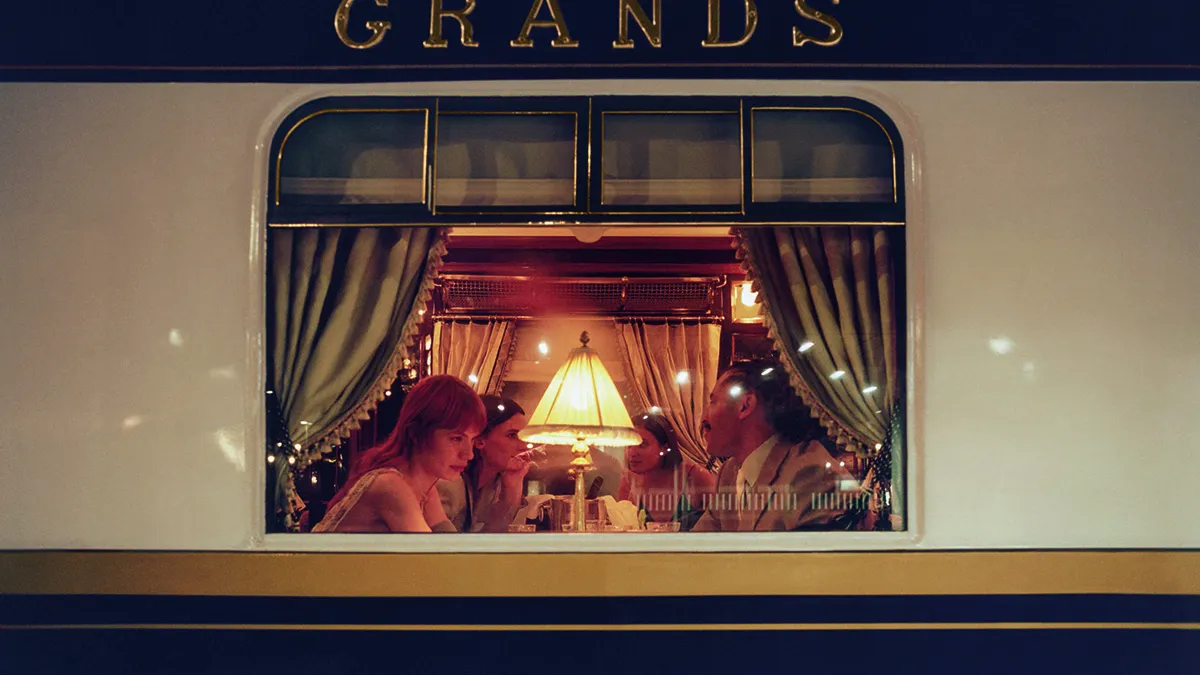
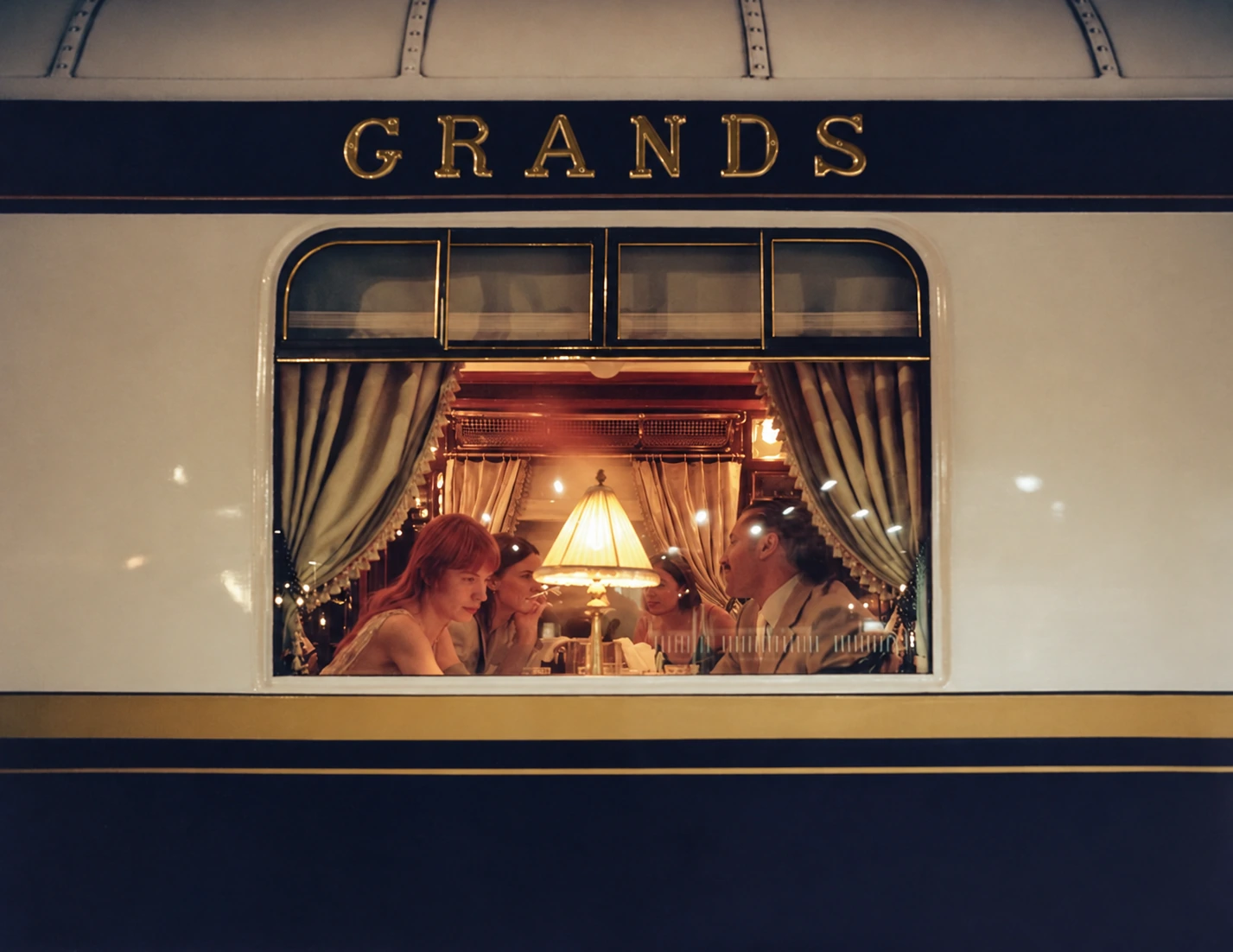
The midnight-blue carriages, restored from the interwar fleet.
The night aboard
Departure is from Paris in the afternoon, aboard carriages built in the 1920s and 1930s and restored with interiors that carry almost a century of journeys. Several of them have their own biographies. Sleeping Car 3309, which now houses Grand Suites, was trapped in a snowdrift for ten days in 1929, the episode that gave Christie her premise.
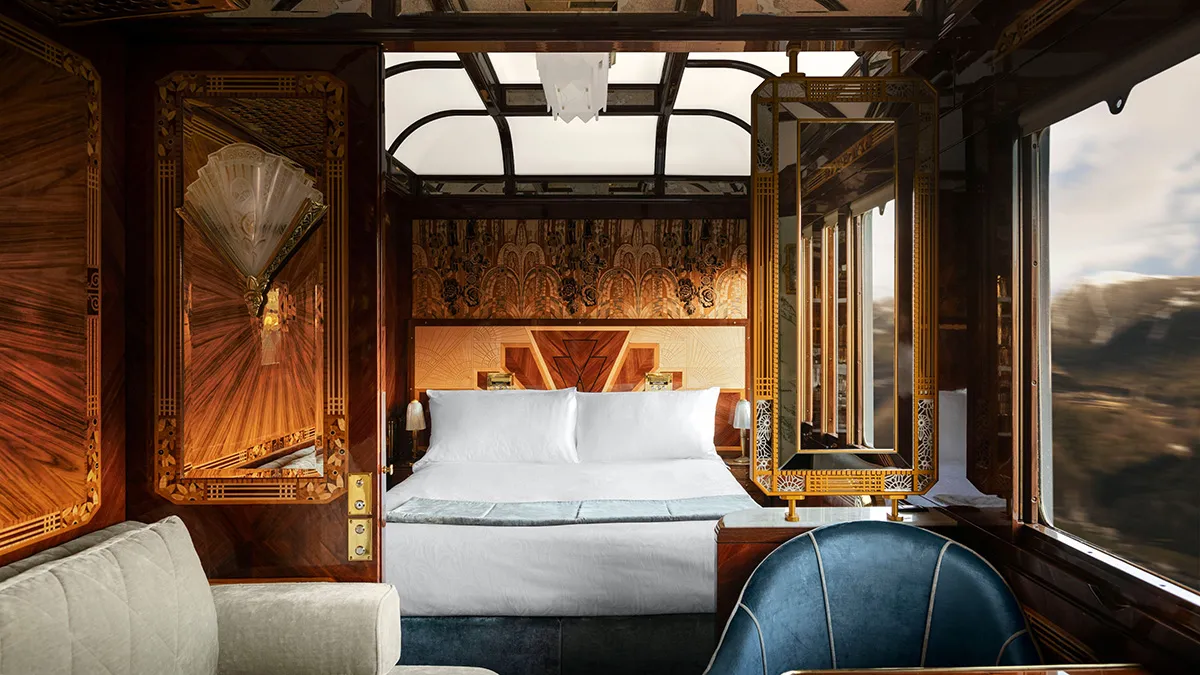
Accommodation runs from Historic Cabins to Suites and Grand Suites, each with its own reading of the train’s Art Deco language. At the top sits L’Observatoire, a carriage conceived with the artist JR and reserved for a single party: a bedroom, a private bathroom with a freestanding bathtub, a sitting room, a library and a hidden tea room.
Grand Suite: joinery and finishes from the golden era of European rail.
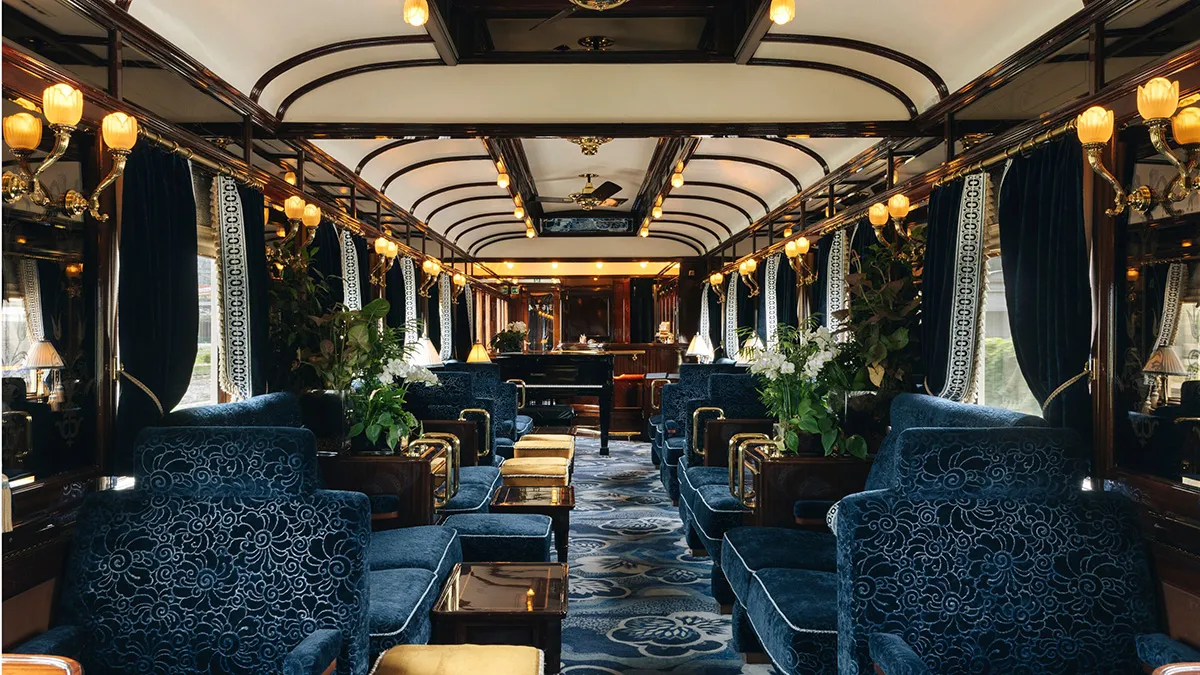
As the light goes, dinner is served in one of two restaurant cars, Étoile du Nord or L’Oriental, each with its own decorative character. The evening is formal by intention; the train has always treated dressing for dinner as part of the journey rather than a detail of it. Later the pace shifts to Bar Car 3674, where cocktails, live piano and conversation carry on into the small hours, until each guest returns to the cabin for the long run south through the Rhône valley.
Bar Car 3674: the train’s evening salon, between cocktails and the piano.
Morning on the Côte d’Azur
Breakfast arrives in the cabin, brought by the stewards: fresh bread, pressed juices, tea and coffee. By then the train has reached the sea. The line skirts the red porphyry cliffs of the Massif de l’Estérel, where the rock drops almost straight into the water, then passes Saint-Raphaël and follows the bays towards Cannes and Nice. It is the same sequence of towns that Le Train Bleu once announced at each platform, now seen from a cabin window with a cup of coffee in hand.
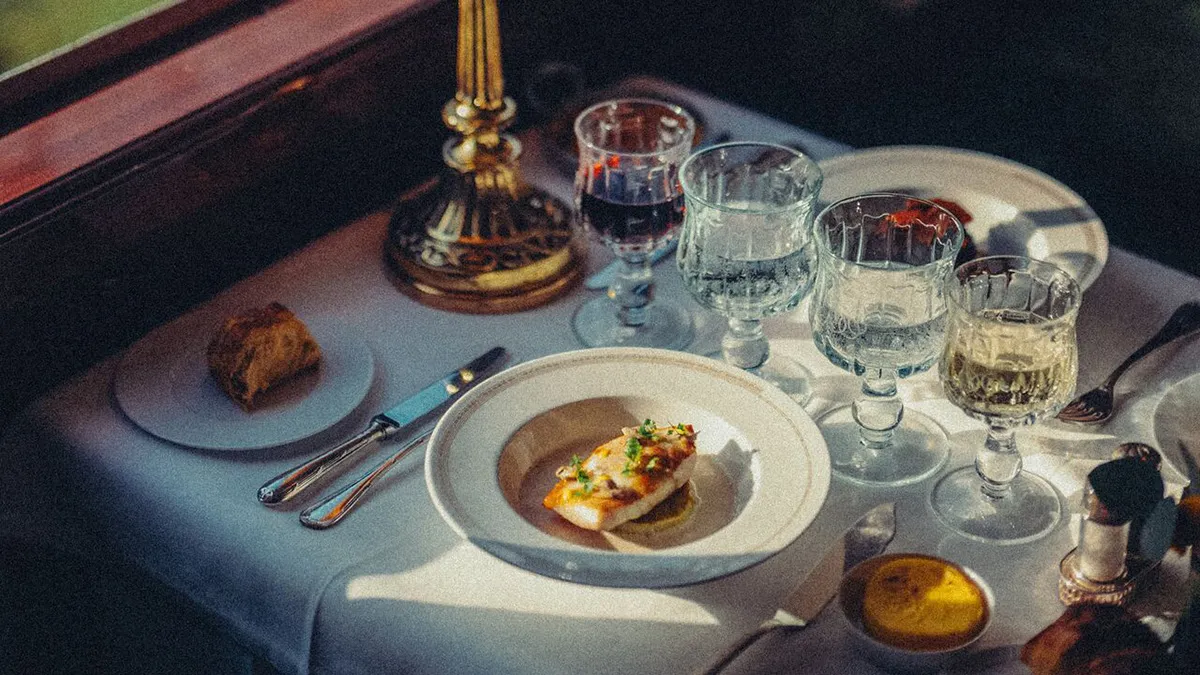
All meals are included, with wines chosen by the sommelier.
A station inside the rock
Near Monaco, the coast disappears. The railway enters the mountainside and the journey ends at Monaco-Monte-Carlo station, which lies entirely underground. Its existence is itself a piece of Monegasque history. For a century the line ran along the seafront, dividing the Principality in two, until Prince Rainier III set out to bury it. The work took four decades in two phases, and the present station, opened above the Sainte-Dévote ravine in December 1999, freed acres of land for the city above.
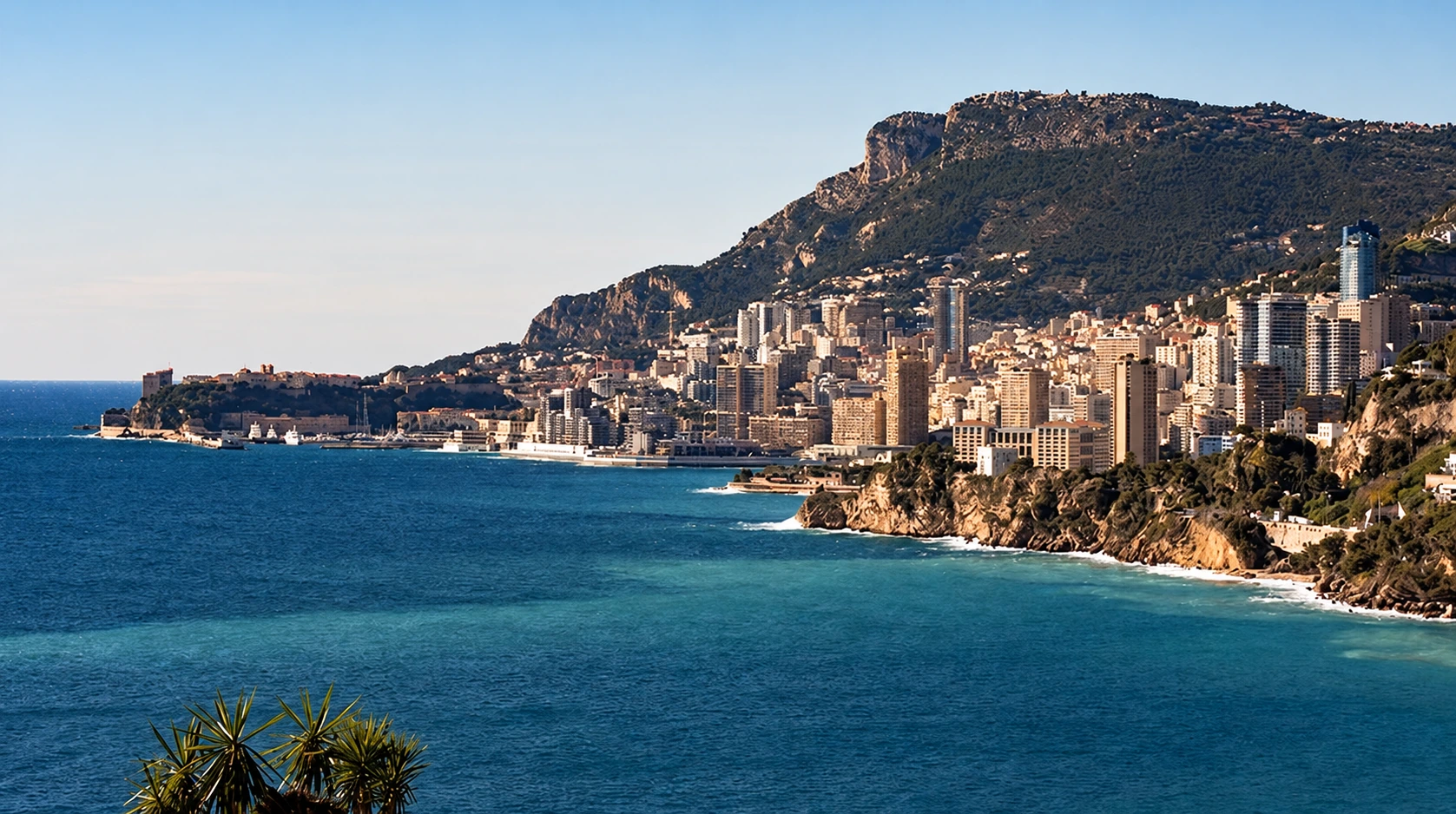
Monaco from above: the railway now runs beneath the city, out of sight.
The old Monte-Carlo station, where the 1977 auction took place, no longer exists. The train that was reborn there will now arrive a short distance away, beneath the rock, a few minutes on foot from the Casino de Monte-Carlo and the streets that become a circuit each spring for the Formula One Grand Prix. Guests may disembark in Monaco or remain aboard as the train continues towards Italy. For those staying on, our guide to Monaco beyond the familiar tables extends the visit past the casino circuit.
A wider map
The new route launches alongside the second year of Villeggiatura by Train, the series that pairs the train with stays at Belmond hotels in Venice, Florence, Portofino and Ravello, including the journey from Paris to the Amalfi Coast we followed earlier. Together, the two programmes stretch the Venice Simplon-Orient-Express along the Riviera and deeper into Italy, and they confirm a shift in how the train sees itself: less a single legendary line between two cities than a moving address that can be pointed towards the places its history already knows.
Monaco is the most personal of those places. Every carriage on the train today exists, in some sense, because two were sold there. Taking guests back to that platform, or as close to it as the modern city allows, closes a circle that opened when the train was a rescue project rather than an institution.
Two carriages changed hands in Monte-Carlo in 1977, under the eyes of a prince and a princess, and everything that followed happened slowly, as most things worth the journey do. In May 2027, the train born of that sale comes down the Riviera to the very place its story began again, this time with coffee served in the cabin and the whole morning in the window.
Venice Simplon-Orient-Express · Paris to Monte-Carlo
First departure: Monday, 10 May 2027, then annually
Route: Paris, the Côte d’Azur (Estérel, Saint-Raphaël, Cannes, Nice) and Monaco-Monte-Carlo, one night aboard, with onward continuation to Venice on selected departures
Fare: from €4,870 per person, based on two sharing a Historic Cabin
Includes: one night aboard, 24-hour steward service, all meals with wines selected by the sommelier, unlimited soft drinks and transfers
Accommodation: Historic Cabins, Suites, Grand Suites and L’Observatoire, a private carriage
Dress: formal for dinner, in keeping with the train’s tradition
From St Andrews and Royal County Down to Cabot Saint Lucia, Hirono and Tara Iti, eleven courses that justify the journey, with how to get a tee time and where to sleep afterwards.
From the Hôtel de Paris in Monte-Carlo to Raffles in Singapore and a Mandarin Oriental in Bangkok marking 150 years, the grand hotels that have stayed relevant for more than a hundred years without surrendering their identity.