FLY
For more than half a century, the executive turboprop was the aircraft chosen with the head. Robust, economical and able to serve destinations with demanding airfield conditions, it solved problems that a business jet might leave to the road. A new generation is changing the experience inside that practical machine without surrendering the reason to choose it.
The twin-engined Beechcraft King Air 360ER, the single-engined Pilatus PC-12 PRO and Daher TBM 980, and the forthcoming Beechcraft Denali bring contemporary interiors, satellite-connectivity options and increasingly automated cockpits into the category. The comparison with a light jet now extends beyond operating cost. It concerns the cabin, the interface and the places at which the journey can end.
The runway comes before the specification
To understand why a buyer with a jet-sized budget chooses a propeller, begin with the map. The attraction may be a mountain airfield, a farm strip or a lodge where a longer transfer would otherwise become part of the itinerary. Courchevel’s short, steep runway is an emblem of that appeal, not a universal operating permission for every aircraft in the category.
Brazil gives the argument another scale. Farms in the Centre-West and Matopiba, smaller airfields on the Bahia coast and lodges in the Pantanal can make access a more important consideration than the cruise-speed advantage of a jet. Elsewhere, the same logic applies to remote or tightly constrained destinations.
The claim needs to remain aircraft-specific. Surface approval, runway length, slope, elevation, weather and payload all change what is possible. Not every turboprop may use every unpaved strip, and emergency landing automation does not make a demanding destination suitable. The value is a wider choice of missions, assessed by qualified operators, rather than access without limits.
PC-12 PRO: the cabin acquires a design language
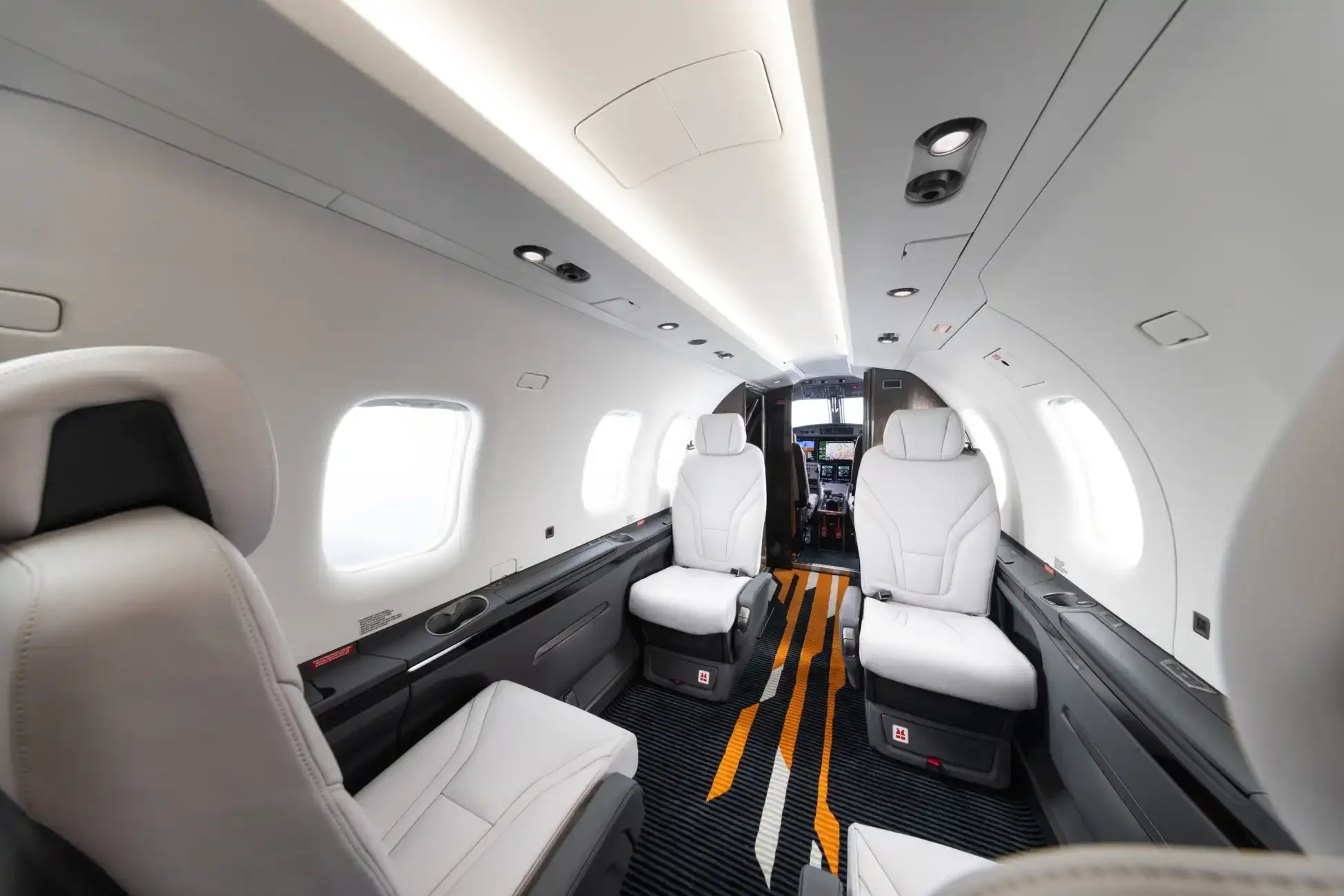
Pilatus presented the PC-12 PRO in March 2025. BMW Designworks’ interiors develop the relationship between materials rather than treating the cabin as a collection of independent upholstery choices. The themes coordinate leather, carpeting, wood and metal finishes, giving the owner a complete environment to select.
The renewed cabin includes larger, more rectangular windows, revised LED lighting, additional storage and executive seating with taller backrests and a greater reclining range. Hand-stitched leather supplies a close-up detail within an interior designed to remain coherent as a whole.
This approach is part of the aircraft’s change in character. A passenger still boards a turboprop with a large cargo door and a flexible working history, but the surroundings no longer ask comfort to be treated as a concession to utility. The design and the mission can coexist.
The PC-12 family’s established international fleet and varied uses, from executive transport to aeromedical work, remain important to its appeal. The PRO modernises that platform rather than discarding it for a new visual identity.
King Air 360ER: two engines and a flexible interior
The King Air family began with the Model 90 in the 1960s. The 360ER continues that long working lineage with extended range, two engines and a cabin that can be configured for different purposes. Its nearly six-metre interior can accommodate executive club seating, a divan or specialist installations such as medical equipment, depending on the chosen configuration.
Revised materials and digitally controlled pressurisation bring the passenger environment into the contemporary brief. Pressure management during climb and descent is one of the changes felt rather than photographed, while the interior can serve operators ranging from private owners to governments and aeromedical fleets.
The twin-engine format and longer-range capability distinguish it within this comparison. They also help explain why the King Air remains attractive to organisations whose aircraft must do more than carry a small group between business meetings.
TBM 980: speed, connectivity and an owner-pilot focus
Daher’s TBM 980 develops the fast single-engine formula associated with the TBM family. Its published maximum cruise speed of 330 knots gives it the most sporting emphasis of the four aircraft considered here. A compact cabin and a high degree of automation suit the owner-pilot travelling with a smaller party.
The interior also reflects how personal flying has changed. High-output USB-C connections, electronically dimmable windows and LED lighting support the time spent on board. Daher describes the aircraft as ready for integration of Starlink Mini; the connectivity installation should be confirmed for the individual aircraft rather than assumed to be standard on every delivered example.
For a family or a small group, connectivity can make the flight an extension of the weekend or working day. Its practical value depends on the installed system, coverage and service, not just the presence of a connectivity name in the brochure.
Cockpits that reduce the layers between pilot and aircraft
Both the PC-12 PRO and TBM 980 use Garmin G3000 Prime. Its large touchscreen displays and revised interface reduce the dependence on nested menus, giving frequently used information and controls a more direct place in the pilot’s workflow.
Each manufacturer develops that foundation differently. Pilatus combines it with PC-24-inspired control yokes and Garmin GWX 8000 weather radar. Daher includes CPDLC capability, allowing supported air-traffic-control communications to arrive as digital messages rather than relying only on voice.
The King Air 360ER follows another route with Collins Pro Line Fusion and ThrustSense autothrottle. Power management is automated within the system’s operating limits, complementing rather than replacing the pilot’s responsibility for the flight.
For the owner who also flies, the attraction is a reduction in workload. A clearer interface leaves fewer steps between seeing a requirement and responding to it, particularly in a cockpit that may be managed by one person.
Autoland as an emergency layer
Garmin Emergency Autoland is one of the most consequential additions to the category. In a suitably equipped and certified aircraft, it can select an appropriate airport, communicate an emergency and complete a landing when the pilot is incapacitated. The sequence also provides information to the passengers as it proceeds.
Daher calls its implementation HomeSafe. Pilatus offers Emergency Autoland for the PC-12 PRO, and Textron has announced it as standard equipment on the Denali. The function is an emergency system, not an alternative to normal piloting or a means of authorising routine operations at unsuitable airfields.
Its importance is clearest in the single-pilot context. An aircraft carrying an owner and family gains another layer of response to a situation in which nobody else on board may be qualified to take the controls.
Denali and the Catalyst engine
The Denali is the new-build aircraft in this group. Its GE Aerospace Catalyst introduces digital engine control and a single lever for power and propeller management, simplifying an operating routine traditionally divided between separate controls.
The engine programme promises improved efficiency relative to comparable designs. Those are manufacturer objectives and comparisons, not independently demonstrated savings for every future operator. The important change is the integration of a new engine architecture with the aircraft’s cockpit and operating method.
Textron specifies a 1.60-metre-wide, flat-floor cabin, the widest single-engine cabin in this comparison. The proposed layouts include six executive seats or nine commuter seats, with an optional lavatory. Published programme targets include a 285-knot maximum cruise and a range of 1,600 nautical miles.
The calendar remains part of the story. Textron’s latest programme update places completion of the certification flight-test programme in October 2026 and planned entry into service in 2027. The Denali should therefore be compared as a forthcoming aircraft, not described as already operating alongside the other three.
Four aircraft, four priorities
The TBM 980 favours speed and the owner-pilot travelling with a few passengers. The PC-12 PRO combines a larger cabin and cargo-door flexibility with an extensively used international platform. The King Air 360ER brings two engines, extended range and a working cabin that supports several missions. The Denali proposes a broad cabin and a new engine-control architecture, subject to completion of its programme.
Published speed and range figures use different conditions and do not represent simultaneous maximums. A meaningful comparison begins with the actual passenger load, the airfields involved and the distance to be flown. Acquisition price, maintenance, training, fuel and support then turn that mission into an ownership calculation.
The new generation does not solve a failure of the old turboprop. It changes what owners expect to find inside it. The cabin can be designed with the same attention as a light jet’s, the cockpit can offer a newer interface, and the propeller can still serve the itinerary that made it useful in the first place.
The choice is no longer simply how much comfort to surrender for the shorter runway. It is how much the extra speed of a jet contributes to the journey being made. For many shorter sectors, the decisive part of the trip remains the place where the aircraft can put its passengers on the ground.
Details and further reading: PC-12 PRO presentation · Manufacturer brochure. · TBM 980 specifications · Denali programme update.
Instagram: @pilatusaircraft.
GABRIEL SILVEIRADO, FOR WAYFARER.