This Is It: Tecnomar treats the catamaran as a piece of architecture
This Is It does not try to make a catamaran resemble a conventional monohull yacht. Its broad beam becomes the premise of the design. Presented at the Monaco Yacht Show in 2023, the Tecnomar vessel uses its twin-hull platform to create an arrangement of glass, terraces and interior volumes that reads more like a contemporary building than a familiar sequence of decks.
This Is It does not try to make a catamaran resemble a conventional monohull yacht. Its broad beam becomes the premise of the design. Presented at the Monaco Yacht Show in 2023, the Tecnomar vessel uses its twin-hull platform to create an arrangement of glass, terraces and interior volumes that reads more like a contemporary building than a familiar sequence of decks.
At roughly 43.5 metres long and close to fifteen metres wide, the aluminium yacht has an unusually generous footprint for its length. Lateral Naval Architects contributed to the naval architecture. The exterior embraces asymmetry, while extensive glazing makes the relationship between the interior and the water a defining part of the project.
Width changes the plan
The scale of the beam allows rooms and outside areas to be organised differently. Rather than allowing the central corridor of a narrow hull to dictate every decision, the design can move across the vessel. Around six hundred square metres of glass contribute to that sense of lateral openness.
The material palette balances that exposure with more tactile surfaces. Leather, Alcantara and metal detailing give the interior another register, preventing the glass envelope from being its only subject. Curves and changes in level continue the architectural character established by the exterior.
A suite across two levels
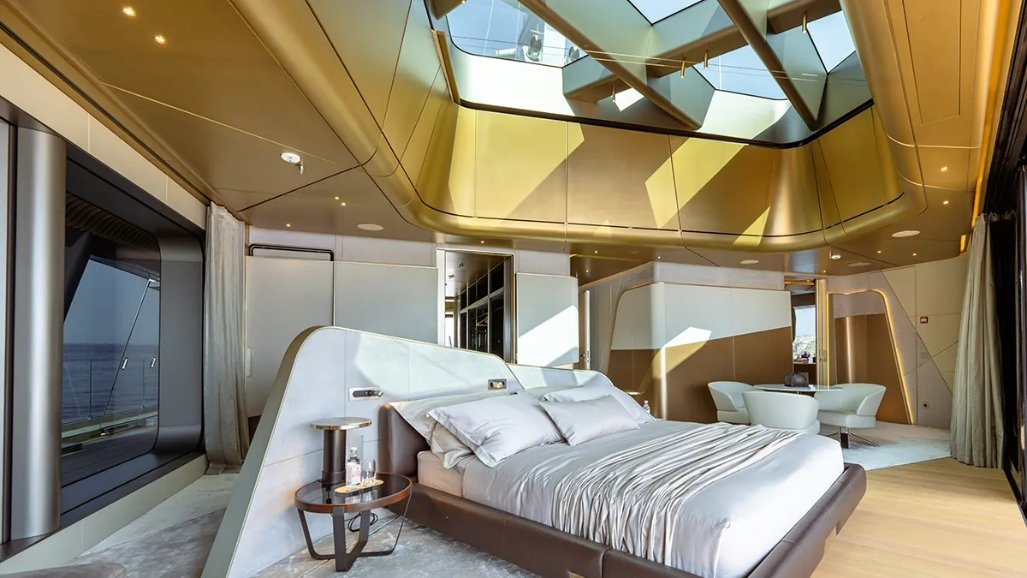
The owner’s accommodation is one of the clearest expressions of the concept. Arranged across two levels, it incorporates a vertical garden and overhead light. Those features introduce a domestic architectural vocabulary without removing the fact that the room belongs to a yacht.
The accommodation plan provides six cabins for twelve guests, with space for a crew of twelve in the specifications accompanying the original presentation. On deck, an asymmetrical pool extends the same approach: it is not merely inserted into a standard layout, but becomes part of how the outdoor space is composed.
A different use of the catamaran
The yacht’s interest lies in how visibly it uses the advantages of the platform. Its width is not hidden; its volumes do not apologise for being unconventional. This Is It shows how a catamaran can become a vehicle for an architectural idea rather than just another solution to a technical brief.
Sales and charter availability can change, and the vessel’s design should not be confused with a current listing. What remains is the project itself: a yacht that uses breadth, light and asymmetry to challenge the expectation of what this size of vessel ought to look like.
Two levels inside a moving object
The owner’s suite translates familiar architectural devices into a vessel: a change of level, overhead light and a vertical garden. Those devices acquire another context aboard a catamaran, where the plan has to belong to a hull rather than to a permanent site.
The broad beam makes that translation visible. Instead of treating width as something to disguise, the project allows it to reshape the relationship between enclosed rooms and terraces. Glass reinforces the openness, while leather, Alcantara and metal give the interior surfaces that can be read at close range. The yacht’s interest lies in the coordination of those scales, from the overall footprint to the place where a guest sits.
Two years after leaving Belfast, the Villa Vie Odyssey is more than 85 per cent sold and has a sister ship, Legacy, due in early 2029. Inside the idea of a home that never stays in one port.
After more than a decade of negotiation, the EU's revised air passenger rights regulation was published in October 2026. It guarantees a free personal item and fares shown with hand baggage included, but not a free cabin trolley, and it applies from October 2027.
Singapore Airlines still owns the two longest scheduled routes on earth, at more than 15,300 km each. A 24-hour Airbus test flight in July showed how far the ranking is about to stretch.