Gin-Gin Mule: Audrey Saunders and the architecture of a modern cocktail
The Gin-Gin Mule is built around a deceptively simple question: how can a drink be fresh, aromatic and approachable without allowing its spirit to disappear? Audrey Saunders answered with gin, mint, lime and ginger, creating a cocktail whose individual elements remain legible even as they come together.
The Gin-Gin Mule is built around a deceptively simple question: how can a drink be fresh, aromatic and approachable without allowing its spirit to disappear? Audrey Saunders answered with gin, mint, lime and ginger, creating a cocktail whose individual elements remain legible even as they come together.
Developed before the opening of New York’s Pegu Club in 2005, the drink became closely associated with Saunders and the bar’s approach to cocktails. It belonged to a period in which the American bar was rediscovering precision, but it did not require guests to understand that wider movement before enjoying what was in front of them.
Ginger as structure
The mule family is often understood through ginger’s sharpness and the character of its ginger component. Here, those qualities meet the botanical character of gin. Juniper and the other aromatics provide a more detailed base than a neutral spirit, while lime gives the drink a clear line of acidity.
Mint adds a second aromatic layer. Its role is not simply to make the glass look finished: the scent reaches the drinker before the first sip and changes the way the gin and ginger are perceived. The balance depends on keeping that freshness intact rather than allowing the leaves to dominate the entire drink.
A familiar format, a distinct identity
Saunders’s composition is often described through its relationship to both the mule and the mojito. The comparison is useful, but incomplete. Lime and mint suggest one family; ginger suggests another. Gin gives the combination its own centre of gravity.
That is what separates the cocktail from a generic long drink. The spirit is not a background ingredient waiting to be concealed by sweetness. Ginger’s heat, citrus acidity and herbal fragrance create a setting in which the gin remains recognisable. Altering the ginger component or changing the gin can therefore change the result considerably.
Why it remains on the repertoire
The Gin-Gin Mule carries the influence of a particular bartender and a particular New York moment, yet its appeal is easy to understand beyond that context. It offers refreshment without flattening flavour and complexity without demanding a ceremonial introduction.
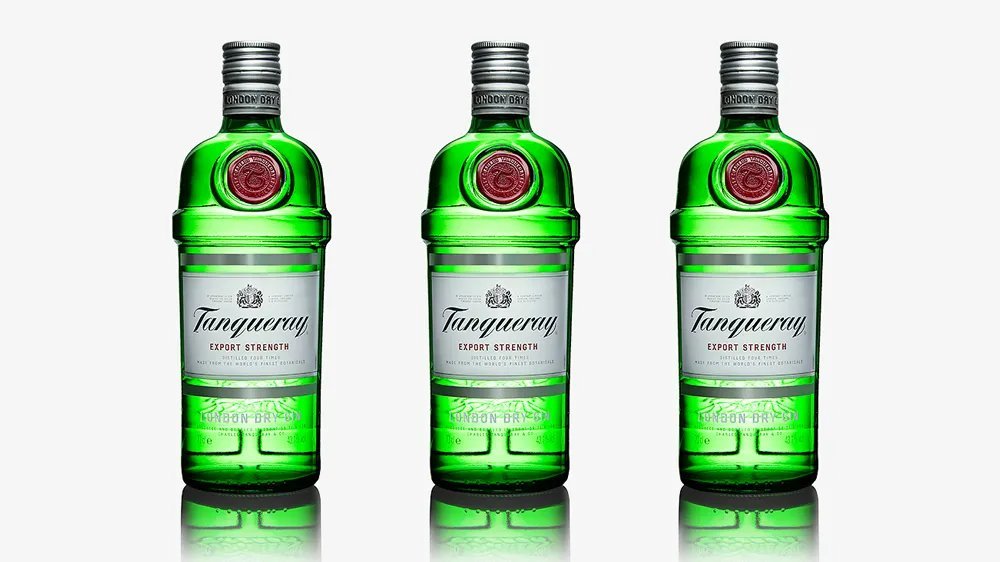
For a bar, it is also a useful demonstration of proportion. Every component is familiar; the achievement is in how they are arranged. It is that discipline, rather than novelty for its own sake, that gives the drink its staying power. The photograph accompanying this article shows a gin bottle as an illustration of the base spirit, not a finished Gin-Gin Mule.
Fresh lime juice: ¾ US fluid ounce, approximately 22 ml.
Simple syrup: 1 US fluid ounce, approximately 30 ml.
Tanqueray gin: 1¾ US fluid ounces, approximately 52 ml.
Homemade ginger beer: 1 US fluid ounce, approximately 30 ml.
Two sprigs of mint, with lime and candied ginger as garnishes.
The published method works one mint sprig with the lime and syrup in a highball, then combines the gin, homemade ginger beer and ice in a shaker before straining into the glass. The second sprig finishes the drink. The metric quantities above are rounded conversions, not a separately tested reformulation.
In the foundation’s account of the drink, Saunders emphasises the homemade ginger beer. The ingredient is therefore part of the recipe’s structure, not a reason to treat every sweet commercial ginger drink as an equivalent substitution.
The proportions make the historical account more specific. Gin remains a defined part of the build, while lime, syrup, mint and ginger establish the relationships around it. The photograph remains an illustration of the base spirit, not a photograph of a Gin-Gin Mule prepared from this recipe.
For Vintage 2015 and Rosé Vintage 2010, Takashi Murakami replaced the vines on Dom Pérignon's labels with his smiling flowers, a meeting of two cultures of patience that Chef de Cave Vincent Chaperon calls harmony.
From the Penfolds Grange, raised in American oak since 1951, to the only cooperage inside a Burgundy house, the choice of wood still decides how a great wine speaks.
Mezcal is made from dozens of agave species, roasted in earthen pits and sipped slowly. Iván Saldaña, the biologist behind Montelobos, reads it as chemistry turned into flavour.