How Kim Kardashian turned her home into the visual code of Skims
At the Skims flagship on Regent Street, designed by Rafael de Cárdenas, the beige of Kim Kardashian's house and a monumental Vanessa Beecroft figure become the architecture of a brand valued at 5 billion dollars.
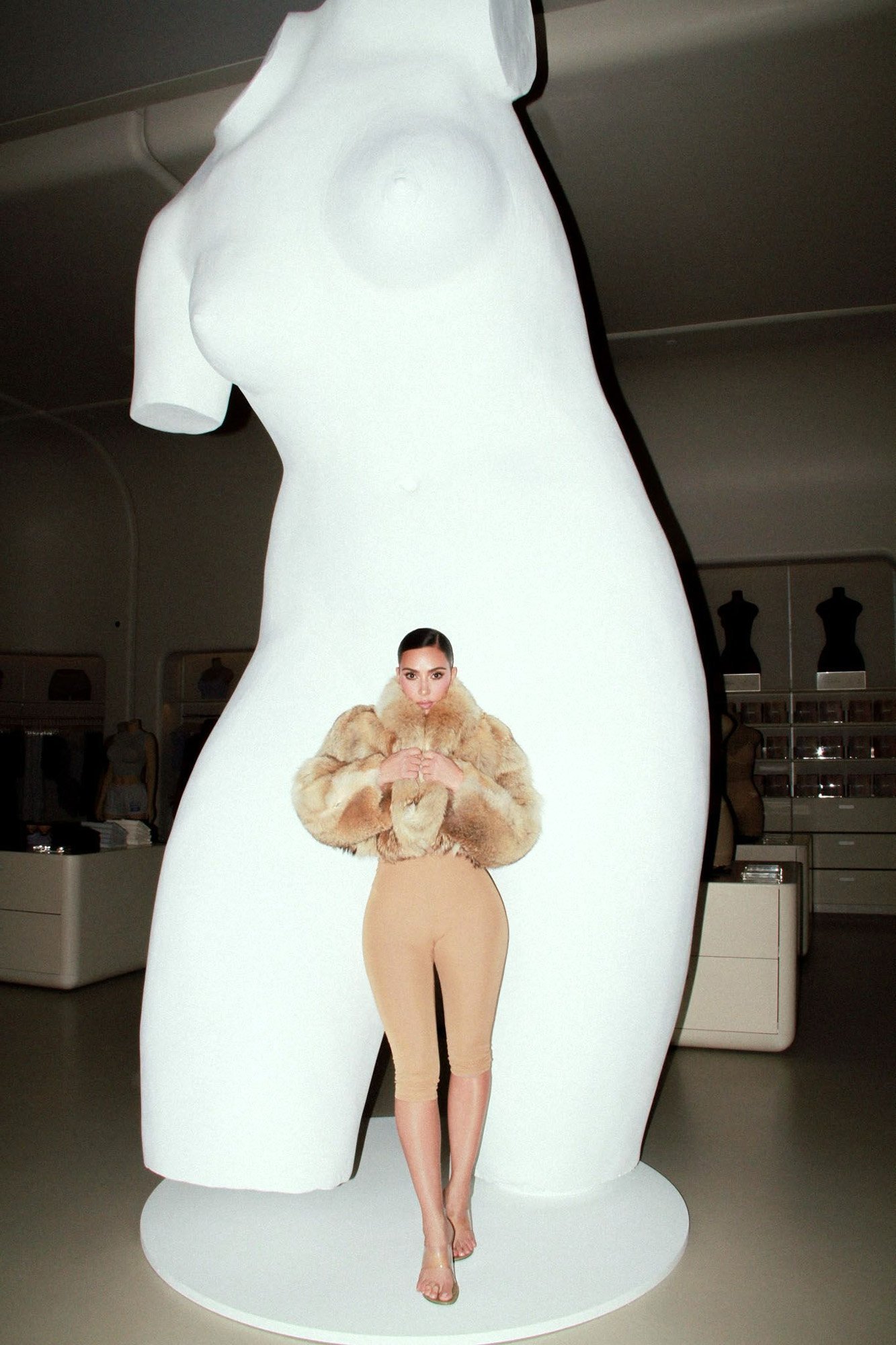
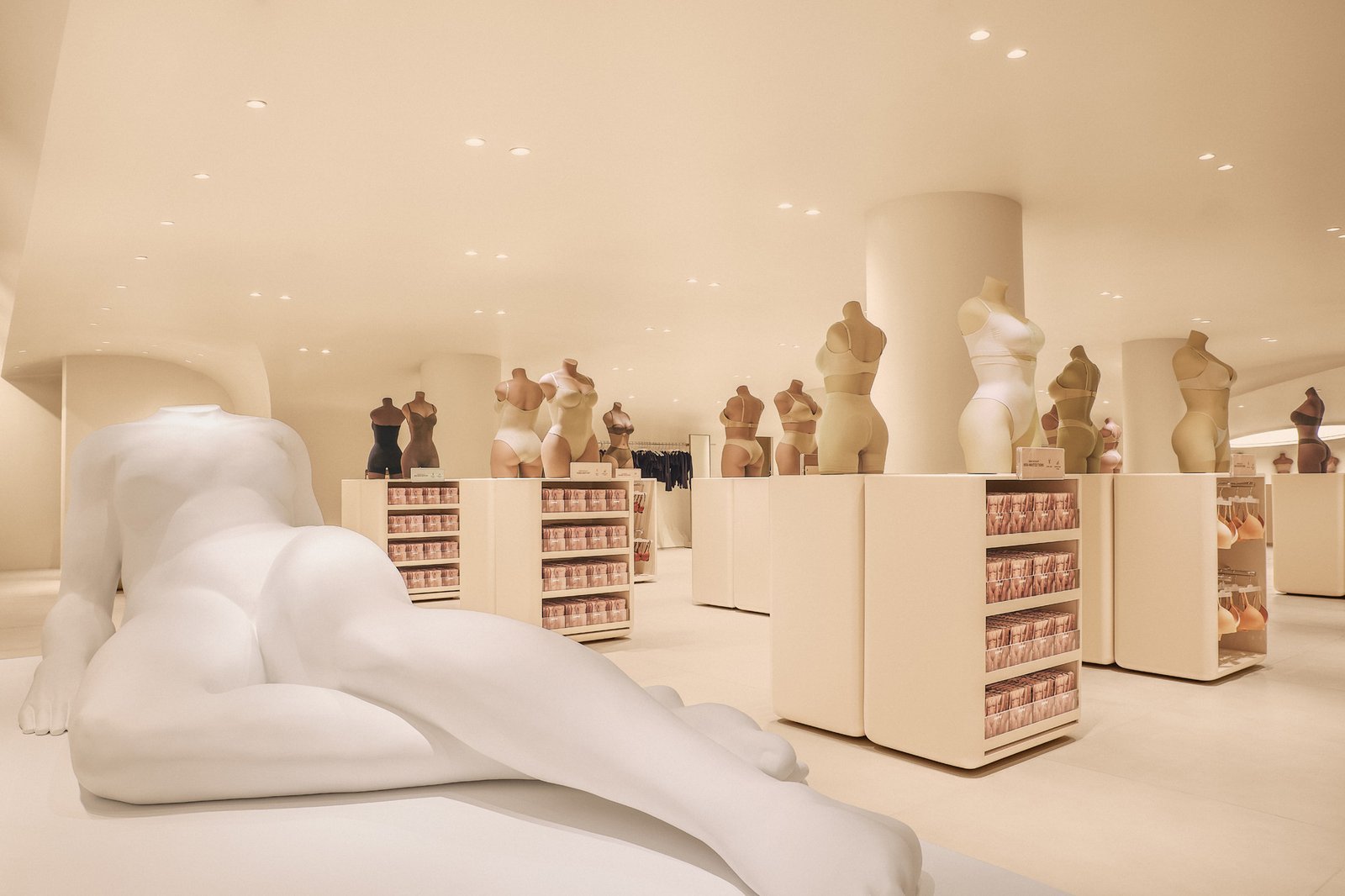
In Kim Kardashian’s world, chaos is answered with beige. The colour has become as central to her iconography as the hourglass silhouette, returning in oat, mushroom, taupe and sand, endless variations somewhere between skin and stone. At the Skims flagship on Regent Street, which opened this summer at 245 to 247 on the old Ted Baker corner, that familiar palette takes on architectural scale. Pale walls curve through some 12,000 square feet; surfaces seem continuous, almost seamless; and a monumental female nude by Vanessa Beecroft presides over the entrance with the authority of an ancient fertility goddess.
The store is grand, yet it serves the most intimate of goods: underwear, T-shirts, socks, the invisible structure worn beneath a dress. There is an almost comic disproportion between the monumentality of the room and the private, occasionally ungainly act at its centre. Pulling on shapewear is rarely an elegant procedure. Skims has housed that negotiation between flesh and elastic inside something close to a temple, and the scale is deliberate.
A brand born at home
The London flagship was designed by the New York architect Rafael de Cárdenas, who began his career at Calvin Klein in the 1990s and is no stranger to minimalism. It is the most complete physical expression of a brand that was quite literally born indoors. Founded in 2019, Skims held its first fittings in Kardashian’s wardrobe, and its early campaigns were shot in the corridors of her house. Rather than emerging from an agency’s drawing board, its visual language grew out of the rooms where the products were developed, and out of the already intensely codified way in which their owner lives. Kardashian has described wanting to carry as much of her home’s materiality as possible into the stores, so that they would still feel part of it.
THE FOUNDER AND HER GODDESS, IN THE LOS ANGELES STORE. IMAGE: PRESS
That house, created with the Belgian designer Axel Vervoordt, is one of the most documented private interiors of the social-media age. Its vast planes of pale plaster have been photographed so often that they have ceased, in any real sense, to be private. Empty and almost monastic, the rooms suggest a retreat for someone who has outgrown the need for possessions, though their owner is one of the most successful merchants of material desire alive. Kardashian is aware that minimalism can read as emotional vacancy, and the task, at home and in the stores, was to keep the calm while restoring some suggestion of human warmth.
The contradiction is pure Kardashian. An avatar of maximum exposure who prefers minimal interiors; a byword for conspicuous consumption whose aesthetic language is subtraction; a woman who made the body spectacular by bringing to the foreground everything required to control it.
Shapewear without shame
Her most consequential intervention was not a particular silhouette but the insistence that the work behind it should no longer be hidden. She dissolved the old beauty conspiracy, in which famous women credited their looks to water, sleep and a few drops of moisturiser. In her universe, beauty demands an almost bureaucratic devotion to maintenance: fittings, lighting, extensions, shapewear, procedures. She speaks openly of cellulite and insecurity, and of wanting something that makes her feel held inside her clothes. She does not pretend that compression cures self-doubt. What interests her is what it allows a woman to do in spite of it.
Skims turned that proposition into a global business. Shapewear once belonged to a faintly embarrassing category, corrective and medicalised, sold in department-store basements, at odds with the lace and low light of the lingerie boutique. Kardashian made it aspirational. The brand speaks the contemporary language of self-acceptance while selling garments designed to compress, smooth, lift and rearrange. It is less hypocrisy than an accurate portrait of the times: we are encouraged to love ourselves unconditionally while treating ourselves as a permanent renovation.
BEIGE, AT THE SCALE OF ARCHITECTURE. IMAGE: PRESS
The numbers suggest the formula works. In November 2025, Skims raised 225 million dollars in a round that valued it at 5 billion, and said it was on course to exceed 1 billion dollars in annual net sales. Its most significant break with the old lingerie industry was to rethink “nude”, which for decades meant a single pale beige presented as the universal absence of colour. Skims did not invent inclusive sizing or diverse casting, but it carried both into the mainstream with the full force of the Kardashian image machine. Its campaigns, from Sabrina Carpenter and Nicola Coughlan to Rosé and a deliberately absurd Will Ferrell, show a brand now confident enough to exist without its founder in every frame.
Every corner softened
Lingerie retail once dictated the terms of sensuality with exhausting certainty, a narrow performance of availability aimed at an implied male gaze. Skims is not without eroticism, but its sensuality is quieter, and the store looks nothing like a conventional lingerie boutique. There is little red satin, no hint of the boudoir, none of the pseudo-French vocabulary through which women were once invited to buy knickers. The room is closer to a contemporary gallery or a wellness space. Kardashian frames a visit as a small, selfish moment away from children, work and obligation.
THE FIRST SKIMS ADDRESS IN BRITAIN, ON REGENT STREET. IMAGE: PRESS
The fitting rooms carry that idea of private attention. De Cárdenas describes them as intimate yet theatrical, built for an age in which trying on clothes means taking a selfie. A customer no longer simply looks in the mirror; she photographs herself in it. For a brand whose aspiration flows from a woman who published a book of selfies with Rizzoli in 2015, the point is lucid. The image is not merely consumed. It is produced, managed and circulated with remarkable discipline.
Kardashian took part in detailed discussions of skirting boards, shadow gaps between wall and ceiling and the precise tone of greige. Beecroft’s figure, she has said, shares a fluidity with the curves of the logo and the drape of the garments, and she wanted nothing sharp in the room. Few walls are actually curved. Instead, two large gestures establish a bodily softness that echoes through the space, and every right angle is rounded or chamfered. As de Cárdenas puts it, “the body doesn’t have these hard, linear edges.” The ground floor gives most of its space to clothing and seasonal collections, with the foundation pieces on which the company was built largely upstairs, alongside menswear and NikeSkims.
NO HARD EDGES, ONLY THE SOFTNESS OF A BODY. IMAGE: PRESS
The architecture also works on the senses beyond sight. A discreet scent was developed for the space, the kind a customer may never consciously register but which settles as a diffuse sense that this room is unlike the street outside. For de Cárdenas, that is the measure of success: people should leave having enjoyed the experience without being able to say exactly why. Kardashian has always been an efficient translator of elite taste, taking aesthetics once confined to galleries and private houses and returning them to popular culture. What begins as Belgian minimalism or performance art ends as the visual language of bras sold to millions.
Perhaps that is the true architecture of Skims: not the curved walls nor the carefully calibrated greige, but a structure of feeling in which insecurity is neither defeated nor hidden. Chaos outside, beige within. Like the woman who built it, the store is a thoroughly contemporary contradiction.
Details: Skims, 245 to 247 Regent Street, London. Designed by Rafael de Cárdenas, with a sculpture by Vanessa Beecroft. skims.com
Developed with the robotics company Dephy, Nike's Project Amplify is a powered footwear system for running and walking. A year after its unveiling, it remains in testing, with a consumer launch still some years away.
Artificial intelligence has left the phone and moved into the kitchen, the bedroom and even the cat's litter box. Five recent objects suggest the domestic future is not about voice commands but about machines that learn to live alongside us.
The smartphone made everyone a photographer. A new generation of dedicated compacts, from DJI's gimbal cameras to the Camp Snap CS-Pro, argues for a device that exists for one purpose only.