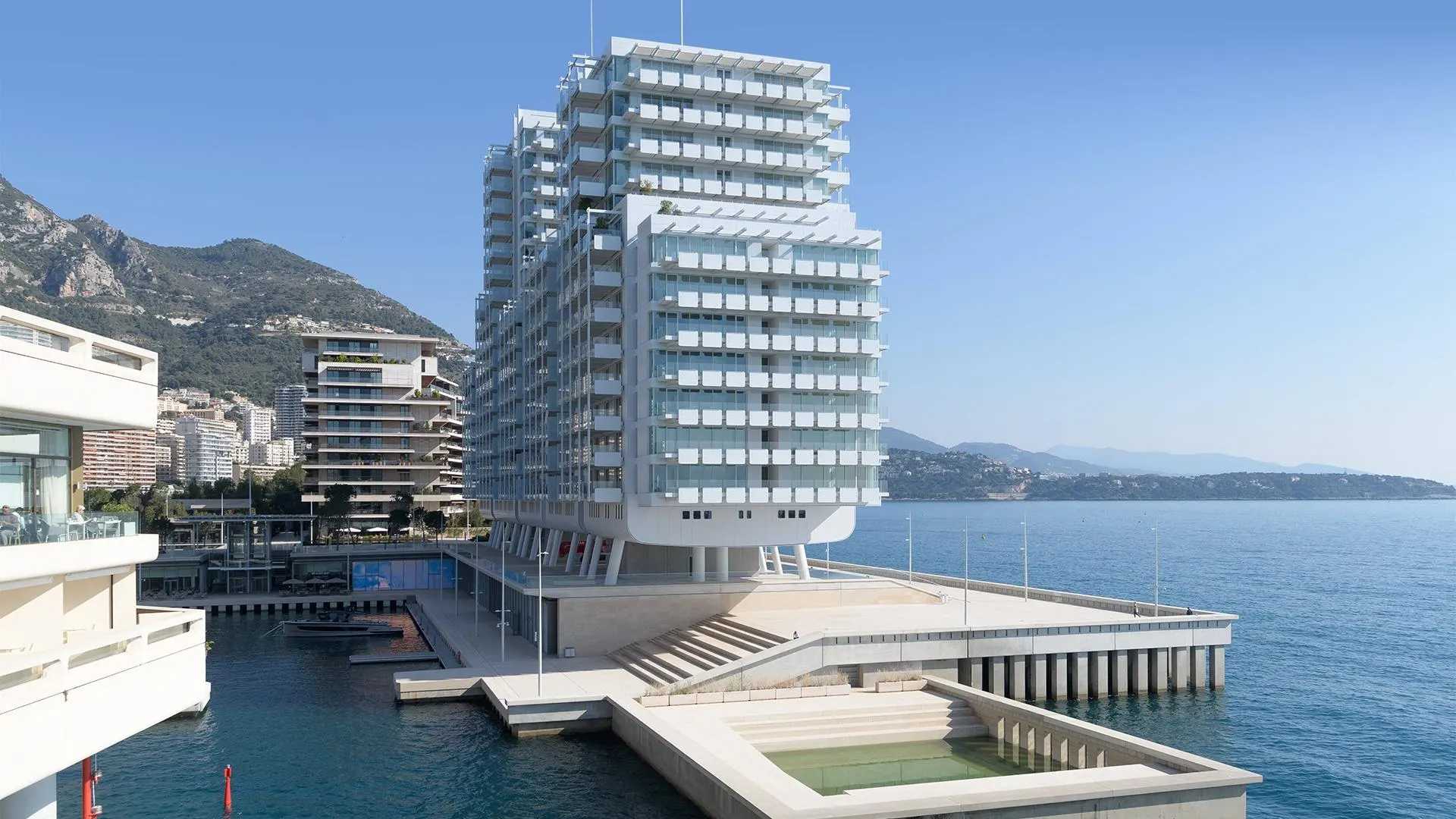
Mareterra begins with a problem that Monaco cannot resolve through an ordinary building plot: a very small territory with sustained demand for more space. Its new district extends into the Mediterranean, creating approximately six hectares of ground for residences, gardens and public routes.
Delivered in December 2024, the project made a new part of the principality rather than merely adding another tower to an existing street. That difference explains both its engineering scale and the scarcity around its residential offer.
Le Renzo and the waterline
Renzo Piano’s Le Renzo gives the development a prominent architectural marker. Its fragmented, ship-like form relates to the harbour setting, while the base connects with the public-facing life around it.
The district also brings waterfront villas into a territory where that combination of new construction, space and direct coastal position is unusually difficult to create. The point is not that all expensive accommodation is alike. Here, the underlying land itself had to be made.
A long project, a private structure
Prince Albert II’s ambition for an offshore extension developed through an earlier interrupted proposal and the later Mareterra scheme. The 2015 concession brought private financing and construction expertise into a project with obligations to the state.
Patrice Pastor was a major investor, alongside other partners. The original account described a selective relationship with initial buyers and a preference for speaking directly with them. Those conditions belong to the development’s sales history, not a rule that can be assumed to govern every secondary transaction today.
The ground before the architecture
Marine work preceded the residences. Environmental measures, sediment management and the installation of large concrete caissons created the supporting boundary for the new district. The caissons were made away from Monaco and brought to the site by sea.
Landscape and public space then gave the extension another function. Promenades and gardens allow people who do not own a residence to use part of the district, making the project visible through walking as well as through an apartment’s outlook.
Scarcity is not the same as a completed sale
The property story includes substantial asking prices and reported private transactions. An asking price is not evidence of what a buyer ultimately paid, and reported individual purchases should not be treated as an independently verified public sales register.
That distinction does not remove the original argument. Mareterra’s limited residential inventory and Monaco’s geographic constraints help explain the attention. They do not supply a guarantee of future appreciation or make every broker’s comparison an established fact.
The district can be understood from two directions. From a residence, it offers a rare new waterfront setting. From the promenade, it shows how engineering, architecture and landscape have extended a small country. Both readings begin with the same decision: to create the ground before building on it.
Cover: Le Renzo at Mareterra, Monaco. Archive image.
Go with WAYFARER. WAYFARER Agency arranges Paddock Club, terraces above the track and yachts in Port Hercule for the Monaco Grand Prix, with a written proposal within 24 hours.
Developed with the robotics company Dephy, Nike's Project Amplify is a powered footwear system for running and walking. A year after its unveiling, it remains in testing, with a consumer launch still some years away.
Artificial intelligence has left the phone and moved into the kitchen, the bedroom and even the cat's litter box. Five recent objects suggest the domestic future is not about voice commands but about machines that learn to live alongside us.
The smartphone made everyone a photographer. A new generation of dedicated compacts, from DJI's gimbal cameras to the Camp Snap CS-Pro, argues for a device that exists for one purpose only.