In a spacesuit, a seam is never merely a seam. It belongs to a pressure garment, a thermal barrier and a moving structure that must let a human bend towards lunar ground without exposing that body to it. The collaboration announced by Prada and Axiom Space on 4 October 2023 was compelling because it treated clothing knowledge as engineering knowledge, then gave that proposition a sequence of hardware on which it could be judged.
The original agreement brought Prada’s engineers into Axiom Space’s systems team to work on raw materials, manufacturing techniques and design features for the Axiom Extravehicular Mobility Unit, or AxEMU. At the time, the suit was associated with NASA’s Artemis III lunar landing, then planned for 2025. Neither the year nor the mission architecture survived unchanged. The technical partnership did.
The suit existed before the fashion collaboration
Axiom Space did not begin with a blank page. NASA had developed the Exploration Extravehicular Mobility Unit, known as xEMU, and supplied the experience and data behind it as a foundation. NASA selected Axiom in 2022 to provide moonwalking services under a task order later described by the company as worth $228 million. The agency sets technical and safety requirements and retains responsibility for astronaut training, mission planning and approval of the service systems; Axiom is responsible for design, development, qualification, certification, production and associated support equipment.
That division of labour gives Prada’s role its proper scale. The Milan house was not asked to style an aerospace object after the difficult decisions had been made. Its product-development team worked with engineers on material recommendations, production methods, patternmaking and features that had to perform in the lunar environment. Prada connected the project to decades of high-performance material work associated with Luna Rossa, where fabric, movement and exposure to weather are also inseparable, even if the consequences are of another order.
From a dark prototype to a white flight design
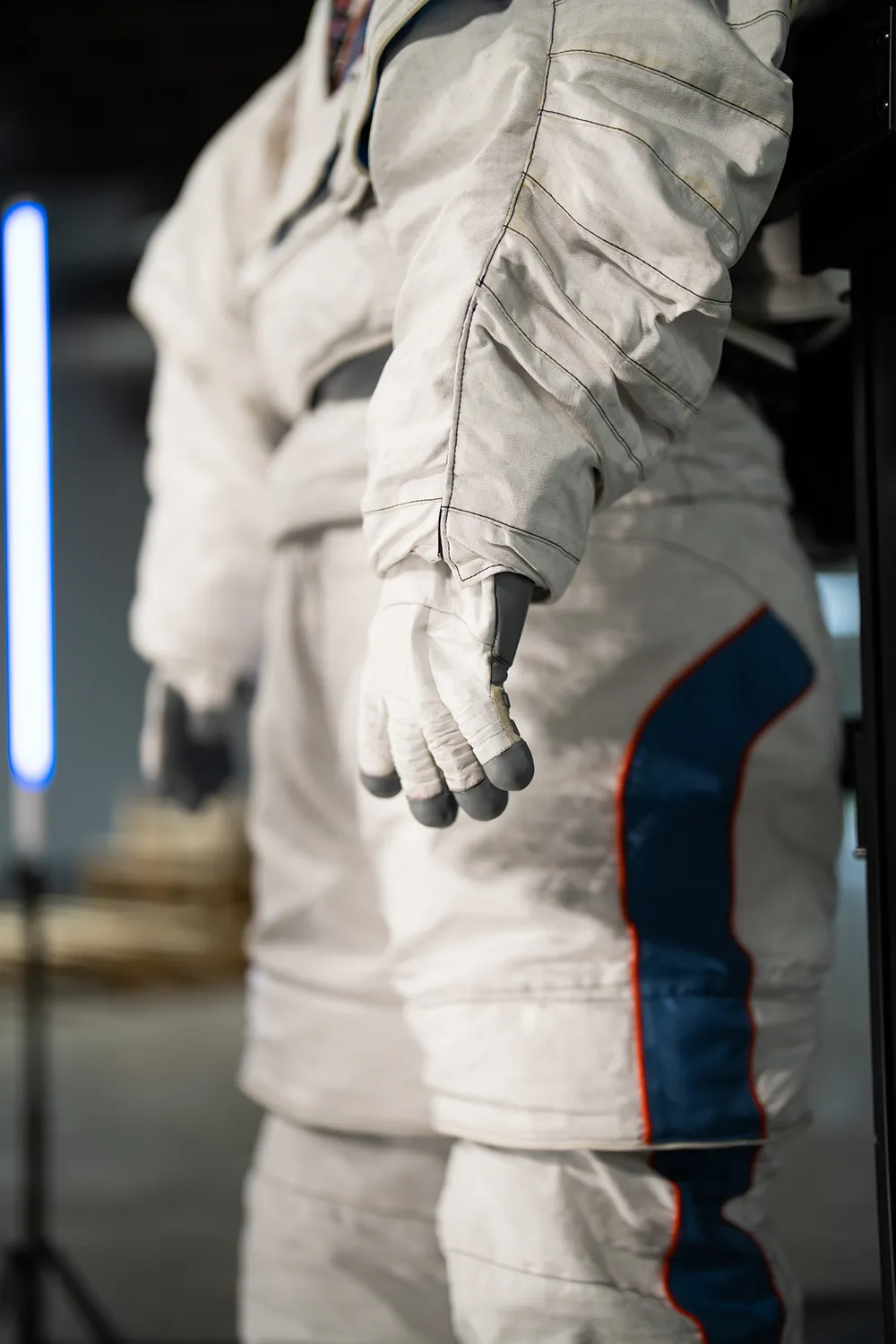
Axiom had revealed a dark-covered prototype in March 2023, before the Prada partnership was announced. That dark layer concealed proprietary technology for display. At the International Astronautical Congress in Milan on 16 October 2024, the companies presented the AxEMU flight design in white, a functional decision intended to reflect heat and protect the wearer from high temperatures and lunar dust.
The specification made the design problem concrete. Axiom said the suit would accommodate crew members from the first to the 99th anthropometric percentile, support spacewalks lasting at least eight hours and endure the coldest conditions in permanently shadowed regions for at least two hours. Its architecture included redundant systems, onboard diagnostics, a regenerable carbon-dioxide scrubber, cooling technology, coated helmet and visor components, and custom gloves developed for scientific tools.
Mobility sits at the centre of those systems. A lunar geologist must kneel, reach, collect a sample and recover balance in one-sixth of Earth’s gravity. A pressure garment naturally resists bending, so soft and hard joints have to preserve motion without sacrificing containment. NASA’s own description emphasises range of motion, flexibility, wider sizing and compatibility with other systems. The silhouette is the visible consequence of those requirements, not their substitute.
The layer closest to the body
On 7 June 2026, Axiom Space and Prada disclosed a second chapter: the Liquid Cooling and Ventilation Garment worn inside the AxEMU. The LCVG uses engineered knitting, three-dimensional modelling and specialised fibres to manage cooling, ventilation, repeat wear and comfort during an excursion of up to eight hours.
Its operation turns the familiar idea of performance clothing into a closed life-support circuit. Cold water moves through tubes positioned across major muscle groups, absorbs metabolic heat and carries it to the portable life-support system, where the heat is rejected. Axiom says the garment has a fully redundant cooling circuit, so a second loop remains available if the primary one fails. Another set of tubes directs oxygen across the face, removing exhaled carbon dioxide before the gas returns through the suit’s scrubber.
Here Prada’s contribution moves inward. The 2024 work addressed the outermost protective shell, including sewing methods and materials capable of handling thermal extremes and micrometeoroid exposure. The 2026 garment sits against the astronaut and must route tubes across a moving body while preserving fit and reliability. Patternmaking becomes a way to organise fluid, gas and human motion.
Artemis changed around the suit
The dates attached to the first announcement now require correction rather than nostalgia. In May 2026, NASA outlined a revised Artemis III as an Earth-orbit mission intended to test rendezvous and docking with commercial lander pathfinders. The agency said that mission could also evaluate AxEMU interfaces ahead of later surface operations. Axiom’s June 2026 release places the next crewed lunar return, and the LCVG’s intended use, with Artemis IV.
The change does not make the suit a theoretical exercise. By February 2026, NASA reported more than 850 hours of pressurised testing with a person inside the AxEMU. Testing included underwater work in the Neutral Buoyancy Laboratory, simulated lunar-gravity tasks and pressure-level evaluations. Axiom had completed an internal technical review, while NASA’s own critical design evaluation and further testing remained part of the path to flight.
Design under consequence
The useful story is no longer that fashion has reached the Moon. It is that the disciplines behind an exacting garment can contribute to an object in which heat, pressure, fit and mobility are matters of survival. Prada supplied knowledge of fibres, engineered knitting, pattern and assembly. Axiom integrated that knowledge into a system governed by aerospace requirements and NASA oversight.
When the AxEMU is finally used on the lunar surface, almost none of that collaboration will read as decoration. It will be present in a white layer rejecting heat, a joint allowing a geologist to bend, a tube carrying warmth away from the body and a seam holding its position through eight hours of work. That is the sharper definition of design here: not how an object announces itself, but how precisely it carries a person through an environment that cannot forgive approximation.
Prada · @prada
Axiom Space · @axiom.space
NASA · @nasa