Good manners are best proved at thirty thousand feet.
Few places in modern life are as prone to friction as an aircraft cabin: dozens, sometimes hundreds, of strangers seated side by side for hours inside a metal tube. It is a small test of coexistence, and most of us have seen both the worst and the best of human behaviour there.
To draw up a definitive code for the skies, travel specialists and working cabin crew share what years of flights have taught them: Sophie Caulcutt, co-founder of The Voyager Club; Vikram Seshadri, co-founder of In Residence; Paul Tumpowsky, chief revenue officer at Fora; and two flight attendants working in the United States, Rich Henderson and Liam, known online as @lifeinlayovers.
Boarding last has its charm
Nobody, least of all in economy, wants more time on board than necessary, so crowding the gate rarely pays. Your seat will still be there at the end. The rush for overhead space is usually unnecessary too: the crew almost always finds room, or checks the bag at no cost. For those flying business or first, Seshadri’s advice is simple: “Enjoy the lounge, have a meal and board last. Your space in the bin is reserved and waiting.”
Gathering the essentials before boarding spares everyone a queue in the aisle · Photo: courtesy
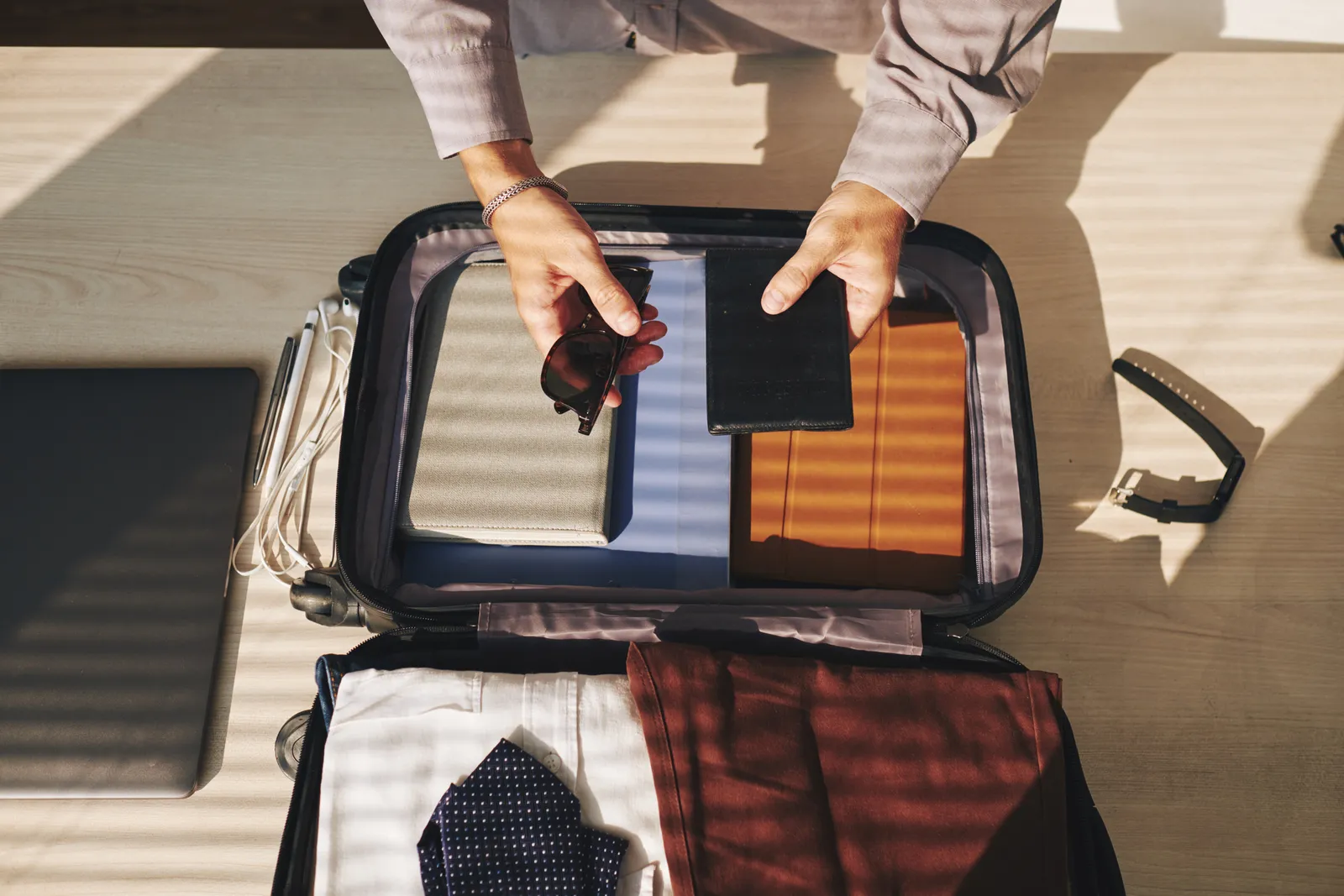
Pack a seat bag before you board
One personal item kept for the flight’s essentials, passport, boarding pass, phone, headphones, eye mask, charger, saves repeated trips to the overhead bin. As Henderson, of the podcast Two Guys on a Plane, puts it, one passenger reorganising a suitcase in the aisle can hold up a hundred people behind. Find the seat, stow the bag, clear the aisle.
Board and leave with efficiency and grace
Acknowledging the crew as you step on board, with eye contact, a smile, a brief hello, costs little and is returned in kind; a final thank you closes the circle. Consider your own strength when packing a cabin bag, and help those who struggle when you can: many airlines discourage crew from lifting bags because of the risk of injury. On arrival, wait until the aircraft has stopped and let the rows ahead leave first.
If your connection is tight, tell the crew
The right move is to tell a flight attendant before landing, not to negotiate your way to the front. “The crew can assess how tight the connection really is and, if warranted, ask other passengers to remain seated,” says Tumpowsky. Such a request carries more weight from the crew than from a passenger who has decided his connection matters more than everyone else’s. Caulcutt suggests a quiet word in the galley during or just after boarding.
Declining to swap seats is perfectly acceptable
A chosen seat is a guaranteed seat, especially when paid for or earned through status. Declining a swap, politely and firmly, is every passenger’s right. The caveat, says Caulcutt, is common sense: do not separate an elderly couple who depend on each other, or a mother from a crying child.
Read the room before you talk
A brief exchange of pleasantries is always welcome, never compulsory. “A polite exchange of courtesies is not a binding commitment to share life stories until the landing gear comes down,” says Tumpowsky. Those travelling in company should keep voices low: engine noise makes people speak louder than they realise. On night flights, whispering is the minimum.
When a baby cries, practise compassion
Breathe and be patient. As Caulcutt reminds us, nobody hates the crying more than the parents.
Watch the safety demonstration, if only out of courtesy
“I promise flight attendants don’t do the safety demo for their own entertainment,” Henderson jokes. Find the nearest exits and the nearest lavatory. In an exit row, answer honestly about your ability to take on the duties that come with the extra legroom.
Keep your seatbelt fastened while seated
“Turbulence can happen without warning, even in perfectly clear skies,” says Henderson. A loosely fastened belt is a habit no one ever regrets.
Recline, but gently
All the experts agree: reclining is a right, it is what the mechanism is for. The unanimous exception is during the meal of the person behind you. Seshadri adds: “Recline slowly, notice whether the person behind is using a laptop, and bring the seat upright when the crew asks.”
By consensus, both middle armrests belong to the middle seat · Photo: courtesy
Use the call button, but do not abuse it
It exists for real needs and medical urgency. “If we’re visibly in the middle of the drinks service and you just want another soda, it’s usually easier to ask when we reach your row,” says Henderson. Liam adds that crews have shrunk as cabins have grown.
The middle armrests belong to the middle seat
On this the experts are unanimous. The window has the window; the aisle has a little extra room. “The person in the middle deserves something,” says Henderson.
Shoes may come off, socks stay on
Removing shoes is acceptable on long flights, as feet swell. Bare feet on display are not, says Caulcutt, and feet never go on armrests, seatbacks or tray tables. Henderson advises never entering the lavatory barefoot or in socks: the mysterious liquid on the floor is rarely water.
No calls, and headphones for everything
With Wi-Fi improving on board, what was a quiet refuge has become another space exposed to modern noise. Headphones are essential for any audio, and voice or video calls are banned by most airlines. “A plane is a shared space, not your living room or office,” says Henderson. Connectivity, Tumpowsky warns, will be etiquette’s next battleground.
Stretch responsibly
Walking the aisle is healthy on long flights, briefly and discreetly, and never during service. The aisle is the crew’s workplace and an emergency route. “A little stretching is one thing; turning the plane into a yoga studio is another,” says Henderson.
It is fine to wake your neighbour, gently
There is nothing wrong with politely waking someone to leave the row. Do it as you would like to be woken. And if your neighbour gets up first, it may be the moment to go too.
Never pull on the seat in front to stand up
It jolts whoever is sitting there, especially if they are asleep. Use your own row for support. And in the lavatory, wipe up any splashes and flush: basic courtesy for whoever comes next.
Comfort, more than style, defines the ideal flying wardrobe · Photo: courtesy
Forget dressing up for an upgrade
If it ever worked, it no longer does. “Today upgrades are decided by status, algorithms, bids or other systems,” says Tumpowsky. “Dress for comfort. It will have far more impact on your flight than looking as if you belong in first class.”
Dress well out of self-respect
Comfort and care are not opposites. A well-resolved travel uniform, a cashmere set or a suit that does not crease, helps one face delays or lost luggage with a little more dignity. Though, admittedly, nobody is obliged.
In the end, be kind
The crew does not control the weather, the delays, the baggage fees or most airline policies, so frustration should not land on those who are there to keep us safe. Patience and kindness go further than they seem, says Henderson, and Seshadri extends the invitation to airport staff and fellow passengers: treating them with respect, he says, “guarantees not only a better flight, but a good dose of luck and happiness too”.
Cabins are fuller, seats smaller, crews leaner. And still we fly. It is there, between boarding and landing, that good manners stop being theory. As Liam puts it, we really are all in the same metal tube.
Four Seasons, Aman, Maybourne, Belmond and Mandarin Oriental now sell the journey as part of the stay, from helicopter transfers into London to 23-day circumnavigations at $238,000 a head. Who flies, why, and what is really being bought.
At the back of Los Angeles International Airport sits a terminal with no queue, no crowd and no gate. What PS costs, who uses it, and why travellers who do not fly private have decided to pay not to wait.
More yachts, more debuts and a shorter average length: Fort Lauderdale 2026 suggested that owners now judge a yacht by how it is lived in, not by its metres.