Unveiled in Geneva on 11 March 1971, Marcello Gandini's Countach grew out of Ferruccio Lamborghini's wish for the perfect grand tourer and became the most radical shape the automobile has known.
Ferruccio Lamborghini only wanted the perfect grand tourer. He ended up giving the world the most radical shape the automobile has ever known.
In the early 1960s, Ferruccio Lamborghini was a man who had already won. He had made his fortune building tractors from post-war military surplus, then heaters and air-conditioning units, and he spent the money the way such men do: on sports cars. He owned Maseratis, Jaguars, Mercedes and, of course, Ferraris.
None of them fully satisfied him. They were fast and they were beautiful, but they were noisy, temperamental and not civilised enough for someone who wanted to cross Italy at speed and arrive in one piece.
A tractor maker in Maranello
The legend, repeated so often it has acquired the status of scripture, says the trouble was the Ferrari’s clutch. Ferruccio is said to have taken his complaints to Enzo Ferrari in person, and Enzo to have replied that a tractor maker had nothing to teach him about sports cars. The details vary with the teller. The outcome does not.
In 1963, Ferruccio founded Automobili Lamborghini in Sant’Agata Bolognese, a few kilometres from Maranello. The first car, the 350 GT, was exactly what he had promised himself: a refined, comfortable and fast V12 grand tourer. Too well-mannered, perhaps, to make history on its own.
History would come from a young team working almost behind the boss’s back. In 1966, Lamborghini presented the Miura, mid-engined and drawn by Marcello Gandini at Carrozzeria Bertone. The world discovered what it would come to call the supercar. And Lamborghini discovered that its destiny was not the well-behaved grand tourer.
Geneva, 11 March 1971, ten in the morning
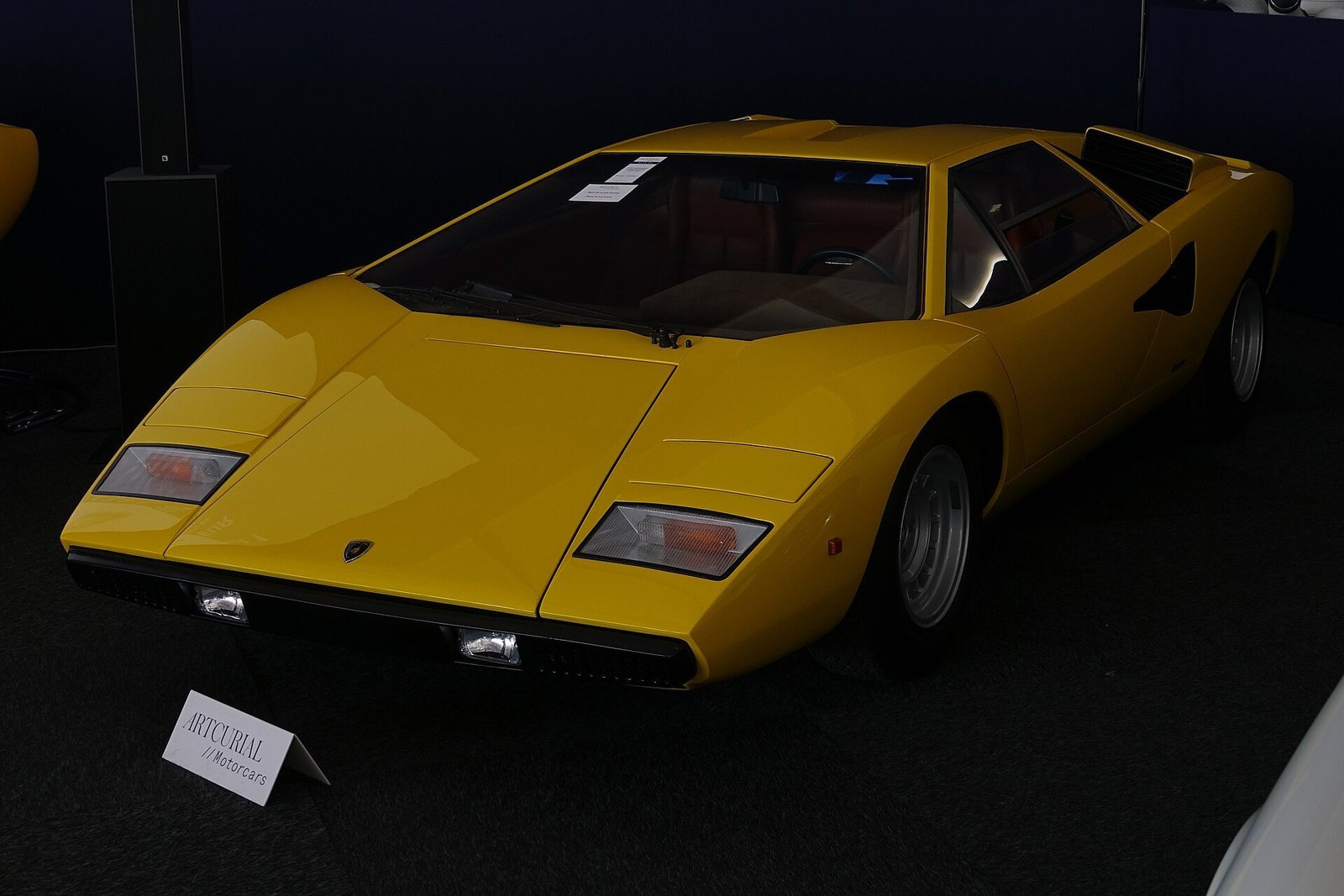
The prototype carried the internal code LP112 and was unveiled on the Bertone stand, because Lamborghini’s own was already taken by the Miura SV. It was yellow, low and angular, and it looked like nothing on any road on the planet. It was called the Countach LP 500.
The mechanicals were the work of the engineer Paolo Stanzani, then the company’s general and technical director. The design, once again, was Gandini’s. If the Miura was all curves and sensuality, the Countach was a wedge, a blade, an object that seemed to have been designed in another century and sent back.
The car was a concept, a show piece. But in Geneva itself, customers were already asking when they could buy one. Lamborghini, which had no plans to build it, spent the next three years racing to turn a provocation into an automobile.
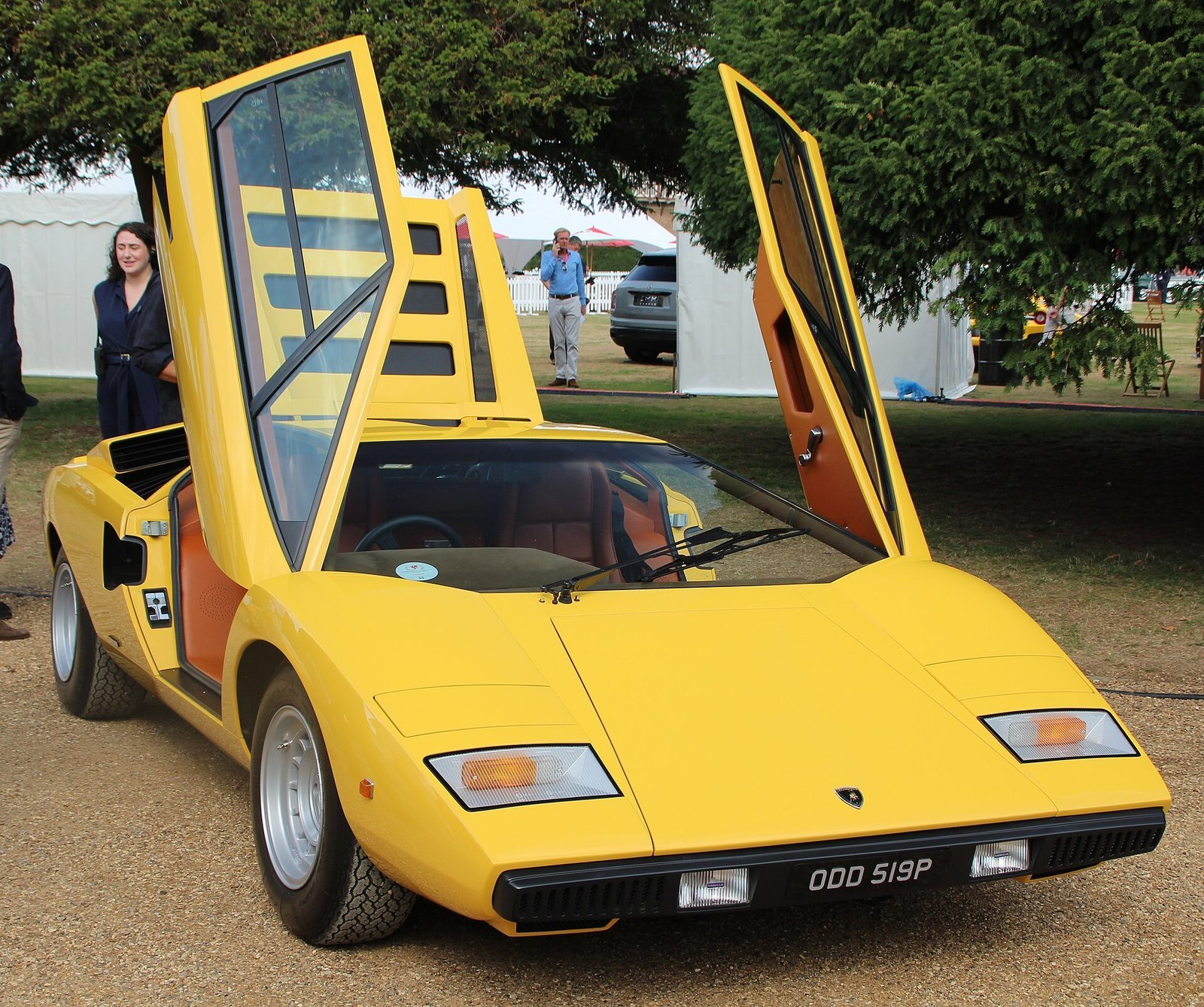
THE WEDGE THAT OPENED ITS DOORS UPWARDS · Photo: MrWalkr / Wikimedia Commons, CC BY-SA 4.0
An exclamation from Piedmont
Almost every Lamborghini is named after a bull or a bullfight. The Countach is the exception. The word comes from Piedmontese dialect and works as an exclamation of astonishment, somewhere between awe and a swallowed oath. According to the version the company itself tells, the prototype was kept in secret on a farm near Turin, and it was the reaction of someone who saw it there that Gandini heard and adopted as its name.
The doors opened upwards, scissor-style, a solution that has since become the signature of the twelve-cylinder Lamborghinis. The V12 sat behind the occupants, mounted lengthways, which is where the initials LP come from: longitudinale posteriore. The gearbox sat ahead of the engine, almost between the seats, to balance the weight.
For production, the prototype’s five-litre engine gave way to a more reliable four-litre unit, and the car became the LP400. Rear visibility was close to nil. Reversing meant sitting on the sill with the door open and looking back. Nobody who bought a Countach seemed to mind.
Sixteen years on the bedroom wall
The Countach stayed in production from 1974 to 1990, in five versions, and just under 2,000 left Sant’Agata. Each generation gained width, appendages and power. The purity of the LP400 “Periscopio”, today the most sought after by collectors, gradually gave way to the wheel-arch extensions, the telephone-dial Campagnolo wheels and the optional rear wing that would define the car’s image for good.
Version
Years
Engine
Power
Units (approx.)
LP400
1974 to 1978
3.9-litre V12
375 CV
157
LP400 S
1978 to 1982
3.9-litre V12
355 CV
235
LP500 S (5000 S)
1982 to 1985
4.8-litre V12
375 CV
321
5000 Quattrovalvole
1985 to 1988
5.2-litre V12, 48 valves
455 CV
631
25th Anniversary
1988 to 1990
5.2-litre V12, 48 valves
455 CV
658
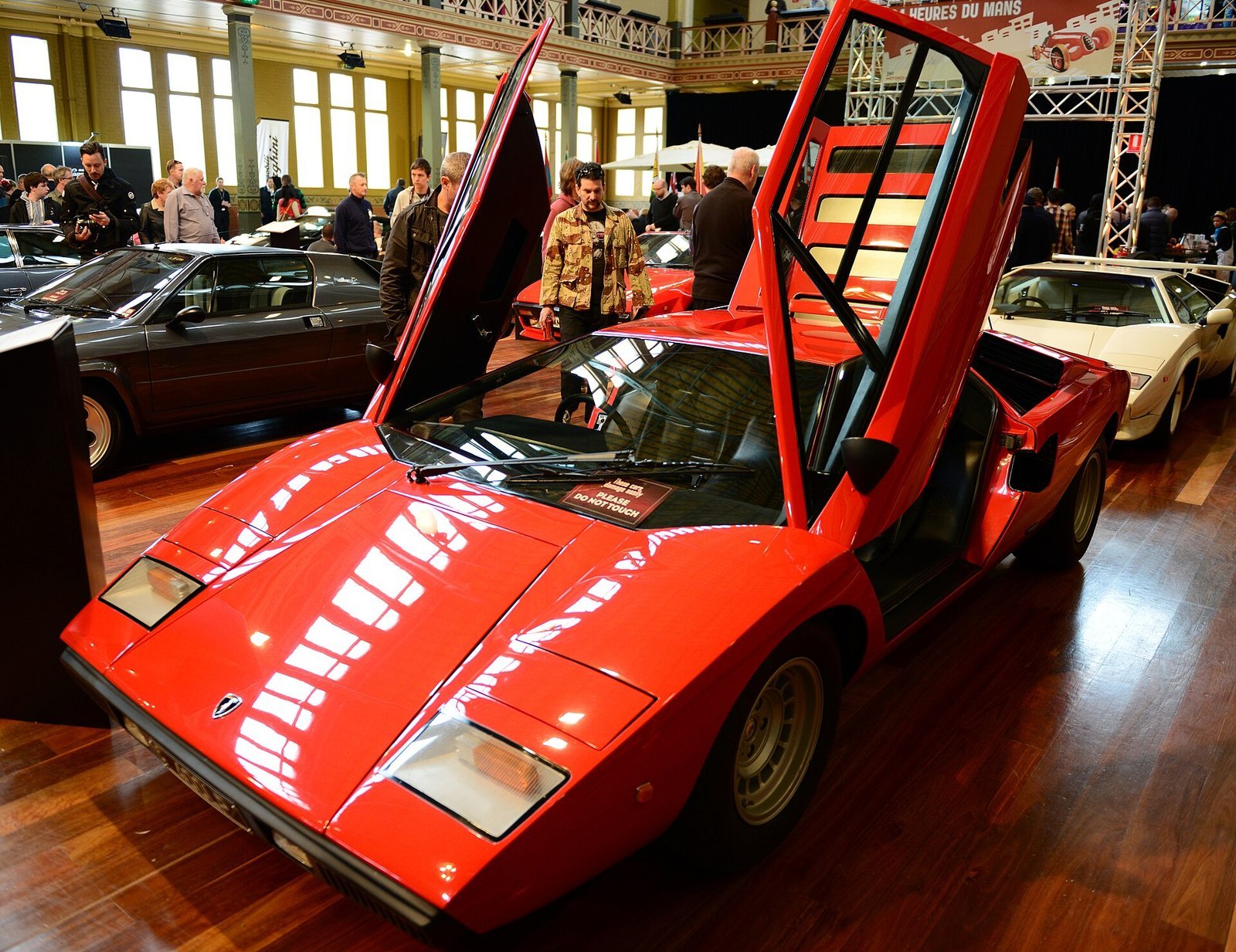
It was precisely this exaggerated phase that turned the Countach into a poster. In the 1980s it hung on bedroom walls around the world, next to rock stars, and opened films that wanted to say, in a single shot, that someone had made it. The last Countach, a 25th Anniversary, left the factory in 1990, and its place passed to the Diablo.
Through the difficult 1970s, with the oil crisis and a succession of owners, it was the Countach that kept Lamborghini alive. Ferruccio, who had already sold his stake, watched from a distance as a car that was never the perfect GT he had dreamed of became a legend.
THE POSTER THAT CAME OFF THE WALL · Photo: Chris Phutully / Wikimedia Commons, CC BY 2.0
The wedge that never left the stage
Every twelve-cylinder Lamborghini since, from the Diablo to the Revuelto, carries the Countach’s grammar: the wedge silhouette, the forward cabin, the scissor doors. More than a model, it became the visual language of the brand and, to a large degree, of an entire category.
In 2021, fifty years after the Geneva prototype, Lamborghini revisited the name with the Countach LPI 800-4: a 6.5-litre V12 with electric assistance, 814 CV and only 112 units. An open tribute, more nostalgic than revolutionary.
The original, meanwhile, keeps gaining in value and in meaning. It was the car that proved an automobile could be, above all, an idea, and that form sometimes arrives before function.
It all began with a man who thought he could do better. Ferruccio wanted a car that would not bother him; he got one that unsettled the entire world. Half a century later, the Countach still does exactly what the Piedmontese farmer did on first seeing it: it draws an exclamation from whoever passes by.
Lamborghini Countach LP400 (1974) Engine: longitudinal mid-rear V12, 3,929 cc, six Weber carburettors Power: 375 CV Transmission: five-speed manual, rear-wheel drive Structure: tubular chassis with aluminium body Design: Marcello Gandini (Carrozzeria Bertone) Engineering: Paolo Stanzani, with development by Bob Wallace LP400 production: 157 units
Profits in China have shrunk, Chinese marques are pricing above German rivals in Germany itself, and analysts speak of the worst crisis in the industry’s recent history.
While the segment raised its roofline, Lexus kept the UX at 1.52 m tall, with a 198 PS hybrid that needs no plug. It uses less fuel in traffic than on the open road, and sends the bill to the rear seat and a 234-litre boot. A nominee at the 2026 RACER Creator Awards.
On the eve of the Paris motor show, Stellantis gathered six concepts at Hangar Y in Meudon. The electric Citroën 2CV led the evening, and with it a case for the small, honest European car.
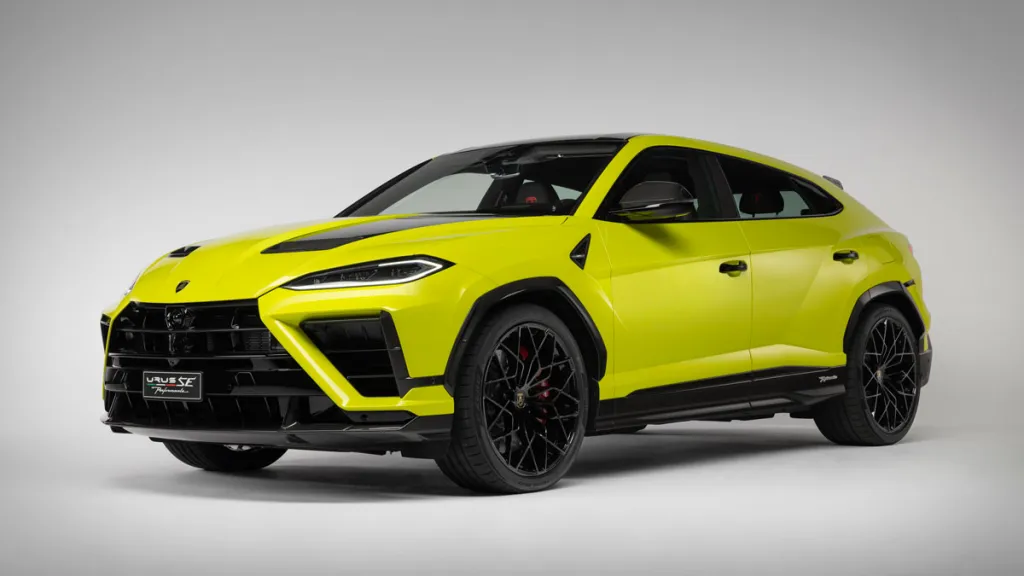
A twin-turbo V8 and an electric motor deliver 812 CV and 1,000 Nm, 0 to 100 km/h in 3.3 seconds and 23 per cent more downforce than the Urus SE. Lamborghini sharpens the segment it invented.
Sant'Agata Bolognese
THE CURATED GLOBE / FROM THE EDITORS
Good stories. Better company.
A considered selection of people, places and ideas from WAYFARER Edition, delivered to your inbox.
Welcome aboard. Your first letter is on its way.
We could not complete your subscription. Please check your email and try again.